49 works in this view — arrow keys or swipe to move between them.
Dance in Art
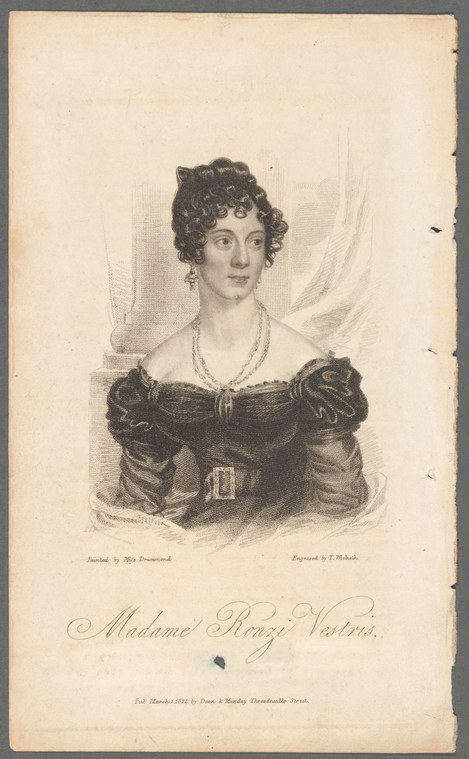
Madame Ronzi Vestris [Caroline Ronzi-Vestris]
Unknown artist
- Collection:
- Prints depicting dance
- Source:
- New York Public Library
- Rights:
- Public domain — free to use, share and adapt.
- Recorded as:
- Public Domain
Madame Ronzi Vestris was a leading international dancer of the Romantic period, and this engraving is part of the visual archive documenting her celebrity and theatrical presence. The print format reveals how dance performers were marketed and remembered by audiences—through portable, reproducible theatrical portraits rather than through documentation of actual movement. For historians of dance, theater, and visual culture, such portraits are primary evidence of how performers were constructed as public figures and what audiences valued in their presentation.
What you are looking at
A half-length portrait of a woman in early 19th-century dress, shown against a plain background with a draped curtain behind her. She wears a dark off-shoulder dress with pronounced puffed sleeves gathered at the shoulders, and a decorative brooch at the center of the bodice. Her dark curled hair is arranged in the Regency fashion, parted in the center with ringlets framing her face. She wears a simple beaded necklace and earrings. The engraving is executed with fine hatching and cross-hatching to model the face and fabric, creating a refined and dignified presentation typical of theatrical portraiture of the period.
The dancing
A single standing figure shown from the waist up, turned slightly toward the viewer in a three-quarter pose. Her posture is upright and composed, with her shoulders back and her gaze directed outward in an engaging manner. No active dance movement or gesture is depicted; the figure presents herself as a performer in formal theatrical dress rather than captured mid-movement. The proportions and elegant carriage suggest a trained performer accustomed to stage presence.
The dance depicted
This is a theatrical portrait rather than a depiction of active dance. Madame Ronzi Vestris (Caroline Ronzi-Vestris, 1800–1883) was a celebrated Italian-French dancer and mime of the Romantic era, known for her performances in ballet and pantomime throughout Europe. The image documents her as a theatrical celebrity rather than preserving a record of her dancing technique or a specific dance style. The refined presentation and elegant dress identify her as a principal dancer of international standing during a period when ballet and pantomime were dominant theatrical forms.
How it was made
This is a wood or steel engraving, executed with fine parallel lines and cross-hatching to create tonal modeling—a reproductive print technique that allowed mass distribution to a wide audience. The technical precision and delicate handling of the face indicate a skilled engraver working from a painted or drawn original. The inscription at the bottom identifies the artist(s): "Painted by Mrs Drummond" and "Engraved by J. T. Wedgwood," establishing this as a secondary work derived from an earlier painted portrait, created for circulation as a theatrical souvenir or print in the commercial theater market.
About this work
This engraved portrait documents Madame Ronzi Vestris, one of the most celebrated dancers of the Romantic ballet era, in formal theatrical dress. Created in the early 19th century from a painted original, it circulated as a commercial theatrical print—a genre that functioned as the visual record of performers' celebrity and the medium through which audiences beyond the theater could encounter their appearance and persona. The work belongs in a dance art collection not because it shows dance in action, but because it preserves the image of a significant historical performer and reflects the visual and commercial culture surrounding early 19th-century theatrical dance.
How to look at it
Observe the careful rendering of the fabric and the modeling of the face through fine engraving lines—this technical precision reflects the engraver's skill and the commercial value of the image. Notice the theatrical presentation: the graceful pose, the elegant dress, and the direct engagement with the viewer are all calculated to convey the performer's status and appeal. The work documents not a moment of dance, but a constructed image of the dancer as a public figure—what audiences in the theater lobbies would recognize and what they would take home as a souvenir.
The artist
The painted original was created by Mrs. Drummond, a portrait painter working in the early 19th century. The engraving was executed by J. T. Wedgwood, a skilled reproductive engraver of the period. Both worked within the established commercial print trade that served the theater industry, creating and circulating portraits of famous performers to theaters, collectors, and the paying public.
The period
The early 19th century saw the rise of Romantic ballet, with female dancers achieving unprecedented celebrity and international fame. The theatrical print became a central medium for disseminating performers' images—more accessible and affordable than original paintings. Madame Ronzi Vestris performed during the height of Romantic ballet's popularity, in an era when mime and pantomime were integral to ballet performance. The Regency-era dress visible in this portrait (c. 1820s–1830s) was contemporary with her performing career, and the refined engraving technique made such images available to a middle-class audience with theatrical interests.
Where it lives
This engraving is held in the New York Public Library's prints collection documenting dance in art. It is part of the broader archive of theatrical portraits and prints that circulated in the 19th-century theater market as commercial souvenirs and collectibles.
Questions about this work
Who was Madame Ronzi Vestris?
Caroline Ronzi-Vestris (1800–1883) was an Italian-French dancer and mime celebrated throughout Europe for her performances in Romantic ballet and pantomime. She was a leading dancer of the early 19th century and achieved significant fame both in Europe and internationally. She was known for her dramatic presence and skill in pantomimic roles as well as for classical dance technique.
Is this a record of an actual performance or pose?
No. This is a formal theatrical portrait in the tradition of celebrity performance documentation. It shows the dancer in dress and posed with dignified carriage, but it is not capturing her mid-movement or in an actual stage role. The portrait functions as a record of her public image and theatrical celebrity, not as documentation of a specific dance or movement style.
What does the engraving technique tell us about this image's circulation?
Engraving was the primary reproductive print medium of the early 19th century, allowing multiple copies to be made from a single plate. This portrait could be distributed widely, sold in theater lobbies, included in print collections, and collected by theater enthusiasts. It was part of a commercial market in theatrical celebrity imagery that made performers' images accessible to the public beyond those who saw them perform live.
What is the dress in the portrait, and does it show period fashion or stage costume?
The dark off-shoulder gown with prominent puffed sleeves represents the fashionable dress of the 1820s–1830s Regency era. It is likely formal day wear or theatrical dress of the period rather than a specific character costume. The elegant presentation reflects both the period's fashion and the conventions of theatrical portraiture, where performers were shown in refined dress rather than in full stage costume.
More dance artwork





