49 works in this view — arrow keys or swipe to move between them.
Dance in Art
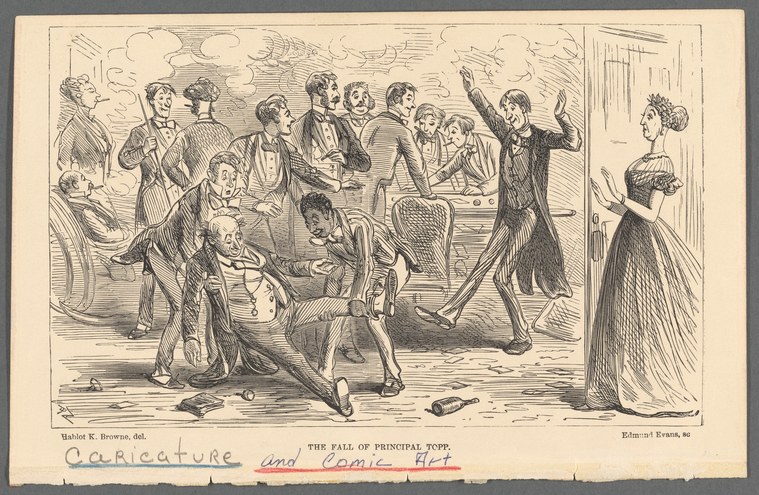
The fall of Principal Topp
Unknown artist
- Collection:
- Prints depicting dance
- Source:
- New York Public Library
- Rights:
- Public domain — free to use, share and adapt.
- Recorded as:
- Public Domain
This print documents how 19th-century audiences and artists understood ballroom society as inherently fragile, pretentious, and comedic. The work shows that satire of formal dance and social propriety was popular enough to be commercially engraved and distributed—it is a window into public attitudes toward the very institutions and rituals that defined polite society. For dance historians, it reveals that dance and ballroom culture were prominent enough in public consciousness to be the subject of dedicated satirical prints, and that failures of propriety or physical mishaps on the dance floor were treated as newsworthy comedy.
What you are looking at
A crowded interior scene of satirical chaos: formally dressed figures in 19th-century evening wear occupy a parlor or ballroom, their composure thoroughly disrupted. The focal point is a woman in the center-foreground, seated or crouching on the floor in a posture of distress or collapse, her skirts billowed around her. Standing figures surround her in attitudes of alarm, gesticulation, and concern—some with arms raised, others gesturing toward her or at one another. A man on the left stands with crossed arms; another figure at right raises both hands in exasperation. The woman at far right, in profile, observes the scene with apparent detachment or displeasure. The composition is dense with overlapping figures and animated poses; the engraver has used fine cross-hatching to create volume and shadow, giving the scene depth and a sense of kinetic disorder. The title, printed below, identifies this as 'The Fall of Principal Topp'—a pun suggesting both the literal tumble of the central figure and the collapse of her social standing or dignity.
The dancing
The primary dancer or subject is the woman on the floor, her body collapsed or fallen, knees bent, arms and skirts in disarray. The surrounding figures adopt poses of shock and reaction rather than coordinated dance: some lean forward in concern, others gesture with raised arms in what reads as alarm or reproach. There is no closed hold, no frame suggestive of partnership dance; instead the bodies are dispersed and individualized in their responses. The engraver has clearly understood how to depict the human form in distress and social disruption, with anatomically plausible poses of falling, catching oneself, and responding to crisis.
The dance depicted
This is not a depiction of dance in the conventional sense, but rather a satirical scene of social collapse. The title 'Principal Topp' suggests a named individual—possibly a teacher, performer, or social authority—whose literal or metaphorical fall is the subject. The composition and the title together imply burlesque or caricature: the 'fall' may refer to an actual tumble (as during a dance or at a formal social event), or it may be a pun on disgrace or loss of status. The formal dress and parlor setting suggest a balls-room or society gathering of the 19th century, but the scene depicts not dance itself but the comic or scandalous disruption of a formal social occasion.
How it was made
This is an engraving executed with fine lines and cross-hatching to create tonal modeling and depth. The technique is that of wood engraving or steel engraving—fine, labor-intensive line work suited to reproduction and circulation as a print. The engraver has signed or credited in the lower margin. The medium implies this was a published satirical print, likely intended for distribution in newspapers, periodicals, or as a separate sheet; the legible composition and clear narrative suggest an audience expected to enjoy both the visual humor and the title-based pun. The fineness of the line work and the density of hatching indicate skilled execution and a work of some ambition.
About this work
This engraved satirical print depicts the dramatic social collapse of a figure named 'Principal Topp,' who has fallen (literally or figuratively) during or at a formal ballroom gathering. The composition is not a celebration of dance but a comic rendering of social disruption: the focal figure is prone on the floor while formally dressed onlookers gesture in shock and concern. The work is typical of 19th-century satirical printmaking, which often targeted social pretense and public figures through exaggerated, narrative scenes. The title functions as a pun, playing on the name and the physical fall to satirize both the individual and, implicitly, the rigid social conventions of ballroom society. It belongs in a dance archive not as a record of actual dance practice but as evidence of how dance and ballroom culture were perceived and mocked by contemporary artists and audiences.
How to look at it
Attend first to the central figure's posture: the engraver has chosen the moment of maximum disruption—the fall itself, not its prelude or recovery. The surrounding figures' gestures are the secondary focus; their raised arms and forward leans create a formal frame of shocked reaction around the chaos. Note how the engraver has used the density of cross-hatching to distinguish the fallen figure (rendered in deep shadow and physical detail) from the more lightly rendered onlookers. The title beneath is essential to reading the scene; without it, the image might be read simply as an accident, but the pun invites a reading of social and moral collapse. The formality of the dress and setting—the carved wainscoting suggested at right, the evening wear—signals that this is not the fall of a servant or laborer but of someone of social standing, making the collapse all the more comic.
The artist
The engraver is credited in the lower margin but is not recorded in the catalogue. The style and technique are consistent with mid-to-late 19th-century satirical printmaking in Britain or America. Without further documentation, the artist's identity and broader practice cannot be established, but the quality and confidence of the line work suggest professional training and a practice in social satire.
The period
This work dates from an era (likely mid-to-late 19th century) when ballroom dancing and formal social dancing were at their cultural height, and when satirical printmaking was a major form of public commentary. The ballroom was not only a place of entertainment but a site of rigid social performance, where lapses in etiquette or physical control could be catastrophic to reputation. Satirical prints exploited this anxiety; they circulated widely and often targeted specific individuals, public figures, or types—teachers, social climbers, or performers whose pretensions made them vulnerable to ridicule. The fixation on the 'fall' of 'Principal Topp' reflects contemporary interest in both the fragility of social status and the physical and moral risks of formal dancing.
Where it lives
The work is held in the New York Public Library's collection of prints depicting dance. It is catalogued by title only; artist, date, and medium are not recorded. The inscription and style suggest it is a 19th-century satirical print, likely published as a separate sheet or appearing in a periodical, but its original source and circulation history are not documented.
Dance in this work
Questions about this work
Is this actually a picture of someone dancing?
Not in the sense of executing dance steps. The central figure has collapsed or fallen; the surrounding figures are reacting in alarm, not dancing. The scene is a satirical depiction of social disruption at a formal ballroom event—a fall from grace, both literal and figurative.
Who is Principal Topp?
The catalogue does not identify the subject. The title suggests a named individual—possibly a dance teacher, performer, or other public figure of enough prominence to be the subject of satirical ridicule. The pun plays on the name and the act of falling.
What does the engraving technique tell us?
This is fine-line engraving, a labor-intensive and expensive technique that indicates the print was professionally produced for circulation. The quality and detail suggest it was sold as a satirical print—the kind of topical, witty graphic commentary that circulated in 19th-century newspapers, periodicals, and print shops.
Why is this in a dance collection?
Because it documents how ballroom culture and formal social dancing were understood and represented in the 19th century. Even though it mocks rather than celebrates dance, it is evidence of how prominent dancing was in public consciousness and how vulnerable dancers and dance teachers were to social satire.
More dance artwork





