49 works in this view — arrow keys or swipe to move between them.
Dance in Art
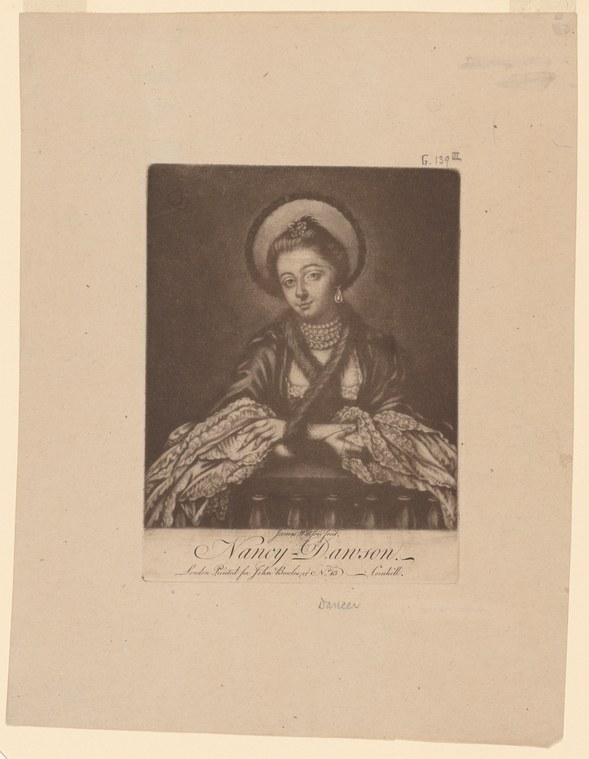
Nancy Dawson
Unknown artist
- Collection:
- Prints depicting dance
- Source:
- New York Public Library
- Rights:
- Public domain — free to use, share and adapt.
- Recorded as:
- Public Domain
Nancy Dawson was a transformative figure in English dance, whose skill and popularity elevated the hornpipe from a provincial jig to a theatrical tour de force, and her face became one of the most recognizable of the 18th-century London stage. This portrait documents the cultural status achieved by a female performer in an era when the stage was a precarious and morally fraught profession, and it represents the kind of circulating imagery through which theatrical fame was constructed and spread. For dance history, the existence and survival of such prints is evidence of how audiences consumed, remembered, and celebrated dancers—not through documentation of movement, but through the iconography of success and fashionable presentation.
What you are looking at
A three-quarter-length portrait of a woman in early 18th-century dress, set against a dark ground with a halo of light around her head. She wears a white linen cap or coif with a slight sheen, multiple strands of large pearls at her neck, and a dark silk dress or bodice with deep lace cuffs at the wrists, one arm relaxed at her side and the other draped across her body. The lace at her cuffs—likely Flemish or Mechlin lace—is rendered with extraordinary delicacy and catches the light dramatically. A striped or patterned fabric, possibly a fichu or shawl, drapes from her shoulders. The woman's face is gentle and finely modeled, her gaze directed slightly to one side. The print bears the inscription "Nancy Dawson" at the base, with additional text below it (now difficult to read).
The dancing
A single figure, shown from the waist up in a static, formal pose. There is no active dance movement captured here. The bearing is upright and composed; the arms are positioned naturally but without the deliberate frame or extension associated with dance. The relaxed placement of the hands and the overall stillness of the pose indicate this is a portrait, not a depiction of dance in action.
The dance depicted
Nancy Dawson was a celebrated English dancer and actress of the 18th century, best known for performing the hornpipe—a quick, rhythmic solo dance that became iconic on the London stage in the 1750s-1760s. However, this image captures her as a social or theatrical figure, not in the act of dancing. The dress and deportment are those of an accomplished woman of the theater, presented with the elegance and refinement befitting a successful performer of her era. No footwork, turnout, or movement of the dance itself is visible; the portrait records her identity rather than her art.
How it was made
This is an engraving (or mezzotint), a technique allowing for the subtle modeling of light and shadow visible here, particularly in the rendering of the lace cuffs and the luminous quality of the cap. The medium created opportunities for multiple impressions, making portraiture of celebrated performers widely available to theater audiences and the curious public. The technical skill evident in the differentiation of textures—the softness of linen, the gleam of pearls, the intricate pattern of lace—indicates a skilled practitioner and suggests this print was of significant commercial and cultural value.
About this work
This is a formal portrait print of Nancy Dawson, one of the most famous English dancers of the mid-18th century. It does not depict her in performance or dance, but rather presents her as a figure of social standing and refinement—the kind of image that would have circulated among theatergoers, collectors, and admirers of the stage. The work belongs to a tradition of celebrity portraiture that capitalized on the fame of performers, making their likenesses available in engraved form for the urban middle and upper classes. While Dawson's historical significance lies in her pioneering performances of the hornpipe, this particular image records not the dance but the dancer—her identity, status, and the fashionable dress of her world.
How to look at it
Look at the rendering of the lace cuffs: this is where the printmaker's skill is most visibly deployed, and it is also the emblem of Dawson's fashionable status. Notice the halo of light that separates her head from the dark ground—a convention of formal portraiture designed to dignify and isolate the sitter. The pearls at her neck and the careful attention to texture throughout suggest an image made to celebrate not a moment of dance, but the presence and persona of a celebrated woman. The pose is static and formal because the purpose is not to capture movement, but to fix and transmit an image of fame.
The artist
The printmaker is not recorded in the catalogue. Based on the style and quality of the engraving—the finesse of the lace rendering and the careful modeling of the face—this was likely the work of a skilled London engraver active in the mid-to-late 18th century, possibly after a painted portrait. The image may derive from a work by a society or theater portrait painter; such prints were often made in multiple states and states, and were sometimes reproduced by different hands.
The period
The 1750s-1760s saw the rise of the individual dancer-star in London theater, a shift enabled by the popularity of popular music and comic entertainments. Nancy Dawson's fame coincided with the heyday of pantomime and afterpiece entertainment, when dancers could achieve celebrity comparable to actors and singers. In the visual arts, engraved and mezzotinted portraits of celebrated performers became a popular and profitable commodity, filling the gap between the exclusivity of painted portraiture and the reach of the theater bills and play texts. The fashion visible in this print—the pearls, the lace, the silk—reflects the prosperity and aspirational style of mid-18th-century London, and signals Dawson's status as a woman of means and taste.
Where it lives
The print is held in the New York Public Library's collection of prints depicting dance. It is catalogued with minimal information, suggesting it may have been acquired as part of a broader collection of theatrical or portrait prints, rather than being individually documented.
Questions about this work
Was Nancy Dawson a real person?
Yes. Nancy Dawson (c. 1728–after 1767) was an English dancer and actress of considerable fame on the London stage. She became celebrated for her performances of the hornpipe, a solo dance in duple meter with rapid footwork and vigorous rhythm. Her popularity was such that she was the subject of prints, poems, and references in contemporary literature, and she achieved a level of celebrity unusual for women performers of her era.
Why is this a portrait and not a dance image?
Engraved theater portraits typically presented performers in their social or street dress, not in character or costume, because the purpose was to circulate an image of the famous person themselves—to make them recognizable to the public, much as celebrity photography does today. Dance-specific imagery would typically be found in satirical prints, program illustrations, or narrative scenes; formal portraiture served a different function.
What is the hornpipe and why did Dawson matter?
The hornpipe is a solo dance with Scottish and English roots, characterized by sprightly music in 2/4 time and footwork emphasizing rhythmic articulation of the ankles and feet. Before Dawson, it was a provincial or lower-class entertainment; her skill and stage presence transformed it into a virtuoso piece, and she effectively created a new genre of solo entertainment that remained popular for over a century afterward. Her success proved that a female dancer could build an independent career and earn significant income from her art.
More dance artwork





