49 works in this view — arrow keys or swipe to move between them.
Dance in Art
Theatrical portraits
Unknown artist
- Collection:
- Prints depicting dance
- Source:
- New York Public Library
- Rights:
- Public domain — free to use, share and adapt.
- Recorded as:
- Public Domain
Theatrical costume portraits like this are crucial historical records of how mid-19th-century stage performers dressed and presented themselves—information that cannot be recovered from written descriptions alone. For historians studying theatrical dance forms, operetta, and the visual language of 19th-century entertainment, such prints provide authentic detail about silhouette, trim, and the theatrical syntax of costume. The survival of theatrical portrait series like this one demonstrates how performance was mediated and commodified through mass-produced imagery.
What you are looking at
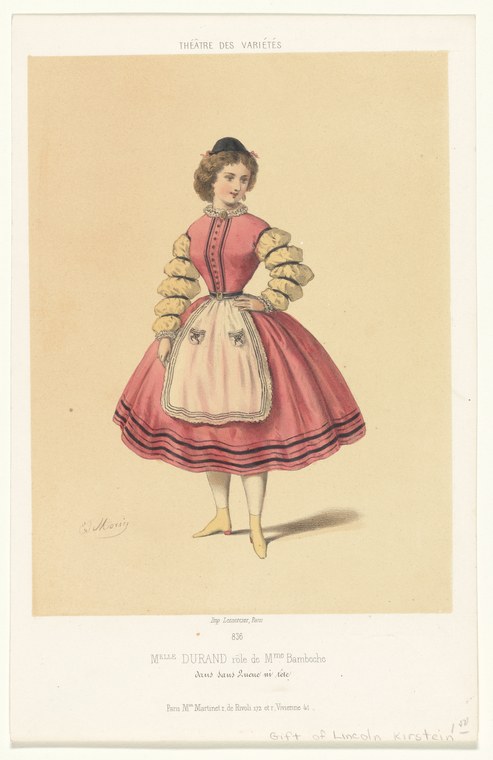
A young woman in a theatrical costume stands center stage against a plain cream background, posed in a formal frontal stance. She wears a coral-pink dress with a fitted bodice trimmed with ornamental buttons or fastenings down the front, and voluminous skirt with horizontal tiers of darker ribbon trim at the hem. Over the dress she wears a cream-colored apron or overskirt decorated with what appear to be small dark ornaments or embroidery. Her sleeves are striking: full golden-yellow puffed fabric that extends to the elbows, a distinctive theatrical detail. Her posture is upright and composed, with hands positioned at the sides, and her gaze direct. Her dark hair is pulled back in a simple style typical of mid-to-late 19th-century fashion. The figure casts a distinct shadow on the ground, emphasizing the picture plane and theatrical staging. The overall composition is that of a theatrical portrait or costume design study, documenting a single performer in character dress rather than capturing movement or narrative action.
The dancing
The figure stands in a neutral, posed position rather than an active dance posture—weight appears evenly distributed, shoulders level, and arms hang relaxed at the sides. There is no indication of dynamic movement, weight shift, or the kind of physical engagement typical of ballet or social dance positions. The body presents the costume to the viewer in the manner of a stage portrait or costume documentation, with the emphasis on the garment and its theatrical composition rather than on the technique or vocabulary of dance.
The dance depicted
This appears to be a theatrical costume study rather than a document of active dance. The dress and styling suggest a mid-19th-century theatrical production, possibly operetta, vaudeville, or musical theatre of the Gilded Age. The distinctive full yellow sleeves and the overall silhouette are consistent with theatrical costuming of the 1860s–1880s. Without evidence of dance-specific technique, hold, or dynamic movement, and given that this is catalogued as a theatrical portrait rather than a scene of performance, the work documents theatrical dress and character presentation rather than a specific dance form.
How it was made
This is a hand-colored engraving or lithograph, as evidenced by the fine linear quality, the tonal range achieved through colored washes, and the overall appearance consistent with 19th-century theatrical print production. The delicate rendering of fabric textures—the sheen suggested on the puffed sleeves, the crisp horizontal lines of the skirt trim—demonstrates the skill of both engraver and colorist. Such prints were produced for theatrical audiences and collectors, circulating as souvenirs of popular performances and as documentation of celebrated performers and costume designs. The credit line visible at the bottom identifies this as part of a series ("Théâtre des Variétés"), suggesting it was part of a published portfolio of theatrical character portraits.
About this work
This is a theatrical costume portrait from the mid-to-late 19th century, part of a documented series titled "Théâtre des Variétés," depicting a single female performer in the dress of a theatrical role. The hand-colored engraving technique was the standard medium for circulating images of celebrated actors and theatrical fashions to the theatre-going public and print collectors. While not a document of dance in motion, it belongs in a dance history context as evidence of theatrical costume, stage presentation, and the material culture of performance during the Gilded Age. The work represents the interface between fashion, theatre, and visual documentation that shaped how audiences understood theatrical spectacle.
How to look at it
Note the careful attention to the texture and color of the fabrics: the luminous golden-yellow of the sleeves, the crisp horizontal striping of the skirt trim, the soft cream of the apron. The artist has rendered these materials to show how they would catch light on stage. Observe the neutral pose and frontal presentation—this is not a moment captured from a dance or dramatic scene, but rather a specimen portrait, allowing the viewer to examine the costume in detail from a fixed vantage point. The distinct shadow at the figure's feet emphasizes the theatrical staging and the picture plane, reinforcing that this is a document of stage presentation rather than a narrative or kinetic scene.
The artist
The engraver's name is not clearly legible in the caption provided, but the print is identified as part of the "Théâtre des Variétés" (Theatre of Varieties) series. Theatrical portrait series were produced by multiple printmakers and colorists working in Paris and other major theatrical centers during this period. These were commercial enterprises: engravers and publishers produced multiple portraits of celebrated performers and made them available to the public, much as theatrical photographs would later. The consistent style and format of the series suggests a single workshop or editorial vision.
The period
This print dates from the era of the Parisian music hall and vaudeville theatre (Théâtre des Variétés was a major venue in Paris), roughly 1860s–1880s. This was a period of explosive growth in popular theatrical entertainment, preceding and overlapping with the Belle Époque and the rise of the can-can and other theatrical dance forms. Theatrical costume had become both an artistic concern and a commercial spectacle; fashion magazines and theatrical prints documented and celebrated elaborate stage dress. At the same time, theatrical lithography and hand-colored engraving were reaching their height as commercial media, just before photographic reproduction would begin to displace hand-drawn theatrical portraiture.
Where it lives
This work is part of the NYPL's collection of prints depicting dance (catalogued as "Prints depicting dance"). It is identified as part of the "Théâtre des Variétés" series, a published portfolio of theatrical costume portraits. The caption below the image provides the performer's name and the character or role represented, following the standard format for such commercial theatrical prints.
Questions about this work
Is this a photograph?
No. This is a hand-colored engraving or lithograph, a printed medium that was the standard for circulating theatrical imagery before photographic reproduction became widespread in the 1880s–1890s. The technique allowed for careful control of color and line, and each print was individually colored by hand or stencil, making them more laborintensive but also more beautiful and varied than mechanical reproduction.
What dance is being performed?
This print documents theatrical costume and presentation rather than capturing dance in motion. The figure is posed statically for examination of the costume. To understand what dances or theatrical forms were performed in roles like this one, you would need to consult the theatre's playbills, reviews, and historical documentation of the Théâtre des Variétés.
Who was Mlle. Durand (or the performer named)?
The performer's name is legible in the caption, but detailed biographical information about minor theatrical performers of this era is often sparse. You may find references in French theatrical histories, playbills from the Théâtre des Variétés, and period newspapers and magazines. The print itself testifies that this performer was celebrated enough to merit inclusion in a published portrait series.
Why is this in a dance collection?
Theatrical portraits document the visual and material culture of stage performance, including dance. Even though this particular image is a costume portrait rather than a scene of active dance, it provides essential historical context: how performers dressed, how theatrical spectacle was presented and circulated, and what the visual language of 19th-century theatre looked like.
More dance artwork





