49 works in this view — arrow keys or swipe to move between them.
Dance in Art
Theatrical portraits
Unknown artist
- Collection:
- Prints depicting dance
- Source:
- New York Public Library
- Rights:
- Public domain — free to use, share and adapt.
- Recorded as:
- Public Domain
This print documents the staging and visual language of a specific operatic moment, capturing how Russian and Caucasian identity were imagined and performed for Parisian audiences in the 1880s. It is essential evidence for understanding both the dance and costume conventions of opera-comique and the imperial mythologies embedded in European theatrical spectacle. For historians of dance and theater, it shows the tight link between costume, character, national type, and performed identity in this period.
What you are looking at
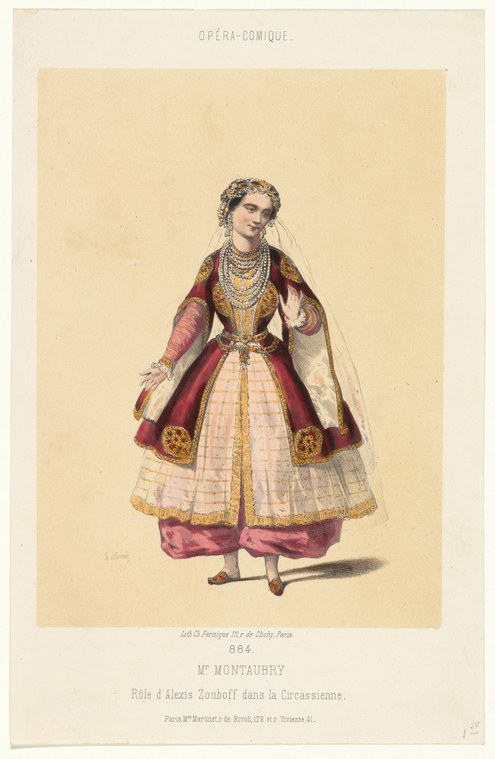
A single female figure stands in three-quarter view against a pale cream background, dressed in an elaborate Russian folk costume. She wears a fitted bodice in golden-yellow with decorative embroidery, over which falls a high-waisted skirt of pale pink or cream linen, gathered and falling to mid-calf. Over this ensemble drapes a sleeveless or short-sleeved overgarment (sarafan) in deep burgundy or wine red, lined and edged in cream, with ornamental circular bosses or buttons at the hips. Her neck is encircled by multiple strands of white or cream beaded necklaces forming a high collar. A cream-colored veil or kokoshnik headdress frames her face, and her dark hair is braided or bound beneath it. She stands with her weight evenly distributed, feet in simple dark shoes, her posture upright and formal. The figure is presented as a theatrical costume study or character portrait, with precise hand-coloring applied over a lithographic or engraved base. The heading reads 'OPÉRA-COMIQUE' at top and identifies her as 'Mlle MONTAUBRY' in the role of 'Aline Zosohoff dans la Circassienne,' dated 1884.
The dancing
The dancer presents a stationary, frontal pose rather than captured mid-movement. Her stance is symmetrical and formal, with arms relaxed at her sides, suggesting a moment of presentation or introduction rather than active dance. The upright posture and centered composition emphasize the costume itself over the body's movement potential. There is no dynamic shift of weight, no indication of footwork or traveling, and no partner; the body is the frame for the dress.
The dance depicted
This is a theatrical costume portrait for a specific operatic character role, not a documentation of an actual dance style or technique. The costume identifies the character as 'Aline Zosohoff' in 'La Circassienne' (The Circassian Woman), a work drawing on Russian and Caucasian cultural imagery popular in 19th-century Paris. While the role may have included choreographed movement within the opera-comique, this image records costume and character type rather than steps, technique, or a recognizable social or theatrical dance form. The folk elements suggest a character linked to Russian or Central Asian identity, a common device in European theatrical production of this period.
How it was made
This is a hand-colored lithograph or possibly a hand-colored engraving, executed with the precision and finish typical of mid-to-late 19th-century theatrical portraiture. The technique allowed rapid reproduction and wide circulation of costume designs and performer likenesses. The application of color—particularly the precise modeling of the embroidered bodice and the subtle gradations of the drapery—suggests skilled professional coloring, likely applied by a workshop rather than by hand after printing. Such portraits were issued individually or in series and sold to theater-goers, serving as both documentation and marketing for productions.
About this work
This is a theatrical costume portrait from the Paris Opéra-Comique, documenting a specific character role in a 19th-century opera-comique production dated 1884. It shows Mlle Montaubry as 'Aline Zosohoff', a character in 'La Circassienne,' dressed in an elaborate pastiche of Russian folk costume adapted for the stage. The work belongs to a substantial genre of theatrical prints produced in Paris during this period—visual records of the costume, makeup, and character type associated with particular singers and roles. It represents the intersection of theatrical production, operatic narrative, and the dance-adjacent movement and spectacle that characterized opera-comique as a form. While the figure does not show active dance technique, the costume itself embodies a type of theatrical movement and presence expected of performers in such roles, and the work documents the visual culture of mid-19th-century Parisian theatrical dance and spectacle.
How to look at it
Look first at the costume itself: the precision of the embroidery detail, the layering of garments, and the balance between fitted bodice and gathered skirt create a specific silhouette and movement potential. The formal, static pose is characteristic of theatrical costume portraiture—it presents the role's visual identity without attempting to capture choreography or a moment of performance. Notice the framing device of the pale background and the careful centering of the figure, which emphasizes the costume as a complete visual statement rather than as clothing on a moving body. The color work—the careful gradation of the red overgarment and the precision of the white beadwork—would have been achieved by hand after the printing, a labor-intensive process that indicates this was a high-value theatrical document.
The artist
The image is credited to the Opéra-Comique archive and appears in their official costume and character documentation series. The hand-coloring and composition suggest a professional theatrical print workshop, likely based in Paris and producing such portraits in volume for the theater's own records and for public sale. The artist and colorist are not recorded in the current catalogue.
The period
The 1880s were a period of intense theatrical innovation and expansion in Paris. Opera-comique—originally a form mixing spoken dialogue and song—had evolved into a vehicle for spectacular staging, exotic costume, and narrative drama. Russian and Caucasian themes were fashionable in European theater and ballet following the Russo-Turkish Wars and the growing cultural visibility of the Russian imperial court. 'La Circassienne' and similar works drew on Orientalist and exoticist fantasies while employing the technical and choreographic achievements of contemporary dance. Hand-colored lithographic portraiture was the primary medium for distributing images of performers and roles to the theater-going public, functioning as both archive and advertisement.
Where it lives
This print is held in the New York Public Library's collection of prints depicting dance. It is part of a larger body of theatrical costume and character portraits from European opera houses, documenting the visual record of stage production in the 19th century.
Questions about this work
Is this a real Russian folk costume or a theatrical invention?
It is a theatrical pastiche, drawing on Russian folk elements but adapted for the European stage. The color coordination, precise embroidery, and layering are more regular and refined than typical historical folk dress, and the construction reflects mid-19th-century European garment-making techniques. It represents how Russian and Caucasian identity were imagined and performed for Parisian audiences, not an ethnographic document.
What is 'La Circassienne' and why was it popular?
It was an opera-comique drawing on the cultural and political visibility of the Caucasus and Russia in 19th-century European imagination. Circassian and Russian themes appeared frequently in opera, ballet, and theater of this period, often tied to imperial politics, Orientalist fantasy, and the appeal of 'exotic' costume and spectacle. Such works allowed European composers and performers to explore narrative and movement in non-European settings.
What is a hand-colored lithograph and why use that technique?
Lithography allowed an image to be drawn on stone and printed in large quantities. Hand-coloring each print made them expensive but achievable at scale for a commercial theater market. This technique was ideal for theatrical portraiture: it preserved fine detail in the face and costume while allowing skilled colorists to render fabric and embroidery convincingly. By the 1880s, chromolithography was emerging, but hand-colored prints remained prestigious.
Did opera-comique performers dance, or only sing?
Opera-comique was a hybrid form combining sung and spoken passages with choreographed movement and spectacle. While the primary focus was often vocal, performers were expected to move well on stage, and many roles included dances or movement sequences. The costume in this portrait was designed to support both the vocal and physical demands of the role.
More dance artwork





