49 works in this view — arrow keys or swipe to move between them.
Dance in Art
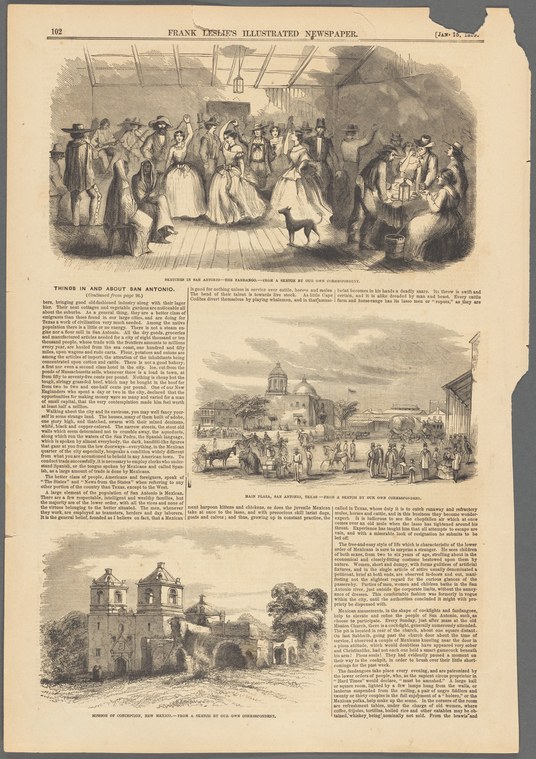
Sketches in San Antonio, the fandango [on full sheet]; Main plaza, San Antonio, Texas; Mission of Concepcion, New Mexico
Unknown artist
- Collection:
- Prints depicting dance
- Source:
- New York Public Library
- Rights:
- Public domain — free to use, share and adapt.
- Recorded as:
- Public Domain
This is one of the few visual records of fandango dancing as a living social practice in 19th-century North America rather than as a stylized performance. It shows the dance in its vernacular context—a public or semi-public social event—and documents how it looked to Anglo-American observers and readers who would have encountered the image in a widely distributed newspaper.
What you are looking at
This is a composite print showing three scenes from Texas and Mexico, rendered in wood-engraving style typical of 19th-century illustrated newspapers. The upper image depicts an indoor dance scene—the fandango—with couples and musicians in a crowded room with exposed ceiling beams. Women wear long dresses with full skirts; men are in period coats. A guitarist and other musicians occupy one corner while dancers occupy the center and sides of the room, their bodies angled in the social proximity of partnered dance. The middle image shows the Main Plaza in San Antonio with military or civic gathering, buildings, and figures dispersed across a public square. The lower image is an architectural study of the Mission of Concepción in New Mexico, showing the church facade with its distinctive twin towers and surrounding grounds. The three scenes are integrated into a single newspaper page with letterpress text columns flanking and separating them.
The dancing
In the fandango scene, the dancers hold each other at moderate distance in what appears to be a closed or semi-closed frame typical of the period. The men's posture is upright; the women's full skirts create a broad silhouette. Arms are positioned at the sides or waist rather than extended. The positioning suggests social dance rather than theatrical performance—dancers are interspersed with standing observers, and the musicians sit rather than stand. The engraving technique renders body weight and movement as outline and shadow rather than anatomical detail, which limits precision about footwork.
The dance depicted
The upper scene is labeled 'the fandango,' a Spanish social dance that became popular in North America during the 19th century, particularly in territories with Spanish colonial heritage such as Texas and New Mexico. The fandango is typically performed by couples in moderate-to-close hold with rotational movement and rhythmic footwork. This image shows it as a social ballroom dance in an indoor setting with musicians, consistent with how the fandango was danced in frontier North American communities of the period. The dress and setting suggest 1850s or 1860s, when Anglo American travelers and settlers first documented fandango dancing in the Southwest.
How it was made
This is a wood engraving—a relief printing technique in which an image is carved into the end-grain surface of a boxwood block, with printed lines appearing as the raised surface. The fine parallel lines (hatching) create tone and shadow. This technique was the dominant method for newspaper and magazine illustration in the 19th century because it could be set alongside letterpress type and printed on the same press. The skill visible here—particularly in the rendering of fabric, faces, and spatial depth—indicates professional newspaper illustration. Wood engravings were often unsigned and created for weekly publications with large circulations.
About this work
This page from Frank Leslie's Illustrated Newspaper documents the fandango as it was danced in Anglo-American Texas during the 1850s–1860s. The fandango was a Spanish social dance that persisted in newly conquered or settled territories and became a point of fascination and sometimes moral anxiety in American journalism. The print situates the fandango within a documentary project—shown alongside architectural and geographic views of the region—that treats it as part of the cultural and social landscape of the frontier. For dancers and historians, it is evidence of how this dance was actually performed in its moment: indoors, in mixed social company, with live musicians, in dress and posture that differs from later theatrical fandango.
How to look at it
Notice the spatial arrangement of the dancers relative to the musicians and observers. The artist has chosen to show the dance in progress but not in a moment of high elevation or dramatic gesture—the figures are grounded and engaged in partnered rotation. The room itself is crowded and informal; this is not a ball in a grand ballroom but a local gathering. The women's skirts are full but not exaggerated (as they would be in a later burlesque or theatrical treatment of the fandango). Look at how the artist differentiated the dancers from the onlookers—the dancers are in the center, the musicians to one side, and a cluster of figures stand or sit around the perimeter. This spatial logic reflects the actual social organization of dance in frontier communities.
The period
Frank Leslie's Illustrated Newspaper, founded in 1855, was one of the first mass-circulation American weeklies to feature wood-engraved illustrations integrated with news reporting. Such publications brought images of distant American territories and their peoples into middle-class homes nationwide. The fandango was a subject of recurring interest in American journalism and literature of the 1850s–1870s, often presented as both exotic and morally questionable. The dance was associated with Spanish and Mexican culture, and reports often carried ambivalence about both the sensuality of the dance itself and the cultural difference it represented. By the 1860s, the fandango had also begun to appear in theatrical contexts, but this image captures it in its social, non-theatrical form.
Where it lives
The work is from the New York Public Library's collection of prints depicting dance, sourced from Frank Leslie's Illustrated Newspaper. The page integrates three separate scenes of Texas and Mexican sites and culture into a single newspaper article, suggesting this was part of a longer series on American frontier territories.
Dance in this work
Questions about this work
What is a fandango?
The fandango is a Spanish social dance in triple meter, typically performed by couples in a closed or semi-closed frame with rotational movement and rhythmic footwork. It originated in Spain and became popular in Spanish colonial territories in the Americas. By the 19th century, it was danced as both a social dance and a theatrical solo or couple dance.
Why was the fandango newsworthy in 1850s America?
The fandango represented Spanish and Mexican culture at a moment when the United States had recently conquered or annexed Mexican territories including Texas, New Mexico, and California. American newspapers treated fandango dancing as exotic and often morally questionable. Publishing images of it allowed middle-class readers to observe unfamiliar cultural practices from a distance.
What is a wood engraving?
A wood engraving is a relief print made by carving an image into the end-grain surface of a boxwood block. The raised surface is inked and printed. This technique dominated newspaper and magazine illustration in the 19th century because the blocks could be set directly into a printing press alongside letterpress type. Each block was typically used for hundreds or thousands of impressions before wearing out.
How do I know this is actually a fandango and not some other dance?
The print is labeled 'fandango' in the caption. The setting (indoor, social, with live musicians) and the dress (long skirts, period coats) are consistent with how fandango was documented in American sources of the period. However, the wood-engraving technique does not capture enough detail about footwork or rhythmic gesture to identify the dance from body language alone.
More dance artwork





