49 works in this view — arrow keys or swipe to move between them.
Dance in Art
Theatrical portraits
Unknown artist
- Collection:
- Prints depicting dance
- Source:
- New York Public Library
- Rights:
- Public domain — free to use, share and adapt.
- Recorded as:
- Public Domain
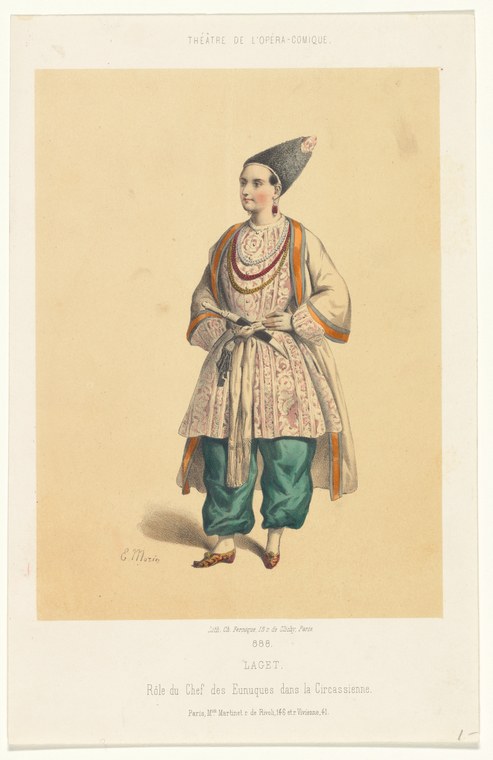
This image reveals how dance and character were conveyed through costume spectacle rather than bodily technique in 19th-century opera and operetta. It is a primary document of theatrical practice and the commercial circulation of dance imagery before photography became the dominant medium for costume documentation.
What you are looking at
A single figure, identifiable as a performer in Russian or Eastern European theatrical costume, stands against a warm cream background. She wears a tall, dark pointed kokoshnik (traditional headdress) adorned with metallic trim, and her dress is an elaborate layered ensemble of white embroidered linen with ornamental trim in rust and gold tones. A long decorative shawl or sarafan overdress drapes asymmetrically, creating volume and movement in the silhouette. The figure's posture is upright and poised, with arms held comfortably at her sides in a pose of quiet presentation rather than active movement. She faces toward the viewer's right, her expression serene. The hand-coloring technique is evident in the refined palette, with careful attention paid to the textile patterns and the metallic highlights of her jewelry and headdress trim.
The dancing
The single figure demonstrates the formal, frontal presentation typical of theatrical costume studies. The body is held erect and symmetrical, the weight evenly distributed, the arms relaxed but not drooping—a stance designed to display the costume's construction and decoration rather than to capture a moment of choreography. There is no indication of active dancing, weight transfer, or the dynamic body tension that would characterize an in-motion performer. This is a costume portrait.
The dance depicted
The inscription identifies this as a role in Offenbach's operetta "Les Contes d'Hoffmann" (The Tales of Hoffmann), performed during the Comédie-Dominique theatrical season. The costume suggests Russian or Slavic character dancing, likely the role of Olympia or a supporting character in the "Olympia" act, which features automaton and fantasy sequences. The elaborate kokoshnik and embroidered sarafan point to a character conceived in the Russian theatrical idiom, though the context of a Parisian operetta house indicates a European interpretation of Russian exoticism. Without further documentation, the specific movement vocabulary cannot be determined from the image alone, but the costume type suggests folk or character dance conventions of the late 19th century.
How it was made
This is a hand-colored lithograph or chromolithograph on paper, characteristic of the theatrical costume documentation tradition of mid-to-late 19th-century Paris. The technique allowed for rapid, economical production of costume documentation for opera and operetta casts, distributed to audiences, critics, and archives. The artist's signature 'C. Montalan' (or similar) appears in the lower left. The hand-coloring, while refined, shows the slight variations in tone typical of period chromolithography before color separation became fully standardized. The warm cream paper stock and refined printing suggest a production of quality intended for relatively high-value distribution.
About this work
This is a theatrical costume portrait from the Comédie-Dominique, a Parisian opera house active in the 1880s, documenting an unnamed performer in the role of a Russian or Eastern European character in Offenbach's operetta. It belongs to a large tradition of 19th-century European theatrical ephemera in which costume rather than movement was the primary subject of visual documentation. The work is significant not as a dance image (there is no dancing depicted) but as evidence of how character dance and ethnic costuming were imagined and marketed in the commercial operetta theater of the period. It demonstrates the visual language through which "Russian-ness" was constructed for Parisian audiences.
How to look at it
Attend to the construction of the costume: the nested layers of the sarafan, the embroidery patterns, the weight and drape of the fabrics, and the metal ornaments that catch light. The stillness of the pose is itself meaningful—this is not a dancer in motion, but a costume on display. The facing, three-quarter turn, and stable stance are conventions of costume illustration, designed to show the garment from a legible angle while maintaining the elegance of the performer's bearing. The warm hand-coloring emphasizes the richness of the textile palette, suggesting the visual spectacle the costume would create on stage under gas light.
The artist
The artist is identified as C. Montalan (or Montalan), a costume illustrator active in Paris during the 1880s. Little is documented about his broader practice or biography, but his work appears in the Comédie-Dominique archive, suggesting he was a house artist or regular contractor for costume documentation. His style—careful hand-coloring, attention to textile detail, formal presentation—is typical of the theatrical fashion illustration tradition of the period.
The period
This work dates to the 1880s operetta season, a period when Offenbach's works dominated Parisian stages and European opera houses. The operetta tradition—lighter, more vernacular than grand opera—embraced elaborate costume spectacle and character types drawn from literature, mythology, and imagined foreign cultures. Russian themes and costumes were fashionable in Western Europe during this era, part of broader Orientalist and exoticist aesthetics. The role of the costume portrait as a primary means of documenting and promoting theatrical performance was in full development before photography superseded hand-colored lithography in the 1890s.
Where it lives
This work is held in the New York Public Library's collection of prints depicting dance. It is part of a series of theatrical costume portraits from the Comédie-Dominique, likely collected as ephemera of theatrical practice and performance documentation.
Dance in this work
Questions about this work
Is there actually dancing in this image?
No. This is a costume portrait of a performer in theatrical dress, presented in a still, formal pose. It is a document of costume design and theatrical spectacle rather than a depiction of movement or choreography. The genre of the theatrical costume portrait prioritized the visibility of the costume over the capture of dancing.
What role was this performer playing?
The inscription identifies the work as from Offenbach's operetta and refers to a 'Chef des Eunuques dans la Circassienne' (Chief of the Eunuchs in the Circassian act, or similar). The costume suggests a Russian or Eastern European character, but the specific role and performer name are not recorded in the available documentation.
How were these costume portraits used?
Theatrical costume portraits were printed in limited editions and distributed to audiences, critics, journalists, and kept in theater archives as documentation of productions. They served as promotional material, souvenirs, and a record of theatrical practice before photography became standard in the 1890s.
What is a kokoshnik?
A kokoshnik is a traditional Slavic headdress, typically tall, shield-shaped, and heavily decorated with embroidery, beads, and metal ornaments. In Russian and Eastern European folk costume, it is a marker of regional and cultural identity. In 19th-century Western European theater, it became a shorthand symbol of 'Russian-ness' and exoticism.
More dance artwork





