49 works in this view — arrow keys or swipe to move between them.
Dance in Art
Giovanni Coralli; Luigi Costa; Nicola Molinari; Luigi Henry
Unknown artist
- Collection:
- Prints depicting dance
- Source:
- New York Public Library
- Rights:
- Public domain — free to use, share and adapt.
- Recorded as:
- Public Domain
For historians of Romantic-era dance, this sheet is evidence of who the leading male performers were, where they worked, and how they were presented to the public. For students of print culture and theatre, it shows the standard way likenesses of stage personalities were mass-produced and distributed. For anyone studying gender in dance history, it is worth noting that male dancers were celebrated as named individuals through portraiture—a different mode of visibility than female dancers typically received in this period.
What you are looking at
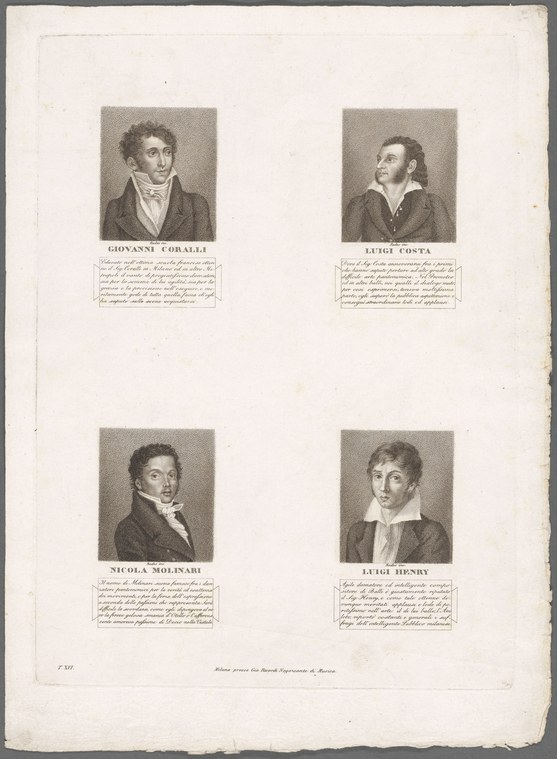
This is a printed sheet of four portrait engravings arranged in a 2×2 grid, each showing a male dancer or choreographer in formal early 19th-century dress. The figures are identified by name below each portrait: Giovanni Coralli (top left), Luigi Costa (top right), Nicola Molinari (bottom left), and Luigi Henry (bottom right). Each portrait is rendered as a bust or three-quarter-length figure against a plain background, with careful attention to facial features and the period clothing—high collars, dark coats, and the neat appearance typical of professional male performers of the Romantic era. Below each portrait runs a block of italic text in what appears to be Italian, likely biographical or professional information about the subject. The engravings are finely detailed, using cross-hatching and tonal gradation to model the faces and suggest texture in the fabric. The overall composition is formal and documentary, presenting these four men as notable figures worthy of commemoration and circulation.
The dancing
Each figure is presented as a portrait rather than a dancer in motion. The men are shown from the shoulders or waist up, turned slightly to reveal the face and upper body. None displays active dance posture—there is no turned-out position, no lifted frame, no dynamic weight shift. Instead, they present the formal bearing of professional men: upright, composed, with restrained gesture. The slight three-quarter turn of the head and shoulders was a convention of respectability in portraiture of this period. This is the likeness of a master or celebrated performer, not a depiction of dance itself.
The dance depicted
These are portraits of four prominent male dancers or ballet masters of the early 19th century, likely Romantic-era figures associated with Milan or Italy based on the Italian text and names. Giovanni Coralli (1793–1854) was a renowned Italian choreographer and dancer who worked throughout Europe; Luigi Costa, Nicola Molinari, and Luigi Henry were likely his contemporaries or collaborators, though without reading the text blocks we cannot establish their specific roles or achievements. The image documents the profession of dance through portraiture rather than through movement—it presents these men as named, individual artists rather than as anonymous performers. The formal engraved portrait was the standard way to circulate the likenesses of celebrated stage personalities in this era, and this sheet serves as a kind of gallery or roster of notable figures.
How it was made
This is an engraving, a print made by incising lines into a copper plate and inking the recessed lines to create the image. The fineness of the line work—especially the even cross-hatching in the shadows and the delicate modeling of the faces—is characteristic of high-quality engraving from the 1820s–1840s. Engravings allowed for mass production and relatively inexpensive circulation compared to original drawings or paintings, making them the standard medium for celebrity portraiture in the theatre world. The text blocks below each portrait, set in italic type, suggest this sheet was printed with letterpress as well, indicating professional commercial production. Such prints were sold individually or in series to theatre-goers, collectors, and fellow performers.
About this work
This is a documentary engraving presenting four named male dancers of the Romantic era—likely Italian or Italian-trained—as celebrated professional artists worthy of commemoration. It is not a dance scene but a gallery of portraits, using the conventions of formal engraved celebrity portraiture to establish these men as named individuals and stage masters. It belongs in a dance gallery because it documents the dance profession and its personnel during a pivotal moment when dance was becoming a respected theatrical art with identifiable stars, and because it represents the primary means by which dancers' likenesses reached a broad public in the pre-photographic era. The work sits at the intersection of dance history, theatre history, and print culture, showing how the profession circulated and valorized its leading men.
How to look at it
Read this as a document rather than a narrative: these are four named individuals presented for recognition and remembrance. Notice the care taken in rendering each face distinctly—the engraver has not produced four identical males, but four particular men with different features and expressions. The formal dress and composed bearing signal respectability and professional status; this is how a celebrated dancer or master presented himself to the world, not how he moved on stage. The text blocks below were meant to be read—they likely contained biographical information, a list of roles, or an account of achievements. The sheet is a record of who counted in the dance world at this moment.
The artist
The engraver is not named on the sheet. The print appears to be a commercial product of a major print publisher, likely Italian or based in a major European theatre centre such as Milan. The style and quality suggest a skilled professional engraver working in the 1820s–1840s, but without more information we cannot attribute the work to a specific individual.
The period
This engraving dates to the height of the Romantic ballet era, when male dancers—particularly Italian and French virtuosos—were celebrated stars. The early 19th century saw the professionalization and theatricalization of ballet, with named choreographers and performers becoming public figures. Coralli, in particular, was a major figure in Romantic choreography, known for works like *La Sylphide* (1832). The engraved portrait was the standard medium for circulating the likenesses of stage celebrities before photography; such prints were sold in theatres, in print shops, and by subscription. They served both as souvenirs for fans and as professional credentials, establishing the dancer as a named, individual artist rather than an anonymous member of the corps.
Where it lives
This engraving is part of the New York Public Library's collection of prints depicting dance. It appears to be a commercial print produced for circulation among theatre-goers and dance professionals. The exact printer and date are not recorded in the catalogue.
Questions about this work
Who was Giovanni Coralli?
Giovanni Coralli (1793–1854) was an Italian choreographer and dancer who became one of the most celebrated figures of the Romantic ballet era. He is best known for choreographing *La Sylphide* (1832) and for working with the leading dancers of his time. He was a dominant figure in European ballet for nearly four decades.
Why are these four men shown as portraits rather than dancers?
Engraved portraits were the standard way to circulate the likenesses of celebrated performers before photography. They served as souvenirs and credentials, establishing the dancer as a named, recognizable individual. A portrait was a more prestigious and permanent form of commemoration than a scene from a ballet would have been.
What does the text below each portrait say?
The text is in Italian and likely contains biographical information about each dancer—his birth place, his roles, his career achievements, or the theatres where he performed. Without a translation, we cannot read the specific content, but such text blocks were standard on these commercial portrait sheets.
How were such prints distributed?
Engraved portrait sheets like this were sold in theatres, in print shops, and sometimes by subscription. They could be purchased as individual sheets or as part of a series. They served both as fans' souvenirs and as professional records, and were often kept in albums or scrapbooks.
More dance artwork





