49 works in this view — arrow keys or swipe to move between them.
Dance in Art
Baccanale
Unknown artist
- Collection:
- Prints depicting dance
- Source:
- New York Public Library
- Rights:
- Public domain — free to use, share and adapt.
- Recorded as:
- Public Domain
Bacchanalian imagery was central to how Renaissance and Baroque elites understood dance as an expression of pleasure, abundance, and divine intoxication. This print is evidence of a visual tradition that connected contemporary dance practice (especially in court and festival contexts) to an imagined classical past, giving social dancing a philosophical and mythological weight. For historians of dance aesthetics and representation, it shows what qualities—elevation, extension, ecstatic gesture, sensual abandon—were prized in the period's visual imagination of dance.
What you are looking at
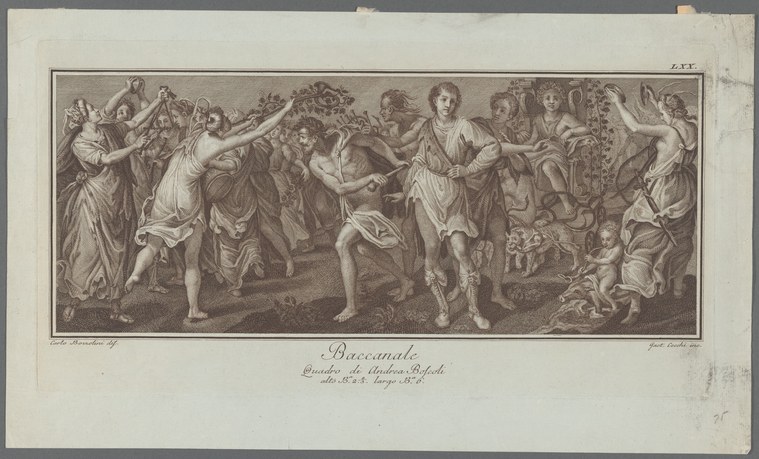
A crowded revelry unfolds across this horizontal composition: a group of figures in classical drapery dance, leap, and cavort in a landscape with distant architecture. The scene is densely populated, with bodies overlapping in energetic abandon. At center, a nude or near-nude male figure leaps with arms raised; to his left, a woman in billowing drapery swings upward in a dynamic pose, her garment catching the light; another figure at right reaches upward. Children and putti (winged cherubs) appear throughout, some dancing, others bearing baskets of fruit and flowers. The foreground is scattered with grapes, grapevines, and harvest imagery. The lighting is warm and even, created by the engraver's line work, with deeper tones in the background and lighter tones in the figures' flesh and drapery. The whole composition vibrates with motion and sensual pleasure.
The dancing
The dancers display open, expansive gestures: arms raised or swept outward, legs extended in leaps and lunges, torsos twisted in ecstatic motion. There is no closed partnership or formal frame—bodies move individually or in loose groupings, often airborne or caught mid-leap. The figures are lightly built and high-waisted in the antique manner, with an emphasis on the linear rhythm of lifted limbs and billowing cloth. Weight is rarely grounded; most figures are captured at the moment of suspension or ascent.
The dance depicted
This is a bacchanal—a scene of Bacchic revelry or festive abandon, likely depicting the followers of Bacchus (Dionysus) in celebration. The presence of grapes, grapevines, and the inscription referencing Bacchus confirms the subject. While not a codified dance form, the bacchanal was a standard allegorical subject in Renaissance and Baroque art and implied exuberant, unstructured movement: leaping, swaying, and ecstatic gesture in celebration of fertility and wine. The image captures the idealized antique fantasy of such revels rather than any contemporary dance practice.
How it was made
This is an engraving, identifiable by the fine parallel lines (hatching and cross-hatching) that build tone and volume across the composition. The technique required a burin incised into a metal plate (likely copper), allowing for precise linear work and tonal subtlety. Engravings of this sophistication circulated widely among educated patrons and artists as prints—they were relatively affordable compared to paintings, portable, and valued as both artistic statements and reference material for other artists. The accomplished line work and the composition's complexity suggest this was the work of a skilled professional, likely part of a larger series or publication on classical subjects.
About this work
This is an engraved rendering of a mythological bacchanal, a scene of Bacchic revelry translated into the visual language of Renaissance or Baroque printmaking. It belongs in a gallery about dance because it represents how classical mythology was visualized and circulated as idealized dance spectacle—not a record of how people actually danced, but a vision of dance as ecstatic, sensual, and liberatory. The bacchanal was a foundational image in early modern European art, repeated across paintings, prints, and sculptures, and it shaped how dance was imagined in courtly and theatrical contexts. The engraving's wide circulation would have made this fantasy of antique revelry visible to artists, patrons, and the merely curious across Europe.
How to look at it
Notice how the engraver has frozen the moment at its peak of energy: every body is in motion, nearly every limb extended, and the composition reads as a kind of visual music—rhythmic and harmonious despite the apparent chaos. The artist has used overlapping figures and a shallow stage-like space to create a sense of crowded revelry. Look at how drapery becomes part of the language of movement: folds and hems echo the trajectory of limbs, so that cloth and body speak the same grammar of flight and swirl. The inclusion of children and putti, and the scattered harvest imagery, roots the scene in abundance and fertility—this is not conflict or tragedy, but pleasure as a moral category.
The period
The bacchanal was a favored subject across sixteenth and seventeenth-century European art, as humanist scholars and artists mined classical texts and sources for subject matter and philosophical authority. Engravings after such scenes circulated widely and were copied, adapted, and reinterpreted. At the same time, court dances themselves were becoming more elaborate and theatrical, drawing on classical and mythological themes; the bacchanal as a visual type offered courtly dancers and their patrons a model of expressive, physically liberated movement. By the Baroque period, such images had become almost formulaic—a repertoire of gestures and compositions repeated across prints, tapestries, and painted decorations.
Where it lives
The work is held in the New York Public Library's collection of prints depicting dance. It is catalogued as belonging to an unknown era and of unknown authorship, but the inscription and stylistic evidence place it securely in the Renaissance or Baroque period. No accession number or detailed provenance is recorded.
Dance in this work
Questions about this work
What is a bacchanal?
A bacchanal is a scene of wild revelry or celebration, especially one inspired by classical mythology and the worship of Bacchus (the Roman god of wine and festivity, equivalent to the Greek Dionysus). In visual art, bacchanalian scenes became a standard way to depict ecstatic, sensual, and morally uninhibited movement—often used to celebrate abundance, fertility, and the breakdown of social hierarchy. Such scenes were popular across Renaissance and Baroque art, and they influenced how dance was imagined and staged in courtly and theatrical contexts.
Who would have seen this print?
Engravings like this circulated among educated patrons, artists, scholars, and collectors across Europe. They were expensive enough to signal sophistication but affordable enough to reach beyond the very wealthy. Artists used such prints as reference material and inspiration; patrons collected them as evidence of taste and learning; and some prints were used as decorative elements in homes or studies. The print's wide circulation made classical imagery and mythological themes available to a broad audience.
Is this showing a real dance or an imaginary one?
This is an imaginary vision of classical antiquity, not a record of a contemporary dance practice. However, it would have been influential: courtly dancers and spectacle designers used such images as inspiration and justification for their own elaborate dances, citing classical authority. The bacchanal as an idea—sensual, exuberant, uninhibited movement in celebration of pleasure and abundance—was translated into actual court ballets and festivals.
Why are there children and putti in the scene?
The presence of children and winged cherubs (putti) reinforces the themes of fertility, innocence, and divine pleasure. Putti were a standard element of classical and Renaissance art, often appearing in scenes celebrating love, abundance, and the natural world. Their presence here elevates the bacchanal from mere drunken revelry to a kind of sacred festivity blessed by the gods.
More dance artwork





