49 works in this view — arrow keys or swipe to move between them.
Dance in Art
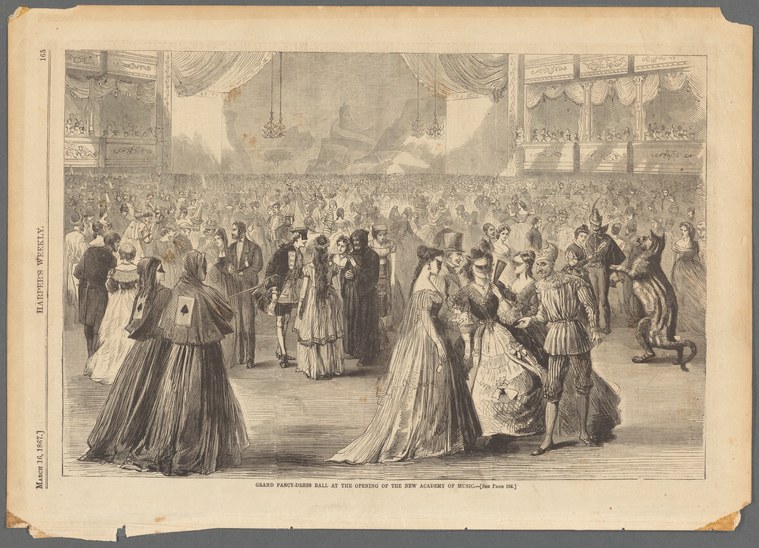
Grand fancy-dress ball at the opening of the new Academy of Music
Unknown artist
- Collection:
- Prints depicting dance
- Source:
- New York Public Library
- Rights:
- Public domain — free to use, share and adapt.
- Recorded as:
- Public Domain
This is one of the primary visual records of how mid-nineteenth-century ballroom dance actually looked in its full social context—not in a drawing room but in a monumental public hall crowded with hundreds. It captures the waltz at the moment of its maximum cultural power, before it became an everyday social form. The engraving also documents the technology of how dance was circulated to people who did not witness it themselves: as printed image in newspapers and magazines, which is how most people knew what the newest dances looked like.
What you are looking at
A grand ballroom crowded with hundreds of formally dressed guests at what appears to be an opening-night gala. The perspective draws the eye down the length of the vast room toward a distant stage or dais, framed by ornate architectural elements and heavy draped curtains. Tall windows along the sides admit light that catches the dancers' silhouettes. The crowd fills the entire floor in a dense crush of movement—some couples are dancing, others stand conversing or watching. The women wear full-skirted ball gowns typical of the 1860s, many with elaborate trim and trains; the men are in dark formal dress with tails. The overall impression is one of coordinated social spectacle on a monumental scale, with the artist capturing the energy of a crowded public celebration through careful attention to the architecture framing it.
The dancing
Numerous couples are visible throughout the composition, though the artist has rendered most at a distance. In the foreground and middle ground, several pairs are shown in closed ballroom hold—men's right hand on the woman's waist, their left hands joined, the woman's left hand on the man's shoulder. The bodies lean slightly into the frame of the dance, and skirts billow outward with centrifugal force, suggesting rotational momentum. Many dancers are shown in profile or three-quarter view, allowing the full volume of their skirts to read; some have their gaze directed toward their partners, others look outward at the crowd. The density of figures makes it impossible to track individual steps, but the posed quality and the formality of hold suggest ballroom dances of the period—waltzes or cotillions—rather than country dances or folk forms.
The dance depicted
This is almost certainly a ballroom waltz or cotillion scene, the two dominant social dances of the mid-nineteenth-century formal ball. The women's dress, the enclosed ball gown, the closed hold, and the scale of the assembly all point to the ballroom repertory. The title emphasizes the ceremonial opening of a venue, which would have called for the grandest and most formal dances. The artist has not attempted to show footwork or specific technique, focusing instead on the visual spectacle of the whirling masses—the primary appeal of the waltz to contemporary observers was precisely this dizzying, voluptuous rotation of couples through space.
How it was made
This is a wood engraving or steel engraving, identifiable by the fine parallel hatching used to build tone and shadow, the precision of the line work, and the overall monochromatic tonal range. The technique allowed for mechanical reproduction and mass circulation—this image was almost certainly printed in a newspaper, periodical, or illustrated book of the period. Engraving's requirement for white-on-black line work encouraged the artist to clarify forms through silhouette and outline; the architectural frame and the choreographed density of the crowd suit this language. The formal, hierarchical composition and the distance of most figures from the viewer are entirely characteristic of engraved reportage of the era.
About this work
This is a journalistic wood or steel engraving documenting a grand ball held at the opening of a new Academy of Music—likely the New York Academy on 14th Street, which opened in 1854. It is a record of a public, ceremonial event captured for a mass audience, and it presents the waltz not as intimate duet but as collective spectacle. The image belongs in a gallery of dance art because it shows how the ballroom dance was understood and circulated in the public sphere: as a visual phenomenon of massed bodies moving in unison, rather than as the sum of individual couples' movements. The composition privileges the architecture and the crowd over the dance itself, yet the dance is what gives the scene its energy and meaning.
How to look at it
Look first at the architectural frame—the artist uses perspective and ornamentation to establish the scale and grandeur of the space, which is as much the subject of the image as the dancers themselves. Then follow the eye into the crowd: notice how couples are scattered throughout the composition, some dancing, some standing, some in conversation. The variety of postures and the overlapping of figures create a sense of teeming social life. Pay attention to the women's skirts—the artist has rendered them with particular care, showing how they swell outward with the rotation of the dance. The formal, almost processional quality of some of the couples in the foreground contrasts with the apparent chaos of the crowds deeper in the composition, creating visual rhythm. Finally, notice the lack of joyful abandon: this is decorous, controlled movement, sanctioned by architecture and social hierarchy, not the ecstatic whirling that the waltz's detractors feared.
The artist
The artist is not recorded. The image bears the hallmarks of professional mid-century newspaper or periodical illustration—competent architectural drawing, control of perspective, an ability to compose a crowd scene with clarity despite the density of figures. The inscription indicates publication source (likely *Harper's Weekly* or a similar illustrated periodical), and the image was likely drawn by a staff illustrator working from sketches made at the event or from secondhand description. The anonymity is typical of the period; most engravers and illustrators of journalism were not credited.
The period
The waltz had been the dominant ballroom dance across Europe and America for half a century by the 1850s, but it was still understood as the epitome of modernity and sophistication. The opening of a new public hall for music and dance was a major civic event, and the opening ball would be extensively covered in the illustrated press. The engraved image allowed newspapers to reach readers who could not attend, democratizing access to the spectacle of high society. This particular print sits at the intersection of three domains: the dance itself (the waltz), the architecture of public leisure (the great hall), and the technology of mass media (the engraved reproduction).
Where it lives
The image is held in the Prints depicting dance collection at the New York Public Library. It is a periodical illustration, almost certainly wood-engraved for reproduction in a newspaper or illustrated magazine; the particular printing source is not identified in the catalogue record.
Dance in this work
Questions about this work
What dance is this?
Almost certainly the waltz, the dominant ballroom dance of the mid-nineteenth century. The closed hold, the rotating couples, the formal setting, and the women's ball gowns all confirm this. The artist has not attempted to show the specific steps or footwork, focusing instead on the visual effect of the dance as spectacle—the whirling masses of couples moving through a monumental space.
Is this a real event or an imaginary scene?
The inscription identifies this as the opening of the Academy of Music, which was a real venue. However, without additional documentation, we cannot determine whether the artist was present at the ball or whether this image is a composite or imaginative reconstruction based on reports. It was common for newspaper illustrators to depict events they did not witness, based on verbal description or standard conventions of how such scenes should look.
Why is this an engraving rather than a photograph?
This image was almost certainly published in the 1850s or 1860s, before photographic reproduction was standard in newspapers and magazines. Wood engravings and steel engravings allowed for fast, economical mass printing, and the tonal control of the engraver's line made it possible to show large-scale crowd scenes with clarity. Photography could not yet be easily reproduced in print.
What would the music have sounded like?
The waltz was danced to orchestral music—typically fast, in 3/4 time, with a simple melody over a regular harmonic progression. The standard waltz tempo was between 50 and 60 measures per minute, giving the dance its characteristic swaying, rotational quality. At a grand ball, the orchestra would have been substantial, often featuring violins, brass, and timpani.
More dance artwork





