49 works in this view — arrow keys or swipe to move between them.
Dance in Art
Céleste Mogador, Céleste Venard, dame Lionel de Mobreton, comtesse de Chabrillan
Unknown artist
- Collection:
- Prints depicting dance
- Source:
- New York Public Library
- Rights:
- Public domain — free to use, share and adapt.
- Recorded as:
- Public Domain
Céleste Mogador represents the paradox of the 19th-century dancer: celebrated on stage, commodified in prints and photographs, yet often excluded from respectable society until marriage to a nobleman granted her legitimacy. Her portrait circulated as eagerly as images of royalty or society women, yet she remained tethered to the demimonde. For dance historians, her visibility in portraiture indexes both the power of theatrical celebrity and the precarity of a dancer's social position.
What you are looking at
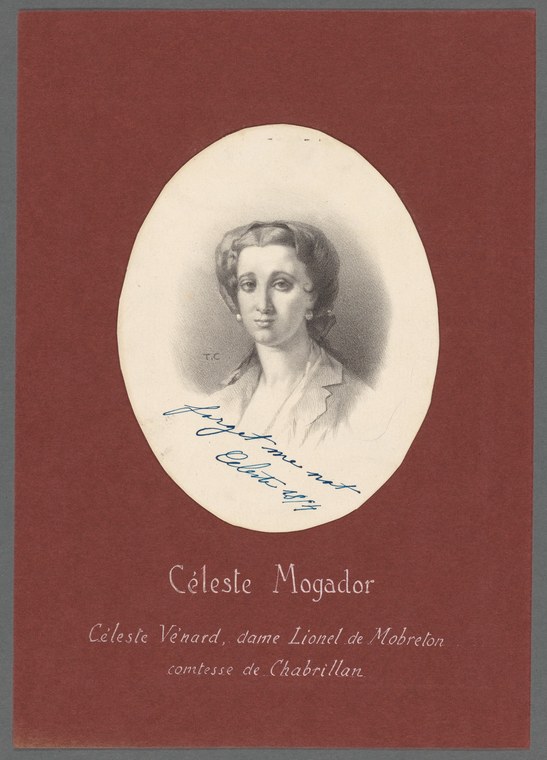
A portrait in an oval frame presents a woman in three-quarter view, her head slightly turned toward the viewer. She wears her dark hair parted in the center and swept back loosely, with a soft, contemplative expression. Her dress is rendered in pale tones—likely white or cream muslin—with what appears to be a simple, high-necked bodice typical of early 19th-century fashion. The background is neutral and unmodeled, allowing the figure to occupy the full attention. Below the portrait, in italic script, runs an inscription in French identifying the subject and her titles. The oval format and soft modeling of form suggest this is a lithograph or steel engraving, a medium well-suited to the circulation of theatrical celebrity portraits in this period.
The dancing
The woman is seated or posed formally, her shoulders relaxed and her gaze direct but gentle. There is no active dance posture or movement suggested; this is a portrait of repose, not action. The composition emphasizes her face and the upper body, with no indication of legs, feet, or the lower body that would show dancing movement.
The dance depicted
Céleste Mogador (1824–1909) was a famous French dancer and courtesan of the July Monarchy and Second Empire, known for her roles in cancan and quadrille performances at the Bal Mabille and other popular venues. This portrait does not depict her dancing; it is a celebrity portrait distributed to audiences, fans, and collectors. The work itself documents her cultural prominence as a public figure rather than capturing a moment of performance. Her later marriage to Lionel de Mobreton and acquisition of the title Countess of Chabrillan, as recorded in the inscription, places this image in the context of her trajectory from dancer and entertainer to nobility.
How it was made
This is a lithograph or engraving—the soft tonal modeling, the quality of line, and the oval vignette are characteristic of 19th-century theatrical portrait prints. The technique allowed for relatively inexpensive reproduction and wide circulation among theater audiences and collectors of theatrical ephemera. The inscription in the margin, printed as part of the stone or plate, indicates this was a commercial product designed for identification and souvenir purposes.
About this work
This is a celebrity portrait of Céleste Mogador, a celebrated Parisian dancer and courtesan of the 1840s–1860s, presented not as a dancer in motion but as a public figure and woman of standing. The work belongs in a dance collection not because it depicts dancing, but because it documents the cultural visibility and social trajectory of a woman whose fame originated in the dance halls of Paris and whose image was circulated as widely as her performances. The portrait records how dancers of her era were consumed as celebrities—as faces and identities to be collected and possessed by fans. The inscription documenting her ascent to nobility through marriage is itself part of her story as a performer who transcended the social boundaries of her profession.
How to look at it
Attend to the inscription below the portrait: it is not simply a name, but a genealogy and claim to status (Countess of Chabrillan). The contrast between her origin as a performer and her acquired titles is the subject of the image. The portrait itself—the soft modeling, the formal dress, the refined gaze—presents her as a woman of dignity and standing rather than as an entertainer. The work invites the viewer to see her as contemporaries of rank and wealth would have wished to see her: as a lady, not a dancer.
The artist
The artist is not recorded. The work is a commercial theatrical portrait print of a type mass-produced in Paris during the July Monarchy and Second Empire. Such portraits were made by lithographers and engravers whose names rarely survive; they served as promotional and collectible ephemera rather than signed artistic statements.
The period
The 1840s–1860s were the heyday of the Bal Mabille and Parisian public dance halls, where cancan dancers like Mogador performed for bourgeois and working-class audiences. This was also the era of Romantic ballet—Taglioni, Elssler, and the cult of the ballerina—yet Mogador belonged to a different, more risqué theatrical tradition rooted in popular rather than elite dance. The period saw a boom in theatrical portraiture as lithography made celebrity images affordable and collectible. Mogador's later ascent to the title of Countess (recorded in the inscription) marks the particular trajectory of a few successful dancers and courtesans who leveraged their fame into social advancement during the Second Empire.
Where it lives
The work is held in the Prints collection of the New York Public Library, part of a broader collection of theatrical portraiture and dance ephemera. It is catalogued without a known artist, medium, or date, indicating it circulated as anonymous commercial ephemera rather than a signed work of fine art.
Questions about this work
Who was Céleste Mogador?
Céleste Mogador (1824–1909) was a celebrated French dancer and courtesan famous for performing cancan and quadrille at the Bal Mabille in Paris during the 1840s–1860s. She later married Lionel de Mobreton and became Countess of Chabrillan, a social ascent unusual for a woman of her background.
Why does this portrait not show her dancing?
This is a celebrity portrait made for circulation to fans and collectors, not a depiction of performance. It functions as a souvenir and identifier, presenting Mogador as a public figure and society woman rather than as a working dancer. Such portraits were common merchandise in theater lobbies and among collectors.
What does the inscription tell us?
The inscription identifies her by both her stage name (Mogador) and her married titles, emphasizing her elevation from dancer to nobility. This dual identification was part of her public image and the marketing of her portrait.
What kind of print is this?
Based on the style, this appears to be a lithograph or steel engraving, media well-suited to theatrical portraiture in the 19th century. The oval vignette format and soft tonal modeling are typical of celebrity prints from this period.
More dance artwork





