49 works in this view — arrow keys or swipe to move between them.
Dance in Art
Dance commune
Unknown artist
- Collection:
- Prints depicting dance
- Source:
- New York Public Library
- Rights:
- Public domain — free to use, share and adapt.
- Recorded as:
- Public Domain
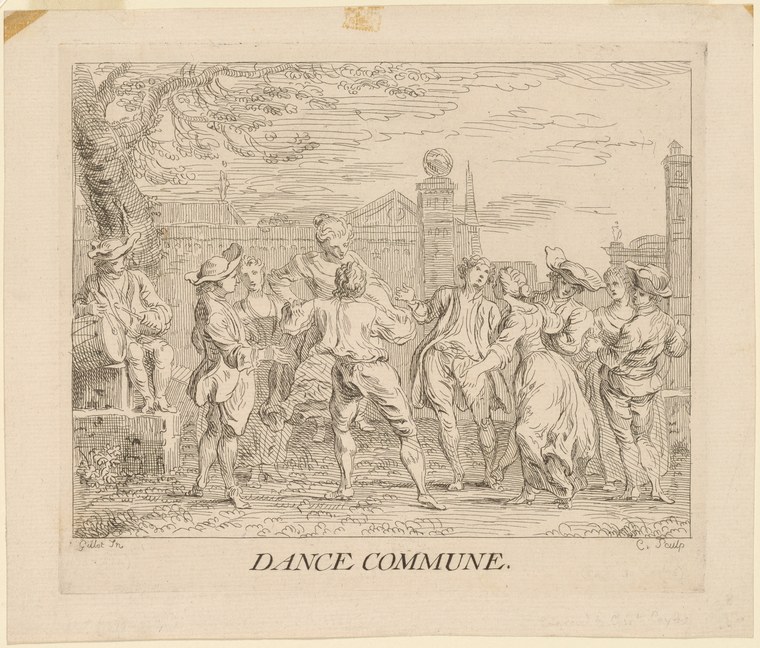
This print is a rare window into how non-elite people danced in early modern Europe. It shows us that dance was not confined to the ballroom or the court, but belonged to village squares and informal public gatherings. The image also reveals an artist's attention to the social and gestural dimensions of dance—how people cluster, address one another, and use their bodies in speech and celebration—rather than to technical form alone.
What you are looking at
A lively outdoor gathering of figures in a piazza or public square, rendered in fine line engraving. The scene is animated with roughly a dozen figures arranged across the foreground, many in animated conversation and gesture. The figures wear loose, flowing garments suggesting either classical dress or the casual attire of common people—billowing shirts and draped fabrics rather than rigid court costume. In the background, a modest townscape with a church spire, bell tower, and pitched-roof buildings establish a European setting. The sky is suggested by parallel hatching lines indicating clouds. The composition is shallow and frieze-like, with the figures spread across the picture plane rather than receding into depth. The title below reads "DANCE COMMUNE"—a phrase that might mean "common dance," "communal dance," or "shared dance," suggesting this depicts folk practice rather than courtly ceremony.
The dancing
The figures are posed in loose, informal attitudes—some standing in pairs or small groups facing one another, others with arms raised or extended in gestural conversation. The postures suggest movement paused mid-gesture rather than a locked ballroom hold; bodies lean and turn toward companions. No two dancers appear to share a formal partnership frame. The dress—simple and unstructured—allows the limbs to move with apparent freedom. The engraver has emphasized expressive gesture and the social clustering of the group rather than the precise bodily positions that mark courtly dance.
The dance depicted
The title and composition suggest a vernacular or folk gathering rather than a named ballroom dance. The loose, animated gestures and informal grouping are consistent with earlier modern European folk traditions—country dances, village celebrations, or the kind of communal social dancing that predates or exists outside formal court practice. The wear of simple dress and the outdoor setting reinforce this reading. Without a specific costume marker (such as a national garment, instrument, or architectural context) it is difficult to place the dance more precisely; the work documents a type of social occasion—collective, informal, outdoors—rather than a technical form.
How it was made
This is a line engraving, executed on copper plate and printed on paper. The fine parallel hatching throughout creates tone and volume; the technique allowed for wide circulation as a portable print. The engraver's control of line weight and spacing suggests a trained hand, and the careful composition indicates this was a designed work, not a documentary sketch. The print would have been relatively affordable and accessible—suitable for a broad audience rather than luxury commission. The medium's fineness made it ideal for rendering social detail and the nuance of gesture.
About this work
This engraving documents a moment of communal dance—a gathering of ordinary people in a public space, animated by music and social pleasure. It is titled "Dance Commune," a phrase that emphasizes the democratic and collective nature of the occasion. The work belongs to a long tradition of prints depicting folk life and village celebration; it shows us not a technique or a named form, but a social practice: the way people gathered, moved together, and enjoyed music without the formality of court. For a gallery of dance in art, it is evidence of how dance functioned outside aristocratic contexts—as ordinary social life, as community ritual, as shared pleasure.
How to look at it
Notice the informality of the poses: no rigidity, no locked frames, bodies turning and leaning toward one another as if in conversation punctuated by movement. The artist is not freezing a moment of choreographed technique, but rather capturing the social texture of a gathering—the way people naturally stand and gesture when music and pleasure draw them together. The outdoor setting and modest dress are deliberate choices that mark this as outside the court; the engraver is showing us an alternative to formality.
The period
The engraving style, the title, and the compositional approach suggest a date somewhere in the 17th or 18th century, when both formal court dances (minuet, gavotte, contredanse) and folk traditions coexisted. Prints of village life, seasonal festivals, and folk customs were popular in Northern Europe during this period, often published in series. The distinction between "dance commune" and courtly practice would have been clear to a contemporary viewer: the setting, the dress, and the informality all mark this as the dancing of common people, not nobility.
Where it lives
The work is held in the New York Public Library's collection of prints depicting dance. It is catalogued with minimal information, suggesting it may be a secondary or miscellaneous item within a larger group rather than a named and studied masterwork.
Dance in this work
Questions about this work
Is this a specific named dance?
The title suggests not—"Dance Commune" means common or communal dance, emphasizing the social nature of the gathering over a technical form. No costume detail, pose, or setting marker points to a named dance like a minuet or contredanse. The image documents a social occasion and a class of dancing, not a choreographed form.
When and where was this made?
The engraving technique, style, and composition suggest 17th or 18th century, most likely Northern European. The catalogue record does not provide a specific date or location. The architectural style in the background appears broadly European but not distinctive enough to pinpoint a region.
Why does this matter if it's just folk dancing?
Because most records of early modern dance focus on court forms, leaving a gap in our understanding of how ordinary people danced. This print is evidence that dance was integral to village social life, and it shows an artist attending to gesture, grouping, and the body language of celebration—not just formal technique.
More dance artwork





