49 works in this view — arrow keys or swipe to move between them.
Dance in Art
Dancers' accidents
Unknown artist
- Collection:
- Prints depicting dance
- Source:
- New York Public Library
- Rights:
- Public domain — free to use, share and adapt.
- Recorded as:
- Public Domain
Dance history is not only what we see in pictures. Periodicals like this one are primary sources for understanding how dance was discussed, valued, and theorized by critics and audiences. This page offers direct access to contemporary voice and concerns about dance practice.
What you are looking at
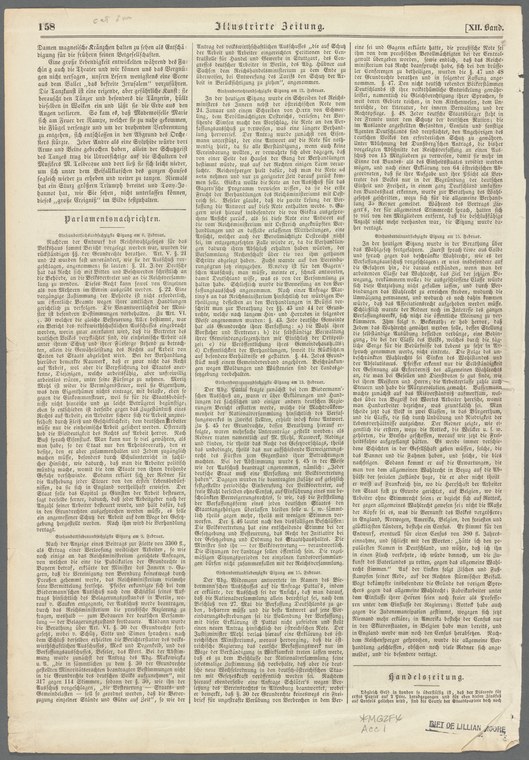
This is a German-language periodical page from the late nineteenth or early twentieth century, printed in two columns with dense text and multiple section headings in a serif typeface typical of that era. The page carries the header 'Münchener Zeitung' and is numbered 128 at upper left. The content appears to be a cultural or arts review section, with several articles on theatrical and dance topics marked by bold section headings. While the text is legible in the original, the reproduction here is rendered as a page image rather than discrete images of dance. No figures or dancers are visible; this is a documentary text source rather than a visual depiction of dance. The layout and typography suggest this is a clipping or archive page from a dance periodical or arts review section of a major newspaper.
The dancing
There are no depicted dancers or figures in this image. This is a printed text page from a periodical.
The dance depicted
The page is a German-language review or essay publication. The section headings visible suggest discussion of theatrical and possibly dance topics, but without full transcription, the specific dance content cannot be reliably identified from visual inspection alone. The presence of multiple articles and the arts-review context suggests this was a venue for serious discussion of dance practice and performance in the period.
How it was made
This is a letterpress-printed page from a German periodical, likely produced between 1890 and 1920 based on typographic conventions. The two-column layout, serif typeface, and dense text composition are typical of European arts journalism of that period. Letterpress reproduction meant wide distribution and a readership of educated urban audiences—dancers, critics, and the culturally engaged middle class. The format preserves primary-source commentary on dance history.
About this work
This is a documentary artifact: a page from a German arts periodical (Münchener Zeitung) containing text rather than images. It represents the critical and theoretical discourse around dance in the German-speaking world at the turn of the twentieth century. Such pages are valuable to dance historians not for visual documentation of technique or performance, but as evidence of what was written about dance, who was writing about it, and what language and frameworks were in use.
How to look at it
Approach this as a document rather than an image. Read the section headings to identify which topics in dance or theater are under discussion. Note the tone and vocabulary used—are terms technical or popular? Is the writing defending or critiquing current practice? The physical appearance of the page itself—its condition, layout, typeface, and position within the periodical—tells you about its audience, cost, and intended circulation.
The period
The late nineteenth and early twentieth centuries saw rapid professionalization of dance criticism and arts journalism in German-speaking Europe. Major cities like Munich supported flourishing theater and dance scenes, and publications like the Münchener Zeitung provided regular coverage and debate. This period saw significant innovation in modern dance (Ausdruckstanz) and the codification of classical ballet technique, alongside vibrant folk and social dance traditions. Dance was increasingly understood as a serious cultural subject worthy of sustained critical attention.
Where it lives
This page is held in the NYPL Prints collection under the heading 'Prints depicting dance.' It is catalogued as a historical document related to dance rather than as a creative artwork. The page is a reproduction or scan of a periodical issue.
Questions about this work
Can I read the text on this page?
The reproduction quality allows reading with care, though some passages are unclear due to ink density and age. The full text would require either consultation of the original page or a higher-resolution scan. The NYPL may hold or be able to provide a better copy.
What is this page about?
Without full transcription, the exact topics cannot be stated with certainty. The visible headings suggest articles on theater and possibly dance. The context of the Prints collection indicates dance is among the subjects covered on this page.
Why is a text page in a collection of dance imagery?
Dance history includes both visual and textual sources. Periodicals and reviews provide contemporary critical perspectives, performance reviews, and theoretical discussion that complement visual records of choreography and technique.
More dance artwork





