49 works in this view — arrow keys or swipe to move between them.
Dance in Art
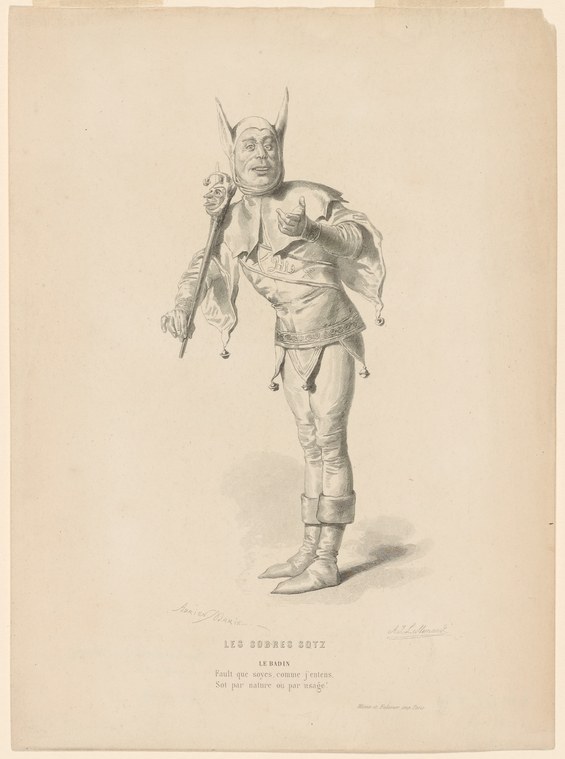
Les sobres sotz: Le badin
Unknown artist
- Collection:
- Prints depicting dance
- Source:
- New York Public Library
- Rights:
- Public domain — free to use, share and adapt.
- Recorded as:
- Public Domain
This print documents the costume and character types of early European theatrical comedy and carnival—a performance tradition that influenced later dance forms and theatrical conventions. For historians of theatre, costume, and popular entertainment, it is a record of how these stock characters were visualised and circulated before photography.
What you are looking at
A single male figure in theatrical costume stands against a blank background in a frontal pose. He wears a tight-fitting doublet or tunic with decorative elements, close-fitting breeches, and pointed shoes. Most striking are the two large curved horns that rise from his head. He holds a staff or wand in one hand and gestures expressively with the other, his body twisted slightly in a contrapposto stance. His facial expression is animated, mouth open as if speaking or singing. The figure projects theatrical mischief and energy. The print is executed in a classical engraving style with fine cross-hatching to suggest volume and shadow, rendered in black ink on cream paper. Text beneath the image in French identifies the figure and provides a brief inscription.
The dancing
The body is upright but animated, with weight distributed unevenly in a dynamic pose rather than a formal stance. The arms are free and expressive rather than formally positioned; one holds an object, the other gestures outward. The head is raised, the facial features animated. There is no partner, no partnered hold, and no formation—this is a solo character portrait in costume rather than a depiction of ballroom or social dance partnering.
The dance depicted
This appears to be a theatrical or masked character rather than a depiction of a specific social dance form. The figure is identified in the French text as 'Le badin' (the trickster or jester), suggesting this is a commedia dell'arte or pantomime character type. The 'Les sobres sotz' reference in the title likely indicates a larger series of character prints. The horned headdress, animated expression, and theatrical costume point to a character from folk theatre, carnival, or masked entertainment rather than a codified dance style. No recognisable dance technique or partnering convention is visible.
How it was made
This is a line engraving, executed with fine parallel lines and cross-hatching to create tone and volume. The technique allows precise detail in the costume and facial features and would have made this a relatively affordable multiple, suitable for wide circulation among theatregoers and print collectors. The style and finish suggest a European print from the 18th or 19th century, though the catalogue offers no date. The engraving process indicates this was a commercial product intended for a broad audience interested in theatrical types and costume.
About this work
This is a character print from a theatrical or carnival tradition, showing a costumed figure identified as 'Le badin' (the trickster). It is part of a series titled 'Les sobres sotz' (The Foolish Ones), likely documenting stock characters or masked types from popular entertainment. The figure is dressed for performance rather than social dance, and the image functions as both a costume record and a comedic character portrait. While theatrical and performative in nature, it does not depict a recognisable dance form or partnered dance technique.
How to look at it
Observe the costume details: the fitted bodice, breeches, and pointed shoes show theatrical tailoring rather than everyday dress. The horned headdress is the dominant visual marker identifying the character type. The twisted pose and raised arm are chosen to convey energy and character rather than to freeze a moment of balletic movement. The open mouth and animated face are central—this is a character expressing emotion and personality, not demonstrating a technique.
The artist
The artist is not recorded in the catalogue. The engraving style and French inscriptions suggest a French or Franco-Germanic origin, likely 18th or early 19th century. The work appears to be one in a series of character types, suggesting it was produced as a commercial print portfolio or theatrical documentation.
The period
This falls within the tradition of commedia dell'arte and European carnival performance, which flourished from the 16th into the 19th century. During the 18th century, character prints and costume engravings were popular collectibles that documented and standardised theatrical types. The figure's horned headdress connects to ancient and medieval folk traditions (devils, satyrs, fertility figures) that persisted in carnival and popular theatre, even as more formalised dance and ballet were developing at court and in theatres.
Where it lives
The work is held in the New York Public Library's print collection documenting dance in art. It is catalogued under 'Prints depicting dance,' though it more precisely depicts theatrical performance and costume rather than a dance form.
Questions about this work
What are the horns and why is he wearing them?
The horns identify the figure as a supernatural or demonic character, likely 'Le badin' (the trickster or foolish one). In European carnival and commedia dell'arte traditions, horned masks and costumes signalled characters associated with mischief, the devil, or wild nature. They were stock elements of comedic theatre.
Is this a real dance?
No. This is a costume portrait of a theatrical character type rather than a depiction of a codified dance. However, such characters did perform in theatrical entertainments that included choreographed movement, music, and pantomime. The print records the costume and character rather than a specific dance technique.
What is 'Les sobres sotz'?
The title translates to 'The Foolish Ones.' This print is part of a series documenting stock comedic and carnival characters. Such series were popular in 18th-century Europe and served as both entertainment and reference records of theatrical types and costumes.
More dance artwork





