49 works in this view — arrow keys or swipe to move between them.
Dance in Art
Grand galerie théatrale
Unknown artist
- Collection:
- Prints depicting dance
- Source:
- New York Public Library
- Rights:
- Public domain — free to use, share and adapt.
- Recorded as:
- Public Domain
This sheet is essential for understanding the relationship between theatrical costume, character type, and performance convention in European theatre. For a dance historian, it documents the visual vocabulary of theatrical dress and formal bearing that shaped how performers moved and presented themselves on stage—the costume and the deportment were inseparable. The image preserves a systematic reference tool that practitioners consulted to ensure consistency and authenticity in character representation.
What you are looking at
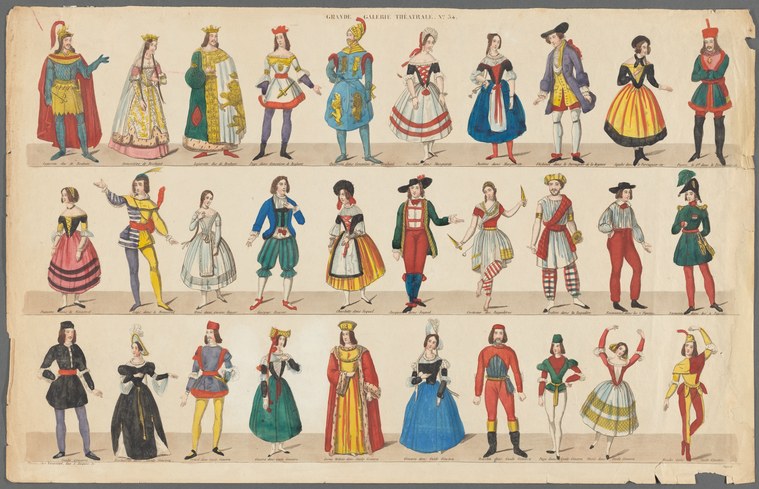
This is a theatrical costume sheet showing thirty figures arranged in three horizontal rows against a plain background. The figures represent characters in elaborate period dress spanning European theatrical traditions, from classical antiquity through the Renaissance and early modern era. Each figure is rendered in full color with careful attention to elaborate costumes: richly patterned tunics, long flowing gowns, doublets, cloaks lined with contrasting fabrics, ornate headdresses including crowns and elaborate bonnets, and decorative hose and boots. The figures stand in varied poses—some frontal, some three-quarter, some in profile—each positioned to display their costume fully. The title "Grand galerie théatrale" (Great theatrical gallery) indicates this is a reference or model sheet, likely for costume designers, theatre practitioners, or students of dramatic arts. The palette is vivid: reds, blues, yellows, greens, and golds predominate, with black used for definition and contrast.
The dancing
The figures occupy upright, relatively static poses with minimal indication of active movement or dance. Most stand with feet planted and arms at sides or in naturalistic gestures; a few raise an arm or gesture expressively, but the primary purpose is to display costume rather than capture kinetic energy. Several figures show contrapposto stance or mild S-curves of the torso, but there is no suggestion of the closed holds, frame, or dynamic partnering that characterizes ballroom or theatrical dance. The bodies are presented as costume supports: the dress is the primary information, not the movement.
The dance depicted
While titled as theatrical and labeled for this collection as depicting dance, the image functions primarily as a costume reference gallery rather than a record of actual dancing. The figures represent stock characters and types from European court theatre, commedia dell'arte, and classical dramatic traditions rather than dancers engaged in choreographed movement. If dance is present, it would be limited to courtly gesture and formal theatrical movement associated with these character types—pageantry rather than structured dance technique. The absence of musical instruments, spatial arrangement suggesting group choreography, or bodies in dynamic relation to one another argues against identifying any specific dance form.
How it was made
This is a hand-colored engraving or woodcut, characteristic of 18th- or 19th-century theatrical and costume documentation. The fine line work, the regularity of the rows, and the precision of detail suggest professional engraving from an original design, with color applied by hand afterward—a standard production method for costume albums and theatrical reference materials. The technique allowed multiple impressions to be made and distributed to theatre practitioners, costume makers, and students, positioning this as a teaching or reference tool with relatively wide circulation among theatre professionals.
About this work
This is a theatrical costume reference sheet rather than a depiction of dance in performance. The title and format identify it as part of a "Grand galerie théatrale"—a systematic survey of theatrical character types and their costuming conventions. The figures represent roles from European dramatic traditions, arranged for easy consultation by costume designers and theatre practitioners. While housed in a dance prints collection and employing theatrical figures capable of stylized movement, the work is organized as costume documentation: the body is a hanger for the dress, and the poses are static display positions rather than captures of choreography. It is valuable as evidence of theatrical culture and the visual conventions for representing character type through costume, but does not constitute a primary source for understanding how dances were actually performed.
How to look at it
Examine the costumes row by row to understand how character type was signaled visually: the noble wears a cloak and crown, the servant is dressed in simpler or comic dress, the young woman in flowing gown, the soldier in armor or martial costume. Note the consistency of silhouette and color within character families—all young women share certain proportions and palette choices; all servants or comic types cluster together. The poses are secondary; the primary information is sartorial. This is a grammar of theatrical dress, meant to be read for reference rather than admired as dramatic art.
The period
European theatrical culture from the 17th through 19th centuries relied on standardized character types—noble, comic servant, warrior, young woman, elderly sage—each with recognized costume conventions. This image likely dates to the 18th or 19th century, when such reference sheets became standard studio and school materials. The theatrical tradition it documents descends from commedia dell'arte and court masque, where costume and formal bearing conveyed character instantly to the audience. By the 19th century, such sheets served teaching institutions and professional theatres alike.
Where it lives
The work is held in the New York Public Library's collection of prints depicting dance and belongs to a broader tradition of European theatrical reference materials. It functions as a teaching and consultation tool rather than a fine-art original.
Questions about this work
Is this a depiction of actual dancing?
Not primarily. While the figures are theatrical characters who may have participated in formal movement or courtly gesture, the image is organized as a costume reference sheet. The poses are static display positions designed to show the costume fully, not to capture choreography or the dynamic of dance in performance.
What period do these costumes represent?
The costumes span multiple historical periods and theatrical traditions, from classical antiquity through the Renaissance and early modern era. The sheet itself likely dates to the 18th or 19th century, but it synthesizes and references conventions from earlier theatrical practice.
Who would have used this sheet?
Theatre practitioners, costume designers, and students consulted such sheets to ensure accurate and consistent character representation. Professional theatres used them as reference during costume construction and rehearsal preparation.
How does costume relate to dance in this image?
Costume was inseparable from performance style. The weight, volume, and construction of garments determined how performers could move, and the formal bearing required by elaborate dress shaped the character of movement—upright, controlled, and ornamental rather than dynamic.
More dance artwork





