49 works in this view — arrow keys or swipe to move between them.
Dance in Art
The polka on 19th-century music covers
Unknown artist
- Collection:
- Prints depicting dance
- Source:
- New York Public Library
- Rights:
- Public domain — free to use, share and adapt.
- Recorded as:
- Public Domain
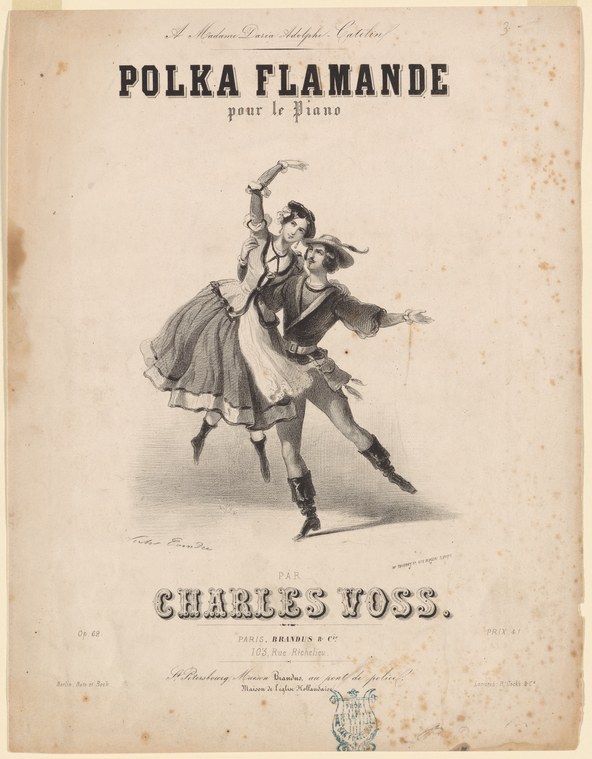
The Polka Flamande is now almost entirely forgotten, surviving mainly through printed scores and images like this one. For historians and dancers, this sheet music cover is a precious record of a real social dance that inhabited French ballrooms and influenced later dance forms, yet left almost no other trace. The image also reveals the aesthetic values of mid-Victorian dance culture: the emphasis on vertical spring, the visibility of the woman's body and energy, and the performance of exuberance as a social virtue.
What you are looking at
This is the cover sheet of a French music publication for piano, featuring an illustration of a spirited Polka Flamande. Two figures dominate the composition: a man in dark military or formal dress with a high collar and a woman in a full-skirted dress with horizontal pleating, captured mid-movement in an energetic leap or bound. The woman's skirts billow dramatically as she rises, her body angled upward and away from her partner. The man, positioned slightly behind and to the side, reaches upward with one arm extended toward the woman's raised hand in a gesture of support or celebration. Both figures are depicted with their feet off the ground, frozen in a moment of exuberant elevation. The background is plain, focusing all attention on the dancers. The illustration is executed in black and white line work with careful attention to the fabric texture of the woman's dress and the detail of period costume.
The dancing
Both dancers are airborne, their bodies dynamically asymmetrical. The woman's weight rises through the leap, her arms extended and her full skirts creating a visual apex. The man, in supporting position, reaches upward with engaged posture, his body angled to follow his partner's trajectory. This is not a closed-position dance—the partners relate through extended arms and spatial connection rather than contact. The composition emphasizes vertical lift and explosive movement energy, with the man's supportive gesture subordinate to the woman's dominant, skyward direction.
The dance depicted
This is a Polka Flamande (Flamenco Polka), a hybrid social dance that combined the rhythmic patterns and character of Andalusian flamenco with the bouncing, accentuated steps of the European polka. The Polka Flamande was fashionable in French ballrooms and salons during the mid-to-late 19th century. The image captures the characteristic explosive energy of the form—the upward spring and lift that distinguishes polka from other social dances. The woman's aerial position and the man's upward-reaching support gesture are both consistent with how the Polka Flamande emphasized vertical bounce and dramatic, celebratory partnering.
How it was made
This is a chromolithograph or engraved illustration, printed as the cover sheet of a published music score. The publisher, Brandus & Cie of Paris, issued dance music for amateur pianists and ballroom players—this was popular domestic music for middle-class consumption. The printed sheet was both advertisement and functional object, enabling dancers to take home the published score and music instruction. The technique allowed for clean, reproducible imagery that could be mass-printed and distributed, making the dance accessible to the widest possible audience of musicians and dancers in France and abroad.
About this work
This is a published piano score cover for a Polka Flamande, a 19th-century French social dance that fused Spanish flamenco character with the mechanical bounce of the polka. The illustration captures the dance in a moment of explosive elevation—both dancers airborne, the woman dominant and skyward, the man supporting from below. As a printed sheet-music cover from Brandus & Cie, it documents both a specific dance form and the commercial circulation of dance instruction through the music publishing industry. The work belongs in a gallery of dance imagery because it records how a fashionable social dance was marketed, consumed, and performed by the educated middle class during the Second Empire and Belle Époque.
How to look at it
Attend to the moment of suspension: both dancers are caught at the peak of their jump, their bodies weightless. The artist has chosen the apex rather than the preparation or landing, emphasizing the explosive, springing quality that defines the polka. Notice how the woman's skirts billow and rise—the illustrator used fabric volume and movement to suggest the speed and lift of the dance. The man's upward-reaching gesture, though subordinate in visual weight, anchors the composition and establishes this as a partnered social dance rather than a solo turn. The blank background isolates the dancers, making their energy and mutual attention the sole subject.
The artist
The artist is not identified in the catalogue record, but the engraved or lithographed illustration is signed with initials that are not fully legible in reproduction. The work was produced by Brandus & Cie, a major Parisian music publisher based on the Rue Richelière, active throughout the 19th century. Brandus published dance music, operatic scores, and popular songs for both professional musicians and amateur home performers. Sheet-music covers by minor or unnamed artists were common in this industry; the publisher's name and the composition's title were often more important to marketing than the illustrator's identity.
The period
The Polka Flamande emerged in France during the 1840s–1860s, in the context of the craze for social dances that mixed national or regional characteristics. The polka itself had arrived in Paris from Prague and Vienna in the 1840s and spread rapidly through European ballrooms. Simultaneously, there was a sustained French fascination with Spanish culture, music, and flamenco, fed by Romantic-era poetry and visual arts. The Polka Flamande was an attempt to synthesize these two enthusiasms. In visual culture, this period saw dance covers become increasingly important to music-publishing marketing; the dramatic, dynamic illustrations were designed to attract buyers and suggest the energy and pleasure of the dance itself. This cover, with its emphasis on upward spring and partnered exuberance, reflects the values of a society increasingly confident in physical display and social dancing as expressions of modernity.
Where it lives
This object is held in the New York Public Library's collection of prints depicting dance. It is a published sheet-music cover from Brandus & Cie, a Parisian music publisher, and belongs to the category of commercial dance documentation—objects that were mass-produced and circulated for practical domestic use rather than as fine-art prints.
Dance in this work
Questions about this work
What is a Polka Flamande?
A Polka Flamande is a 19th-century social dance that combined the rhythmic bounce and accentuated steps of the European polka with the character and spirit of Spanish flamenco. It was fashionable in French ballrooms during the 1850s–1870s but largely vanished from practice by the early 20th century. This sheet-music cover is one of the main visual records of how the dance was performed.
Why do both dancers have their feet off the ground?
The upward spring and explosive bounce are essential to the polka family of dances. The artist captured the dancers at the apex of their leap to emphasize this characteristic vertical energy. Freezing the moment at its highest point makes the dynamism and lift of the dance visually apparent.
Was this music meant to be played by professional musicians?
No. Brandus & Cie published music for amateur pianists in the home. This score was intended for middle-class dancers and musicians who wanted to perform the latest fashionable dances in domestic settings. The cover image served as both marketing and a visual guide to the character of the dance.
What does the artist's style tell us about dance imagery of this period?
Mid-19th-century dance covers prioritized dynamic, expressive posture and dramatic moments of movement. The emphasis on upward lift, open partnering, and the woman's visible energy reflects the Romantic and early Victorian belief that dance should express joy, vitality, and social confidence. The engraved line technique allowed for fine detail in costume and sharp clarity of gesture.
More dance artwork





