49 works in this view — arrow keys or swipe to move between them.
Dance in Art
The polka on 19th-century music covers
Unknown artist
- Collection:
- Prints depicting dance
- Source:
- New York Public Library
- Rights:
- Public domain — free to use, share and adapt.
- Recorded as:
- Public Domain
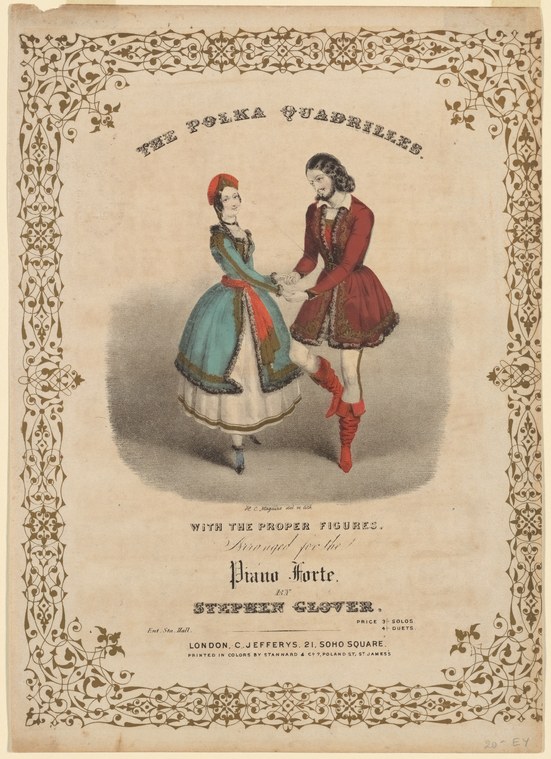
The polka was one of the first dances to be genuinely global and cross-class, and this image captures how it was sold and taught to ordinary people through affordable print media. For historians of social dance and 19th-century popular culture, such commercial prints are primary documents of how dances entered the public imagination and domestic practice.
What you are looking at
Two young women in early 19th-century dress perform a lively dance, captured in a hand-colored engraving framed by an ornate acanthus border. The figure on the left wears a turquoise skirt with red trim and a red-trimmed jacket, her hair crowned with a red feather; the figure on the right wears a deep red dress. Both are caught mid-movement in a social dance position, their bodies turned toward each other in animated interaction. The woman on the left appears to lead or initiate a stepping movement while the woman on the right responds, her skirt lifted to suggest active footwork. The composition is intimate but energetic, set against a neutral background that focuses all attention on the dancers' bodies and brilliant costumes. The print is published by C. Jeffereys of Soho Square, London, with a price notation visible at the bottom.
The dancing
Both dancers are upright and close together in a social hold characteristic of couple dances of the period. The woman on the left extends her weight forward in a stepping action, while her partner mirrors the energy. Their arm positions suggest a standard closed or semi-closed hold for the era—arms are visible and the bodies face each other at an angle that allows for turning. The lifted skirts and dynamic leg positions indicate rapid footwork typical of social dances of this period. Neither dancer is en pointe or in a balletic frame; the movement is social and popular rather than theatrical.
The dance depicted
This is a polka, as the title confirms. The polka emerged in Bohemia in the 1830s and became a craze across Europe and North America by the 1840s–50s, making it one of the dominant social dances of the mid-19th century. The image shows the characteristic lively, energetic stepping and close partnership of the polka, performed by dancers of modest social standing (suggested by the print's popular format and price). The rapid footwork implied by the lifted skirts and the animated body positions are consistent with the polka's quick tempo and bouncing action.
How it was made
This is a hand-colored lithographic or engraved print, produced for mass circulation as sheet music cover art—a common and affordable way for popular dances to reach a broad audience. The ornate decorative border and title lettering are typical of commercial music publishing in London's mid-19th century. The technique allowed rapid reproduction and colored by hand or in successive passes, making polka music accessible to amateur musicians and dancers in homes and dance halls. The price annotation suggests this was a commercial product sold to the general public, not a rare or elite object.
About this work
This is a commercial music cover or dance instruction print from the English music publisher C. Jeffereys, documenting the polka during its mid-19th-century heyday as a social dance craze. The image shows two figures in period dress performing the characteristic stepped, turning action of the dance in a cheerful and accessible style. The print is evidence of how popular dances were marketed, taught, and consumed by a broad audience through affordable printed images and musical scores. As a mass-produced object, it speaks to the polka's role as a democratic social phenomenon, available to classes beyond the nobility or trained performers.
How to look at it
Notice the lifted skirts and the stepping action of both dancers—this is the visual signature of the polka, a bouncing, rhythmic dance quite different from the gliding waltzes and smooth quadrilles of earlier decades. The closeness of the partnership and the face-to-face orientation between the dancers is also characteristic of the polka, which was danced by couples in quick, energetic contact. The bright colors and cheerful energy of the image reflect the dance's reputation for fun and modernity; this is not a solemn or formal dance. The print's commercial nature (visible price, publisher name, ornate but mass-market framing) is itself significant—it shows that by the 1840s–50s, popular dances were no longer confined to courtly or elite performance but were packaged and sold as consumer goods.
The period
The polka emerged in the 1830s in Bohemia and swept across Europe as a symbol of modernity and popular energy in the 1840s–50s. Unlike the formal court dances of earlier centuries (minuet, cotillion), the polka was fast, accessible, fun, and associated with urban middle and working-class life. It arrived in London around 1844–45 and became a genuine craze: polka melodies dominated drawing rooms and public dance halls, and polka imagery saturated sheet music covers, prints, and periodicals. This print dates to the height of polka mania, when music publishers like Jeffereys produced dozens of polka compositions annually and marketed them with bright, cheerful images. The ornate border and amateur painting style are typical of popular sheet music artwork of the period, designed to be visually appealing but inexpensive to produce.
Where it lives
The work is held in the New York Public Library's prints collection, catalogued as a dance-related image from the 19th century. It is a commercial music cover or dance instructional print produced for retail sale by a London publisher.
Dance in this work
Questions about this work
When was the polka invented, and where did it come from?
The polka originated in Bohemia (now the Czech Republic) in the 1830s. It quickly spread across Europe and became a major craze in the 1840s–50s, reaching London, Paris, Vienna, and America. It was one of the first truly popular, cross-class dances that appealed to urban middle and working-class people rather than being confined to nobility or trained performers.
Why are there so many polka prints from this period?
The polka was wildly fashionable, and music publishers capitalized on the craze by producing polka compositions constantly. Each piece needed a cover, and these covers became advertising for the dance itself. Bright, appealing images of dancers in period dress made polka music attractive to amateur musicians and dancers buying or requesting scores for home performance and public balls.
What does the footwork in a polka look like?
The polka involves quick, bouncing steps in a fast tempo (roughly 120 beats per minute), danced by couples in close contact. The lifted skirts in this image suggest the active, percussive footwork; the dancers step, hop, or spring in a rhythmic pattern while turning. It was much livelier and faster than the waltz or quadrille.
Who danced the polka?
Initially the polka was associated with working-class and urban culture, but it rapidly crossed class boundaries. By the mid-19th century, everyone—nobility, middle-class amateurs, and ordinary people—danced the polka in drawing rooms, dance halls, and public balls. This print, being a commercial product sold for a modest price, was aimed at amateur musicians and dancers in homes and public spaces.
More dance artwork





