49 works in this view — arrow keys or swipe to move between them.
Dance in Art
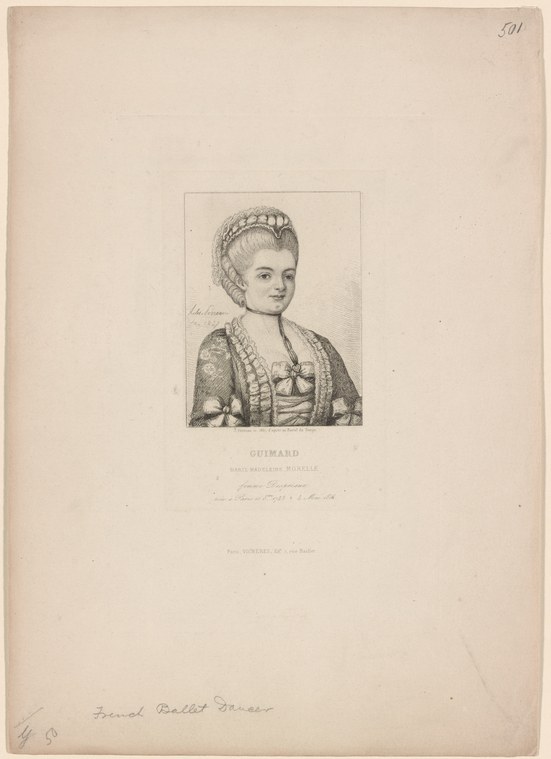
Guimard, Marie Madeleine Morelle, femme Despreaux, née à Paris 10 8bre 1743 [décédée] 4 mai 1816
Unknown artist
- Collection:
- Prints depicting dance
- Source:
- New York Public Library
- Rights:
- Public domain — free to use, share and adapt.
- Recorded as:
- Public Domain
Marie-Madeleine Guimard was among the most celebrated dancers of her generation, and this portrait is evidence of the celebrity culture that surrounded prominent performers in the eighteenth-century opera house. The existence and circulation of her engraved portrait demonstrates how dancers became objects of public interest and admiration in their own right, independent of any single performance or role.
What you are looking at
A three-quarter-length portrait engraving of a young woman identified as Marie-Madeleine Morelle (Guimard), shown against a plain background. She faces slightly left, her head tilted gently upward in a pose of elegant repose. She wears her pale hair arranged high on her head in an elaborate coiffure typical of the 1760s–70s, adorned with what appears to be a delicate headpiece or jeweled ornament. Her bodice is fitted and richly decorated with embroidery or brocade, worn over a shift with a decorative edging at the neckline. Over her shoulders falls a sheer, gauze-like wrap or fichu, rendered in fine cross-hatching to suggest transparency. The engraving technique allows for precise definition of her facial features and the intricate surface patterns of her costume, while her gaze and the slight turn of her head suggest a moment of genteel composure rather than active movement.
The dancing
A single standing figure, motionless and composed. Her weight appears evenly distributed, her posture upright and dignified. There is no indication of dance movement, active gesture, or dynamic pose; instead, the body is arranged in the formal, static mode of portraiture. The slight tilt of the head and the soft downward gaze create an air of refined gentility rather than performance or exertion. The arms are not visible, suggesting they may rest at her sides or be obscured by the angle and the engraving's frame.
The dance depicted
This is not a depiction of dance in motion. Marie-Madeleine Guimard (1743–1816) was a celebrated dancer of the Paris Opéra during the latter half of the eighteenth century, famous for her roles in ballet and opéra-comique, but this portrait presents her in her capacity as a person of fashion and social standing rather than as a performer. The image serves as a commemoration of her status and elegance off the stage. No dance vocabulary, pose, or spatial relationship supports identification of a particular dance style.
How it was made
This is an engraving, executed in line and cross-hatching on paper. The technique allows for fine detail in portraiture—the delicate rendering of her coiffure, the texture of her fabrics, and the definition of her facial features—and suggests circulation as a print, suitable for collectors, fans, or theatrical patrons. The precision and finish indicate a skilled practitioner and a work of some refinement. Engravings of this kind were relatively affordable and portable compared to paintings, making them important vehicles for the dissemination of celebrity portraits during the eighteenth century.
About this work
This is a formal portrait engraving of one of the Paris Opéra's most celebrated dancers, rendered not in a moment of performance but as a statement of her person, rank, and visual distinction. Guimard was renowned for her technique and her roles in the sophisticated ballet and comic opera productions of the late eighteenth century, yet this image presents her in civilian dress, composed and poised as a woman of refinement. It belongs in a gallery of dance in art as a document of how dancers were commemorated and circulated as public figures in their own era—not always through images of the dance itself, but through portraits that advertised their elegance, beauty, and social presence.
How to look at it
Approach this as a portrait rather than a dance image: note the formality of the pose, the precision of the engraving's line work, and the effort to convey both the texture of her costume and the refinement of her bearing. The slight upward tilt of her head and the softness of her expression create a moment of repose and dignity—qualities the engraver sought to associate with her name and reputation. The technical skill of the engraving itself—especially the rendering of transparent fabrics and ornamental detail—would have been an important part of its appeal to eighteenth-century viewers.
The artist
The engraver is not recorded in the catalogue. The quality and finish of the work suggest a professional practitioner working in the mid-to-late eighteenth century, likely in Paris or within the orbit of the Opéra. The inscription below the portrait (partially legible in the image) may carry a signature or attribution, but it is not fully resolved here.
The period
The 1760s–70s were a period of transformation in European dance and theatre. The Paris Opéra was at the height of its influence, and dancers—particularly women—became celebrated public figures. Jean-Georges Noverre's reforms of ballet, begun in the 1750s, were reshaping dance toward greater expressivity and naturalism, and the technical and artistic reputations of individual performers became matters of genuine cultural interest. The fashion evident in this portrait—the elaborate coiffure, the sheer wraps, the fitted bodice—reflects the aristocratic elegance that dominated elite visual culture of the period. Portraits of dancers and singers were popular commodities in this era, circulated as engravings to satisfy public curiosity about the celebrated performers of the stage.
Where it lives
The work is held in the New York Public Library's collection of prints depicting dance. It is catalogued by the subject's name and dates, with a handwritten inscription at the bottom of the page identifying her. The library's catalogue entry records it as an engraving (medium not explicitly stated in the original record but evident from inspection), with no artist attribution currently recorded.
Questions about this work
Was Marie-Madeleine Guimard a famous dancer?
Yes. Guimard (1743–1816) was one of the most celebrated performers of the Paris Opéra in the late eighteenth century, known for her technique, grace, and roles in both ballet and opéra-comique. She was also a socialite and a patron of the arts, and was widely admired in her time.
Why is this portrait in a collection of dance imagery if she is not dancing?
Portraits of dancers are important documents of how the dance profession and its celebrities were understood and circulated in their own era. This engraving shows that Guimard was celebrated not only for her performances, but as a public figure and woman of fashion—evidence of the cultural status dancers had achieved by the late eighteenth century.
Who made this engraving?
The artist is not currently recorded. The quality suggests a professional practitioner working in Paris in the mid-to-late eighteenth century, but the engraver's name is not yet identified from the available information.
More dance artwork





