49 works in this view — arrow keys or swipe to move between them.
Dance in Art
Jean Baptiste Blache
Unknown artist
- Collection:
- Prints depicting dance
- Source:
- New York Public Library
- Rights:
- Public domain — free to use, share and adapt.
- Recorded as:
- Public Domain
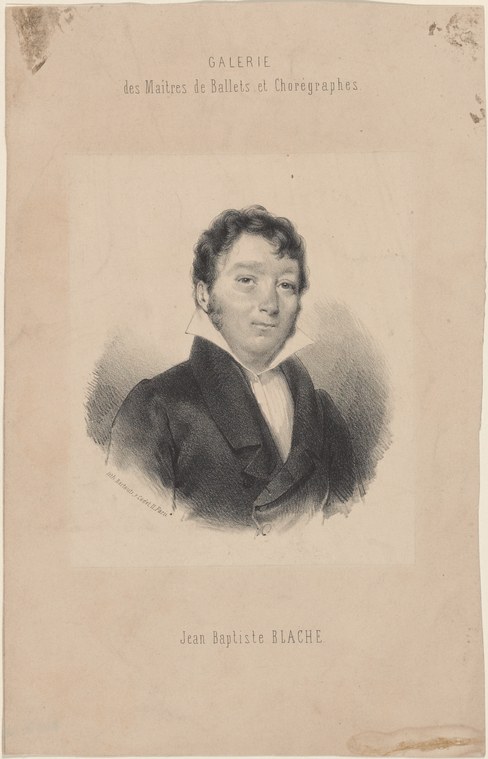
This portrait illustrates the celebrity status of choreographers and ballet masters during the early Romantic era, when their images were commercially reproduced and collected as part of a broader culture of theatrical fandom. As part of a titled series celebrating masters of ballet and choreography, it documents which figures were considered worthy of canonical status and how the profession chose to represent itself to the public.
What you are looking at
This is a head-and-shoulders portrait of a young man in early 19th-century dress, rendered in lithograph or engraving. He wears a dark coat with a white shirt front visible beneath, and is turned slightly to his left, his gaze directed toward the viewer with a composed, professional expression. The figure is set against a plain cream background that offers no setting or context—a convention of theatrical portraiture from this era. The artist has used soft shading to model the face and hair with care, capturing the texture of his dark, slightly curling hair and the definition of his facial features. There is no indication of movement, gesture, or dance pose; this is a formal portrait of a performer, not a depiction of choreography or performance action.
The dancing
The subject is seated or stationary, turned at three-quarter angle to the viewer's right. His shoulders are relaxed within his coat; his arms are not visible. His head is held upright and steady. There is no bodily tension, no arabesque, port de bras, or any posture suggesting active dance. The stillness and formality are deliberate—this is portraiture, not action.
The dance depicted
The sitter is named Jean Baptiste Blache, a figure associated with early 19th-century ballet and choreography in France and beyond. However, this image shows him at rest, not dancing. Without further documentary context, it is not possible to identify his specific training method, style affiliation, or the dances he performed from the portrait alone. The work is a record of his identity and professional status rather than a record of his art.
How it was made
This appears to be a lithograph or engraved print, executed with considerable skill in tonal shading and linear detail. The soft gradations of grey and black, the delicate handling of the hair and facial contours, and the crisp baseline and text below the image are consistent with lithographic printing of the 1820s–1840s. The technique allowed for rapid reproduction and distribution—such prints were standard publicity tools for theatrical talent and were collected in series, as the header 'GALERIE des Maîtres de Ballets et Chorégraphes' (Gallery of Ballet Masters and Choreographers) indicates. The portrait's semi-formal size and finish suggest it was marketed to theatregoers and professionals.
About this work
This is a professional theatrical portrait of Jean Baptiste Blache, a prominent figure in early 19th-century French ballet and choreography. It belongs to a published series celebrating the master teachers and choreographers of the era, and serves as a record of his appearance and social standing rather than as a document of his choreographic or performative work. The image is valuable primarily as evidence of how the ballet profession was commemorated and circulated during the Romantic period—through collected portrait engravings that were bought, displayed, and preserved by audiences and institutions.
How to look at it
Look at this as a document of professional identity rather than artistic practice. Note the formal, composed bearing and the commercial finish of the print—the careful lettering below, the consistent frame, the studio quality of the execution. This is how the early 19th-century dance profession marketed itself: through the faces and names of its most celebrated figures, presented without action or context, relying on the viewer's prior knowledge of Blache's fame. The portrait insists that the sitter's identity and reputation speak for themselves.
The artist
The artist is not recorded in the catalogue. The execution and style are consistent with French lithographic portraiture of the 1820s–1840s, a period when multiple commercial studios produced theatrical celebrity portraits in series. The work's quality and care suggest a trained lithographer working within an established commercial tradition.
The period
This portrait dates to a period of major transformation in ballet. The 1820s–1830s saw the crystallization of Romantic ballet aesthetics—the elevation of the female dancer, the emphasis on pointe work and ethereal movement, and the consolidation of the Paris Opéra as the artistic center of European dance. Jean Baptiste Blache was active during the transition from 18th-century court ballet and pantomime toward the codified, professionalized ballet of the 19th century. Choreographers and ballet masters of his generation were becoming celebrities, their methods and innovations discussed and celebrated in print, and their likenesses distributed as collectible prints—a phenomenon closely tied to the rise of Romantic-era print culture and theatrical publicity.
Where it lives
This print is held in the New York Public Library's collection of prints depicting dance. It is part of a titled series, 'Galerie des Maîtres de Ballets et Chorégraphes' (Gallery of Ballet Masters and Choreographers), suggesting it was one of a set sold or distributed together.
Questions about this work
Who was Jean Baptiste Blache?
A choreographer and ballet master active in the early 19th century, associated with French ballet during the Romantic era. Without additional research beyond this image, his specific accomplishments, training, and repertoire cannot be detailed here. Historical records and dance archives hold fuller documentation of his career and influence.
Why is there no dance pose in this portrait?
This is a formal portrait of a professional, not a depiction of performance. It follows the convention of theatrical celebrity portraiture—the subject is presented at rest, in street dress, allowing the viewer to recognize and identify him by face. Action poses and costumes were reserved for scenes showing performance itself.
What does 'Galerie des Maîtres de Ballets et Chorégraphes' mean?
It translates as 'Gallery of Ballet Masters and Choreographers.' It indicates this portrait was part of a collected series celebrating the leading figures in French ballet and dance education, sold or distributed as a commercial set during the early 19th century.
What printmaking technique was used?
The record does not specify, but the image is consistent with lithography or fine line engraving of the 1820s–1840s. Both techniques were used for theatrical portraiture and allowed prints to be made in quantity and sold to the public.
More dance artwork





