49 works in this view — arrow keys or swipe to move between them.
Dance in Art
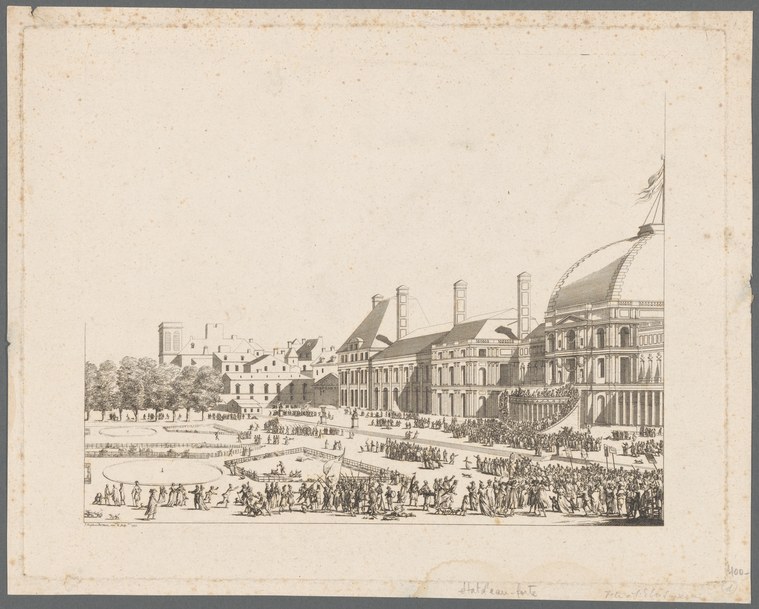
Fête à l'Etre suprême aux Tuileries, 8 juin 1794
Unknown artist
- Collection:
- Prints depicting dance
- Source:
- New York Public Library
- Rights:
- Public domain — free to use, share and adapt.
- Recorded as:
- Public Domain
This image is crucial for understanding the political aesthetics of the French Revolution and the role of choreographed or coordinated public assembly in constructing revolutionary community. It shows how dance, spectacle, and civic ritual became tools of revolutionary ideology—the organization of bodies in space as political statement. For scholars of dance history, it demonstrates that the boundary between dance and non-dance ceremonial movement is historically contingent; what counts as dance depends on context, intention, and the gaze of the recorder.
What you are looking at
This engraving depicts a vast civic gathering at the Tuileries Palace during the French Revolution, on the occasion of the Fête à l'Être Suprême (Festival of the Supreme Being) on 8 June 1794. The palace façade dominates the right side of the composition, its neoclassical architecture crowned with a flag and domed structure. The courtyard and surrounding ground stretch away to the left in steep perspective, filled with hundreds of figures arranged in loose formations across the space. The scale is monumental: the palace windows are rendered small by distance, emphasizing the vast crowd. The engraver has rendered the scene in fine parallel lines characteristic of the period's print technique, creating a uniform grey tone across the whole. Figures in the crowd are suggested rather than detailed—they appear as small marks in clusters and lines, many in profile or silhouette. The light is even and cool, casting no shadows; the mood is formal and civic rather than intimate.
The dancing
The figures are too small and distant for precise bodily detail, but their postures suggest a ceremonial gathering rather than active dance. Some appear to stand in lines or clusters; a few in the foreground show raised arms or animated stances. The composition suggests a crowd witnessing an event or participating in a formal procession, with individuals oriented toward the palace or toward a shared focal point. No couple holds or partner positions are evident. The scale and perspective render individual footwork or detailed movement impossible to assess; the viewer is meant to apprehend the civic body as a whole rather than its constituent dancers.
The dance depicted
This image documents a Revolutionary civic festival rather than ballroom or theatrical dance. The Fête à l'Être Suprême was a large-scale public ceremony staged by Robespierre's regime to promote the revolutionary cult of reason and virtue; it involved processions, speeches, and symbolic gestures rather than choreographed dance in the modern sense. However, such festivals often incorporated processional movement, possibly singing, and coordinated crowd action that blurred the boundary between ritual and dance. The image itself does not show recognizable dance steps or formations. It is instead a historical document of a moment when revolutionary politics and popular assembly created forms of collective movement.
How it was made
This is an engraving, identifiable from its fine parallel hatching (cross-hatching and directional lines) throughout, the characteristic technique for creating tone and form in intaglio printmaking. Engraving allowed wide distribution and was the standard medium for documenting important events in the 18th and early 19th centuries. The fine, even line work suggests a skilled practitioner and careful execution, and the result would have been reproducible in multiple impressions. The technique was labour-intensive but economical at scale—ideal for a print commemorating a major state event. The image likely circulated among educated audiences as a record of the festival, combining documentary and propagandistic intent.
About this work
This engraving documents the Fête à l'Être Suprême at the Tuileries Palace on 8 June 1794, a major public ceremony of the French Revolution. While not a depiction of ballroom or theatrical dance, it records a moment of civic assembly and processional movement during an ideologically charged revolutionary festival. The work belongs in a gallery of dance in art because it captures a historical moment when political ritual, public spectacle, and collective bodily movement converged—a precedent for the twentieth-century mass gatherings and choreographed civic events that would follow. The scale and perspective emphasize the crowd as a unified civic body, a visual register of revolutionary utopian ideals made manifest in physical assembly.
How to look at it
Attend to the composition's use of perspective: the palace is rendered monumental and distant, the crowd fills the entire foreground and middle ground, emphasizing the scale of civic assembly. The engraver has chosen a vantage point that presents the crowd as a collective body rather than a collection of individuals—no face is clearly visible, no person dominates. Notice how the crowd appears organized but not rigidly coordinated; the formations suggest processional movement or clustering around the palace, a kind of dispersed energy rather than tight choreography. The print's technique—fine parallel lines creating uniform tone—was chosen for its capacity to render large crowds at scale and to circulate as a documentary record to wide audiences. The image's power lies in its assertion that this vast assembly itself is the spectacle, the message, the revolutionary statement.
The period
The Fête à l'Être Suprême was staged on 8 June 1794 (20 Prairial Year II in the Revolutionary calendar) at the height of Robespierre's authority during the Reign of Terror. The festival was designed to promote the revolutionary cult of reason and virtue and to consolidate popular support for the regime through grand public spectacle. Revolutionary festivals of this period deliberately drew on traditions of court spectacle and civic pageantry while attempting to remake them as expressions of popular sovereignty rather than royal authority. Engravings documenting such events served as official records and propaganda, circulating to audiences across France and beyond. This image is one of several documentary prints of the 1794 festival, part of a broader revolutionary project of staging politics as visual and bodily event.
Where it lives
This engraving is held in the New York Public Library's collection of prints depicting dance, catalogued under the holding 'Prints depicting dance.' It is part of a broader documentary record of the French Revolution and its civic festivals, though the specific engraver and publication details are not recorded in the catalogue.
Dance in this work
Questions about this work
Was the Fête à l'Être Suprême an actual dance event?
No—it was a civic ceremony and political rally staged by Robespierre's regime to promote revolutionary ideology. However, it involved processional movement, gathering, and potentially singing or coordinated action by the crowd, blurring boundaries between ritual, spectacle, and dance. Revolutionary festivals often incorporated elements we might now recognize as choreography, even if they were not called dance at the time.
Why is this engraving in a dance collection?
Because it documents a historical moment when collective bodily movement, public assembly, and political ritual merged—a precedent for twentieth-century mass spectacles and civic choreography. It shows that dance history includes forms beyond ballroom and theatrical performance, including the political aesthetics of organized crowds and processional movement.
Who was the engraver?
The catalogue record does not identify the artist. Engravings of major Revolutionary events were often produced by multiple printmakers and published in series; attribution would require further research.
More dance artwork





