49 works in this view — arrow keys or swipe to move between them.
Dance in Art
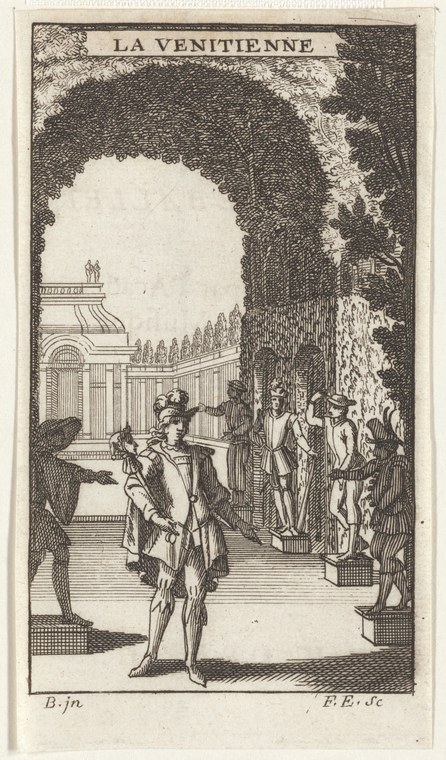
La vénitienne
Unknown artist
- Collection:
- Prints depicting dance
- Source:
- New York Public Library
- Rights:
- Public domain — free to use, share and adapt.
- Recorded as:
- Public Domain
For dance historians, this print documents the costume vocabulary and masquerade tradition that shaped 18th-century theatrical spectacle and informed later Romantic ballet. The architectural framing and presentational pose reveal how costume was marketed and consumed as spectacle distinct from but adjacent to dance performance.
What you are looking at
This engraving depicts a figure in 18th-century Venetian masked costume in the foreground, standing in a theatrical pose within an ornate architectural setting. A massive rusticated arch frames the composition, its deep shadow contrasting dramatically with the lit courtyard beyond. Through the arch, a colonnade recedes into space, with small figures in contemporary dress arranged along the colonnade. The architecture suggests a palazzo or grand public space. The light is theatrical and carefully controlled, with the arch creating a proscenium-like effect that frames both the costumed foreground figure and the miniature scene beyond.
The dancing
The foreground figure wears the voluminous breeches, stockings, jacket, and cape characteristic of Venetian carnival dress, with a distinctive mask. The pose is sprightly and presented to the viewer—one leg slightly bent, the body tilted in a relaxed but performative stance. The figure does not appear to be executing a specific dance step but rather displaying the costume itself in a presentational manner typical of theatrical prints. The small figures glimpsed in the distant colonnade appear to be standing or walking rather than dancing, rendered too small to assess their movement.
The dance depicted
This is not primarily a dance scene but a costume print commemorating Venetian carnival dress and masquerade culture. The work documents the vénitienne—the fashionable Venetian masked costume adopted across Europe in the 18th century—rather than depicting an actual choreographed dance. The figure's pose is display rather than motion, the kind adopted in costume albums and theatrical documentation of the period. The work belongs to a tradition of engraved costume prints that circulated among theatre practitioners and society rather than to a tradition of documenting actual dance practice.
How it was made
This is an engraving, identified by the precise parallel hatching, crisp line work, and fine detail characteristic of the medium. The monochromatic print on laid paper allowed for easy reproduction and wide circulation. Engraving was the standard medium for publishing costume designs, theatre documentation, and prints for sale to a educated public or theatrical practitioners. The technical sophistication and tonal subtlety—particularly in the rendering of shadow within the arch and the distant colonnade—suggests professional production, likely for publication as a single sheet or as part of a series.
About this work
This engraved costume print documents Venetian carnival dress of the 18th century rather than depicting choreographed dance. It presents a masked figure in the distinctive vénitienne costume—breeches, stockings, short jacket, and cape—in a presentational pose within a grand architectural setting. The work is part of a European tradition of theatrical costume documentation that circulated among performers, designers, and society patrons. It records not a movement vocabulary but a social costume and the masquerade culture from which European Romantic theatre drew much of its visual language and fantasy.
How to look at it
Attend to the architectural framing: the engraver has used the massive arch as a stage proscenium, placing the costumed figure as though on display before an audience. The contrast between the sharp detail of the foreground costume and the diminished scale of the background figures creates a hierarchy typical of costume prints—the dress itself, not narrative or movement, is the subject. Notice how the figure's pose is relaxed and presentational rather than caught mid-gesture; this is display of a garment and a social role, not documentation of motion.
The period
Venetian carnival and masquerade culture exercised enormous influence on 18th-century European theatre and visual culture. The vénitienne costume was adopted across courts and public theatres as a marker of sophistication, exoticism, and theatrical modernity. Costume prints like this were produced for commercial sale and theatrical reference, part of an expanding market for images of fashion, theatre, and spectacle. The tradition of engraved costume documentation stretched back through the 17th century and would continue into the 19th, supporting a theatrical and social culture that prized display and transformation.
Where it lives
The work comes from the New York Public Library's collection of prints depicting dance, which houses an archive of European theatrical imagery spanning several centuries. The cataloguing as a dance-related print reflects its place within the archive rather than a primary focus on choreography; it is a theatrical or costume document.
Questions about this work
Is this an actual dance being performed?
No. This is a costume print documenting Venetian carnival dress. The figure is posed for display rather than caught in mid-movement or executing a step.
What is the vénitienne?
A fashionable masked costume adopted from Venetian carnival culture by courts and theatres across Europe in the 18th century. It became a symbol of theatrical sophistication and was widely imitated, copied in costume albums, and referenced in theatre design.
Why is there an architectural arch framing the figure?
The arch functions as a theatrical proscenium, a visual convention of costume prints that positioned the wearer as a performer on stage. This framing was standard in theatrical documentation of the period.
Who made this print, and when?
The artist and date are not recorded in the catalogue. Based on style and technique, it is an 18th-century engraving, likely produced for publication as a single sheet or as part of a costume series, but attribution and dating cannot be confirmed from the image alone.
More dance artwork





