49 works in this view — arrow keys or swipe to move between them.
Dance in Art
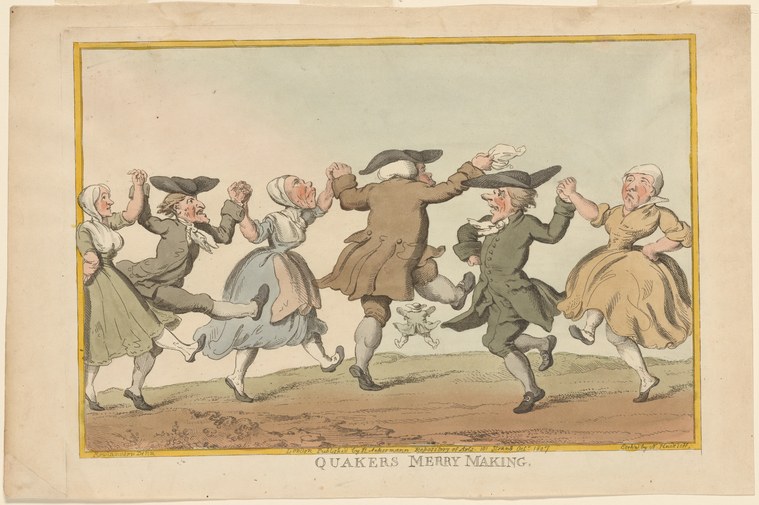
Quakers merry making
Unknown artist
- Collection:
- Prints depicting dance
- Source:
- New York Public Library
- Rights:
- Public domain — free to use, share and adapt.
- Recorded as:
- Public Domain
This work is valuable as evidence of how eighteenth-century satirists understood and mocked the body in unrefined movement. It shows us not a dance that people actually danced, but a caricature of movement itself—a visual statement about class, restraint, and the loss of decorum in revelry. For dancers and historians, it offers insight into period attitudes toward bodily control and the comedy of abandon.
What you are looking at
Seven figures in eighteenth-century dress dance vigorously in a line across an open ground, their bodies in exuberant motion. The scene reads left to right: a woman in a white bonnet and pale dress kicks one leg high; next to her a shorter figure in a brown coat and tricorn hat springs upward with arms raised; a woman in a pink dress and white cap leans back mid-leap; a central male dancer in a tan coat spreads his arms wide in expansive gesture; to his right a woman in a green jacket and bonnet moves with raised arms; another woman in a pale dress; and finally a portly figure in tan clothing on the far right. All figures wear the simple, practical dress of working-class people—not court finery. The ground is bare and sandy; the sky is light and empty. The composition captures not a formal, structured dance but a moment of joyful, unrestrained movement—bodies flung about, legs kicking, heads thrown back. The print is hand-colored in greens, pinks, tans, and earth tones, and the title below reads 'QUAKERS MERRY MAKING.'
The dancing
The seven dancers show no formal hold or closed frame; instead, each body moves independently in exuberant, almost anarchic gesture. Legs are high and straight, torsos twist, arms fly upward and outward. The movements are percussive and weight-driven rather than flowing—this is jumping, kicking, and swinging rather than gliding. Several dancers appear to be airborne or caught mid-spring. The poses are asymmetrical and varied; no two figures repeat the same gesture. There is no line dance or formation apparent; the dancers move as individuals seized by the same impulse.
The dance depicted
This is not a recognizable dance form but rather a caricatural image of social or festive movement, likely satirical in intent. The inscription 'Quakers merry making' suggests the scene is intended as a jesting comment on Quaker (Religious Society of Friends) restraint and sobriety—the implicit joke being that even the famously austere Quakers, when abandoned to merriment, become wild and undignified. The figures dance not with the control and grace of fashionable society dance, but with the ungoverned exuberance of village or working-class revelry. This is not ballet or courtly measure, nor is it any named social dance; it is rather a satirical snapshot of unrefined joy.
How it was made
The work is a hand-colored engraving or etching, evident from the fine linear work defining the figures and the characteristic plate-mark boundary. The coloring is applied in translucent washes that suggest watercolor or hand-applied pigment over the printed line. This technique—engraving combined with hand-coloring—was the standard method for circulating topical prints, satirical images, and social commentary in the eighteenth century. Such prints were inexpensive and widely distributed, reaching a popular audience beyond the wealthy; this work's subject matter (social satire of a religious group) and execution indicate it was made for that market. The print's accessibility and humor made it a form of social criticism as much as artistic statement.
About this work
This is an eighteenth-century hand-colored satirical engraving depicting a scene of unrestrained festive dancing, titled 'Quakers merry making.' The image captures seven figures in vigorous, individual motion—kicking, jumping, and swinging their limbs with no formal structure or refined technique. The work uses the incongruity between Quaker doctrine (which emphasized plainness and restraint) and the visible wild abandon of the dancers to create a social commentary; the message is not that Quakers actually danced this way, but rather that unchecked merriment would reduce even the most sober to undignified motion. The print belongs in a dance gallery because it documents how unstructured, joyful movement was understood and represented in visual culture of the period—and because its satire tells us something about what counted as 'refined' or 'acceptable' dance in contrast.
How to look at it
Attend to the asymmetry and wildness of the pose—no two bodies mirror each other, and several dancers appear caught mid-leap with no apparent control of their landing. Notice the raised legs, flung arms, and twisted torsos, which mark this as movement without technique or formal structure. The artist has chosen the moment of maximum abandon, not the composed moment; the bodies are in the air or off-balance, never planted or stable. This compositional choice—freezing the moment of greatest exuberance and loss of control—is the key to the print's satirical message: it shows us what happens when restraint is abandoned.
The period
The print dates from the eighteenth century, when hand-colored satirical engravings were a major form of popular visual culture and social commentary in Britain. This was an era when dance was sharply divided by class: aristocratic and gentry circles performed formal dances (country dances, cotillions, minuets) governed by strict rules of posture and deportment, while working-class and rural people engaged in less regulated festive movement. Quakers, as members of a dissenting religious group known for rejecting frivolity and ostentatious dress, were frequent targets of satirical imagery. The image's humor depends on the viewer's familiarity with Quaker plain dress and sobriety, and on the assumption that the reader would recognize the depicted movement as vulgar or comic precisely because it violates the restraint expected of 'civilized' people.
Where it lives
The work is held in the New York Public Library's collection of 'Prints depicting dance,' a curated assemblage of visual materials documenting dance in historical and contemporary representation. This locates it as part of a scholarly project to document dance across visual culture.
Dance in this work
Questions about this work
Did Quakers actually dance like this?
No. Quakers were known for their rejection of frivolous pastimes, including ornamental dance. The image is satirical—a mockery of Quaker restraint by showing the imagined extreme of its opposite. The joke works precisely because Quakers did not dance this way; the point is the incongruity.
What dance form is this?
This is not a named dance form. It is a caricatural image of unstructured festive movement, designed to look ungoverned and comic. The exuberant, individual gestures and lack of formal frame distinguish it from the courtly and country dances that dominated polite society at the time.
Why is this in a dance collection?
Satirical prints like this one document not only how people actually danced, but how movement was understood, coded, and judged in a given period. This image tells us what counted as refined versus vulgar, as controlled versus abandoned—categories that shaped the development of dance technique and social practice.
What does the hand-coloring tell us?
Hand-colored engravings were the cheapest and most widely circulated form of visual media in the eighteenth century. This technique indicates the print was made for a mass audience, not wealthy collectors. It is a work of popular satire, designed to be bought, viewed, discussed, and passed around.
More dance artwork





