49 works in this view — arrow keys or swipe to move between them.
Dance in Art
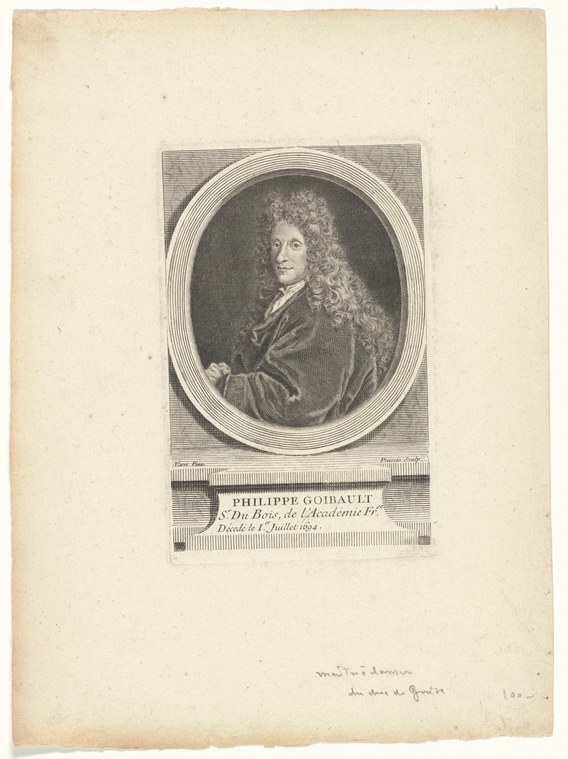
Philippe Goibault Sr. Du Bois, de l'Académie Fr[ançai]se: Décedé le 1er Juillet 1694
Unknown artist
- Collection:
- Prints depicting dance
- Source:
- New York Public Library
- Rights:
- Public domain — free to use, share and adapt.
- Recorded as:
- Public Domain
This work is a documentary artifact of French academic life in the late 17th century, preserving the appearance and name of a member of the Académie Française at a precise historical moment. It demonstrates the conventions of formal portraiture and memorial engraving in the period when French dance was becoming a codified and prestigious art form under royal patronage.
What you are looking at
A three-quarter-length portrait of a man in elegant late 17th-century dress, shown against a dark background and framed by a double-lined oval border. He wears a coat of rich fabric with ornate embroidery or decoration, a white cravat at the neck, and his hair falls in long, abundant curls past his shoulders—the fashionable coiffure of the period. His right hand is raised slightly, gesturing outward with a graceful, composed pose. The engraving renders fine detail in the fabric textures and the careful modulation of light across his face and clothing. The inscription below identifies him as Philippe Goibault, Sr. du Bois, and records his death on 1 July 1694. The formal oval frame and restrained background suggest a memorial or official portrait, the kind circulated among the French academy and cultivated circles.
The dancing
A single male figure, standing three-quarter length and turned slightly to the viewer's right. His right arm is extended with the hand open and fingers relaxed, a gesture of address or presentation. His left arm remains at his side. The posture is upright and dignified, with the weight evenly distributed. The pose suggests a man of rank and learning—the gesture is refined rather than dynamic, more suited to conversation or formal presentation than to active movement.
The dance depicted
This is not a dance image. It is a formal portrait of an individual identified as a member of the Académie Française. While the figure adopts an elegant and composed stance typical of aristocratic portraiture of the period, there is no evidence of choreography, dance movement, or theatrical context. The raised hand and upright posture are conventions of formal French portrait style, not indications of dance instruction or performance.
How it was made
This is an engraving, identifiable from the fine parallel hatching lines used to render tone and shadow, the crisp contour lines, and the overall linear character typical of burin engraving. The technique was ideal for reproducing formal portraits in multiple copies for circulation among academy members and the educated elite. The double-line oval frame is a standard feature of such memorial and official engravings, lending gravitas and formality. The work survives as a print, likely one of many impressions made from the plate.
About this work
This engraved portrait documents Philippe Goibault Sr., du Bois, a member of the French Academy at the time of his death in 1694. It is the kind of commemorative print that circulated among the French intellectual and artistic establishment, preserving the likeness of notable figures through the medium of engraving. While the collection is titled 'Prints depicting dance,' this particular work is a formal portrait with no dance content; it is included, presumably, because it was found among materials related to dance or because its context once involved such imagery.
How to look at it
Attend to the precision of the engraving technique—the fine parallel lines that model the face and fabrics, and the control required to render the soft fall of the curled hair and the texture of expensive cloth. The double-line oval frame is characteristic of formal French academic portraiture. The pose is studied and deliberate, frozen in a moment of composed address rather than caught in movement or action. The raised hand and direct gaze are conventions designed to convey authority and cultivation.
The artist
The artist is unrecorded in the catalogue. The engraving is competently executed in the standard French style of formal portraiture of the 1690s, suggesting a professional workshop or established engraver working for the academy or for private patrons. The quality and technique are consistent with official commemorative prints of the period.
The period
In 1694, French court dance and ballet were at a sophisticated and documented stage of development under Louis XIV's patronage. The Académie Royale de Danse had been established in 1661 to codify and preserve dance technique. Goibault's membership in the Académie Française (the literary academy, not the dance academy) places him among the educated elite of Paris. Formal engraved portraiture was the standard way to immortalize such figures and circulate their likenesses among peers and institutions.
Where it lives
This print is held in the New York Public Library's collection of prints depicting dance. It was likely acquired or catalogued as part of a group of 17th-century French prints related to the visual culture of dance, even though this particular example is a pure portrait with no dance content.
Questions about this work
Why is a portrait of an academy member in a dance collection?
The print was likely grouped with other French 17th-century cultural prints during collection or cataloguing, or it may have belonged to a dancer or dance historian's archive. Its inclusion reflects the historical breadth of materials that gather around the study of dance, though the work itself depicts a person rather than an act of dancing.
What does the inscription mean?
It reads 'Philippe Goibault, Sr. du Bois, of the Academy [Française]; Died 1 July 1694.' This is a memorial inscription typical of prints issued after the death of a notable figure, recording his name, title, and the date of his passing for distribution among colleagues and archives.
How was this made?
It is an engraving made with a burin (engraving tool) on a metal plate, most likely copper. The image was then printed by inking the plate and pressing it against paper. This technique allowed many identical copies to be produced and distributed.
More dance artwork





