49 works in this view — arrow keys or swipe to move between them.
Dance in Art
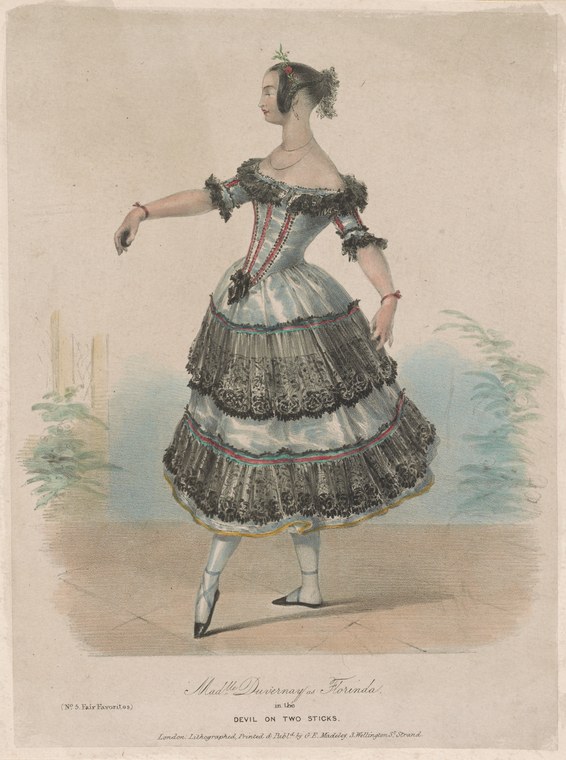
Madlle. Duvernay as Florinda in the Devil on two sticks
Unknown artist
- Collection:
- Prints depicting dance
- Source:
- New York Public Library
- Rights:
- Public domain — free to use, share and adapt.
- Recorded as:
- Public Domain
This print preserves the image of a named female performer from the period when women dancers were beginning to dominate European stages, yet her identity is now obscure. It shows how theatrical costume—especially the elaborate skirt with its tiers of lace and the fashionable silhouette—functioned as a sign of femininity, elegance, and theatrical glamour. It is also evidence of the commercial infrastructure of 19th-century theatre: the rapid production and sale of portraits that turned stage performers into commodities and celebrities.
What you are looking at
A young woman in theatrical costume stands in a posed attitude against a faintly sketched architectural backdrop suggesting a garden or terrace. She wears a fashionable off-shoulder dress with a fitted bodice in grey-blue silk, corseted with a red-and-white striped waistband, and an elaborate skirt composed of two tiers of black lace ruffles separated by pale silk bands. A black lace shawl or fichu drapes from her shoulders and upper arms. Her dark hair is pinned up with a decorative comb or tiara. She stands in a relaxed three-quarter stance, her left arm raised with hand extended in an elegant gesture, her right arm held at her side with wrist bent. The figure is rendered in hand-coloured lithographic print, with delicate watercolour washes establishing the pale background and the sculptural quality of her dress. The inscription below identifies her as "Madlle. Duvernay as Florinda in the Devil on two sticks."
The dancing
A single female figure stands upright in a balanced pose with weight on both feet, suggesting either a moment of repose or the beginning of movement. Her left arm rises to approximately shoulder height with an open hand, suggesting a gesture of acknowledgment or offer; her right arm extends slightly forward at waist level. The upper body remains relatively still and frontal, while the lower body is positioned in a subtle three-quarter turn. Her posture is poised and controlled rather than dynamically caught mid-leap, suggesting either a formal greeting, a prepared entry, or a moment of theatrical presentation rather than active choreographic motion.
The dance depicted
This is a theatrical portrait of a named performer, not a representation of choreography in motion. The work documents Mademoiselle Duvernay in the role of Florinda from the comic opera *Le Diable boiteux* (The Devil on Two Sticks), a work that relied on theatrical spectacle and song rather than dance as its primary medium. The costume and posed moment suggest the conventions of early 19th-century theatrical portraiture—a single figure in character, staged for recognition and circulation as a souvenir of a popular performance. No specific dance style is depicted; rather, this is a portrait of a performer in costume.
How it was made
This is a hand-coloured lithographic print, a technology that allowed rapid production and wide distribution of theatrical portraits in the early 19th century. The image was printed in London, as stated in the inscription, making this a commercial theatrical souvenir rather than a fine art original. The soft tonal ranges and delicate colouring are characteristic of the medium, allowing both fine detail in the costume and atmospheric suggestion of the setting. Lithography enabled theatrical companies and publishers to capitalize on the fame of performers by producing affordable prints for sale to the theatre-going public.
About this work
This is a hand-coloured lithographic portrait of an early 19th-century theatrical performer in costume, not a depiction of dance itself. Mademoiselle Duvernay appears as Florinda, a character from *Le Diable boiteux*, a popular comic operatic work. She is shown in a posed, frontal attitude typical of theatrical portraiture of the period—elegant, stilled, and designed for recognition and circulation as a souvenir of performance. The work belongs in a gallery of dance in art as evidence of the theatrical world within which dance existed: the costume culture, the performer economy, the intersection of opera and dance, and the methods by which performers became famous and recognizable to audiences. It is a document of how a dancing body was packaged, displayed, and remembered in the early 19th century.
How to look at it
Attend to the costume rather than the body: the elaborate engineering of the skirt, the visible waistband that divides and shapes the torso, the lace ruffles that speak to the labour of costume-making and the economics of theatrical glamour. Notice the arm position—raised but not dramatically so, a gesture of aristocratic ease rather than virtuosity. The pose itself is formulaic: a three-quarter turn, a lifted arm, the body presented as an object of visual pleasure rather than as a virtuoso dancer in action. This is a theatrical *portrait* using the conventions of a formal fashion plate.
The artist
The print is attributed to "J. Tilt & Mansell" as publishers (visible in the inscription), based in London. The artist is not recorded. This suggests the work was produced by a commercial lithographic printing house specializing in theatrical portraiture, a standard practice in the 1830s-1840s. Prints of named performers were a major business, and individual artists' identities were often submerged in the publisher's name.
The period
This print dates from the Romantic era of European ballet and theatre, when the female dancer in spectacular costume became the central attraction of operatic and theatrical spectacle. *Le Diable boiteux*, based on Alain-René Lesage's 1707 novel, existed in multiple operatic versions; the most famous was Auber's 1836 opera. The image documents the conventions of early 19th-century theatrical dress: the off-shoulder neckline derived from Romantic ballet costume, the corseted silhouette, the elaborate lace skirts that allowed for visible legwork while maintaining feminine propriety. Women performers of this era were often known by their stage names alone; Duvernay's full identity is now lost to most records.
Where it lives
The print is held by the New York Public Library in the collection of Prints depicting dance, catalogued as part of the Library's performing arts holdings. It is a commercial theatrical print produced and sold in London in the early 19th century, part of the mass of ephemeral memorabilia that circulated after performances.
Questions about this work
Who was Mademoiselle Duvernay?
She was a theatrical performer active in the early 19th century, known for roles in operas and theatrical productions in London and Europe. Beyond this print and the catalogue record, little is known of her career or biographical details. She represents a category of performer—female stage dancers and singers—who achieved fame and circulation through such prints but whose names have often been lost to history except through archival records like this one.
What is 'The Devil on Two Sticks'?
*Le Diable boiteux* is a French comic novel by Alain-René Lesage (1707) that was adapted into multiple theatrical and operatic versions throughout the 18th and 19th centuries. The most famous operatic version was Auber's 1836 opera. The work was a vehicle for theatrical spectacle and comedy rather than for virtuosic dance, though dancers and singers often performed in it.
Is this woman a dancer or a singer?
The print does not specify. In the early 19th century, theatrical performers often did both: they appeared in operas, comedies, and spectacular productions that incorporated singing, acting, and dancing. A performer known as a 'danseuse' might have sung; a soprano might have danced. The costume and the context suggest a theatrical rather than a concert performance, but the specific designation of Duvernay's role is lost.
Why is she posed this way?
This is a theatrical portrait pose, derived from fashion-plate conventions. The three-quarter stance, the raised arm, the frontal orientation, and the carefully arranged costume are all designed to display the performer and her clothing to best advantage for a standing portrait. It is not meant to represent active choreography but rather a posed 'character' presentation—the way she would be recognized and remembered.
More dance artwork





