49 works in this view — arrow keys or swipe to move between them.
Dance in Art
The polka on 19th-century music covers
Unknown artist
- Collection:
- Prints depicting dance
- Source:
- New York Public Library
- Rights:
- Public domain — free to use, share and adapt.
- Recorded as:
- Public Domain
This image is a primary historical document of how the polka was actually taught and understood in the nineteenth century: the hold, the frame, the gender roles, and the spatial relationship between dancers. For historians and dancers, it offers proof of a particular choreographic tradition at a moment when the polka was dominating European and American ballrooms, and it exemplifies the remarkable output of commercial dance-instruction graphics that shaped how millions of people learned to move together.
What you are looking at
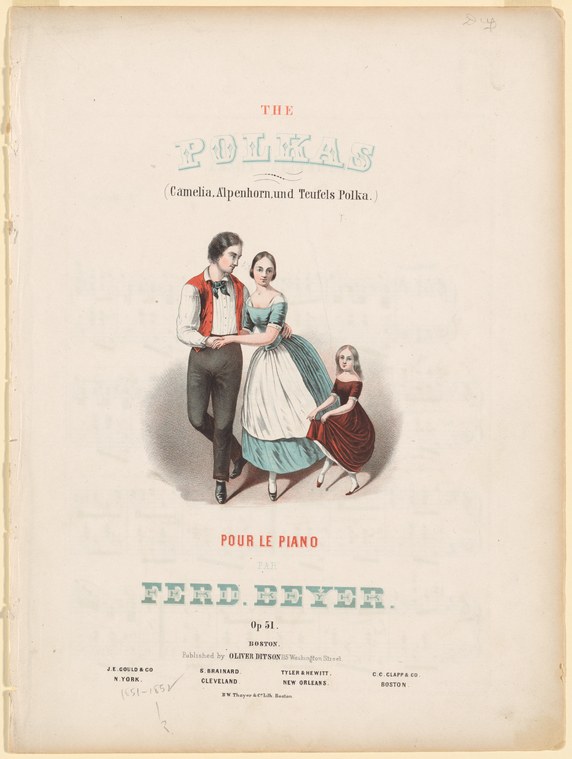
A hand-colored engraving showing three figures in Central European folk dress, evidently demonstrating or dancing the polka. A man in dark trousers and a red-trimmed vest stands at the center-left, his body angled in profile, one arm extended toward a woman in a full skirt of pale green over white underskirt. She faces him in an engaged posture. To the right, a smaller girl in a burgundy dress watches or waits her turn. The figures are set against a plain cream background, rendered without architectural detail or landscape—the emphasis is entirely on the bodies and their dress. The hand-coloring is restrained and precise: the reds, greens, and flesh tones are applied with care but without atmospheric depth, typical of the colored prints of the period. The composition is frontal and staged, as though the artist were documenting a living example of the dance for instruction or publication.
The dancing
The man's posture is upright and alert, his weight forward and his right arm extended as though leading or inviting. The woman faces him with an open, engaged stance; her arms are at her sides or lightly held, her weight appears mobile rather than committed to a single position. The smaller girl stands apart, her body relaxed but attentive. The spatial relationships suggest instruction or demonstration—this is not a snapshot of social dancing but a posed showing of how the figures relate and move together.
The dance depicted
The title declares this to be a polka—specifically the Camelia, Alpenhorn, and Teufels variants. The polka was a Central European social dance, Czech in origin, that swept across Europe and North America from the 1840s onward and became a standard of ballrooms and public balls. The image documents how the polka was held and performed: the man and woman in an open or semi-closed frame, their bodies articulate and ready for the characteristic quick, syncopated step-hop rhythm that defined the dance. The inclusion of three figures—and the subtitle's reference to variants—suggests this is a teaching image, meant to show the basic position and the progression that dancers learned.
How it was made
This is a hand-colored engraving or lithograph, established from the crisp line work, the graphic quality of the figures, and the restrained palette. The technique allowed for mechanical reproduction: a base image could be printed in quantity and then colored by hand in workshops, making this an affordable and widely distributed educational tool. The neatness and clarity of the line work, and the absence of heavy shading, point to a commercial rather than fine-art production. Objects of this kind served the rapidly expanding dance-instruction and ballroom-culture market of the mid-nineteenth century.
About this work
This is a mid-nineteenth-century commercial print documenting the polka at the height of its European and transatlantic popularity. It served as a teaching aid—one of many such prints published for ballroom dancers, dance masters, and the expanding middle-class leisure culture. The print is part of a larger wave of dance instruction materials that emerged as social dancing became a codified accomplishment and a social necessity. Prints like this one, often bound into instruction manuals or sold separately, were how dancers encountered and learned the conventions of fashionable steps before the age of photography and film. The work belongs in a dance archive both as evidence of a specific historical moment and as an artifact of how knowledge of dance was transmitted and standardized.
How to look at it
Attend to the hold and frame: the man's arm extended, the woman's open readiness, the lateral spacing that allows for the quick, hopping step that defines the polka. Notice the dress—the man's trim vest and the woman's full skirt—both of which would have been essential to the movement: the skirt giving amplitude to the turn, the vest keeping the man's upper body mobile and visible. The print is a static image, but it shows the moment of connection and readiness before or during the dance, not a moment of rest. The three figures arranged at different scales and depths suggest a sequence of instruction: the primary pair demonstrate the hold, the girl waits to learn.
The artist
The artist is not recorded. The print is attributed to Ferdinand Beyer, a prolific composer and arranger of dance music for the ballroom and concert hall, active in the nineteenth century. Beyer published numerous polka arrangements and instruction materials; it is likely that Beyer provided the musical side of this pedagogical project and collaborated with an unnamed engraver or lithographer to create the visual documentation. This was common practice in the ballroom-instruction trade: the musician or dance master would lend their name and authority while the actual visual work was carried out by commercial print workshops.
The period
The polka emerged in Bohemia in the 1830s and became a continental sensation by the 1840s. It represented a democratic, energetic alternative to the formal and remote minuet or the stately waltz: it was faster, more rhythmically playful, and more accessible to ordinary middle-class dancers. By the time this print was made (the record does not specify the date, but the style and dress suggest the 1860s–1880s), the polka had become a standard fixture of ballrooms across Europe and North America, taught in dancing academies and performed at public balls. The period saw an explosion of commercial dance-instruction materials—prints, choreographies, musical scores—that served the massive growth of social dancing as a leisure activity and a marker of respectability and accomplishment.
Where it lives
The print is held in the New York Public Library's collection of dance prints. It is part of a broader commercial output of dance-instruction graphics, lithographs, and engravings that were produced in large numbers for the European and American ballroom market in the nineteenth century. This particular print was published by J. L. Girlod (New York), Oliver Ditson (Boston), and other firms, indicating that it was widely distributed and available to middle-class dancers and dance teachers.
Dance in this work
Questions about this work
What is the polka and why was it so popular?
The polka originated in Bohemia (modern Czech Republic) in the 1830s. It is a lively, syncopated social dance in 2/4 time, danced in pairs. It was revolutionary because it was fast, energetic, and rhythmically playful—a dramatic contrast to the formal minuet and even the stately waltz. By mid-century, it dominated ballrooms across Europe and North America and became a marker of modern, fashionable dancing.
How do I know this is a polka and not another dance?
The title of the print explicitly names the polka (and three variants: Camelia, Alpenhorn, and Teufels). The hold, posture, and spatial arrangement shown in the image are consistent with the polka as documented in other nineteenth-century sources: an open or semi-closed frame, a mobile and upright carriage, and the readiness for rapid, hopping steps.
Who was Ferdinand Beyer?
Beyer was a prolific nineteenth-century composer and arranger, best known for his dance music and instruction materials for the ballroom. He published polka arrangements and other dances for amateur and professional performance. His name on this print lends authority and indicates that the dance shown was based on his musical notation and his understanding of how the polka should be danced.
What is the difference between a polka, a waltz, and a mazurka?
The waltz (in 3/4 time) is smooth, turning, and continuous; the polka (in 2/4 time) is quicker, hopping, and syncopated; the mazurka is Polish, emphasizes a particular rhythmic pattern and a proud carriage, and is often performed in sets or formations rather than pairs. All three were ballroom staples in the nineteenth century, but the polka was the most energetic and the most newly fashionable.
More dance artwork





