49 works in this view — arrow keys or swipe to move between them.
Dance in Art
Eveline Roll
Unknown artist
- Collection:
- Prints depicting dance
- Source:
- New York Public Library
- Rights:
- Public domain — free to use, share and adapt.
- Recorded as:
- Public Domain
If Eveline Roll was indeed a performer known to dance historians or the theatre public of her time, this engraving is primary documentary evidence of how she was publicly presented and remembered. The dress, the pose, and the quality of execution all speak to her status and the conventions governing the representation of women performers in this period.
What you are looking at
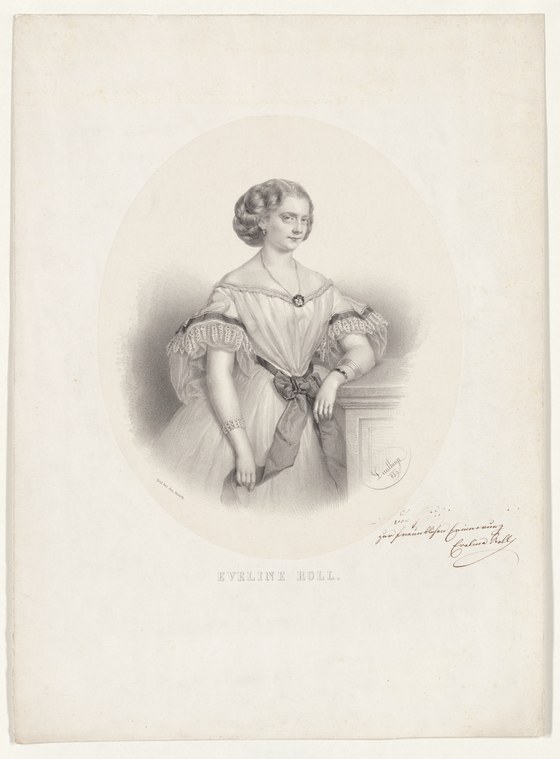
A young woman in an elegant white or pale silk evening dress stands in a three-quarter pose against a plain oval background. The dress features off-the-shoulder sleeves with decorative frogging or epaulettes, cinched at the waist with a dark ribbon bow, and falls to mid-calf length. She wears a small circular brooch at the neckline and has her hair styled in the fashionable waves of the mid-nineteenth century. Her posture is upright and composed, with one arm resting naturally at her side while the other hangs relaxed. The setting is minimal—a simple architectural element (perhaps a pilaster or column base) appears at the right edge, and the oval vignette framing suggests an intimate portrait rather than a theatrical scene. The entire composition is rendered in soft greyscale, with careful attention to the play of light on fabric and the delicate modeling of her features.
The dancing
A single standing female figure, isolated and presented frontally. The body weight appears centered and at rest; there is no active dance posture, weight transfer, or dynamic line through the frame. The arms hang naturally rather than being held in any dance position—neither closed-position frame nor the lifted upper body and extension typical of theatrical dance. The stance is one of elegant repose rather than motion or preparedness to move. This is the formal deportment of a social portrait rather than the kinetic language of performance.
The dance depicted
The image does not depict dance in progress. The subject stands in the formal, upright posture required for nineteenth-century portrait conventions. While the elegant dress and refined presentation might suggest a young woman who was a dancer or performer—the name "Eveline Roll" could indicate a theatrical or ballroom figure—nothing in the pose, gesture, or composition shows her dancing or in a state of readiness for movement. This is a portrait of a person, not a record of dancing.
How it was made
This is a steel or copper engraving, identifiable by the fine parallel hatching used to build tone and the precise linear quality of the drapery and features. The vignette format—the soft oval fading into the white of the paper—is characteristic of mid-nineteenth-century commercial portraiture. The technique allowed for wide circulation via prints, suggesting this was a well-known public figure. The care taken in rendering the fabric texture and the fastidious detailing of dress indicate a skilled reproductive engraver working from a drawing or painting original.
About this work
This is a portrait engraving of a woman identified as Eveline Roll, rendered in the formal conventions of mid-nineteenth-century society portraiture. The work belongs in a dance collection not because it shows dance but because it may document a dancer or performer of the period—the name and the care of execution suggest she was a public figure. The print serves as a historical record of costume, deportment, and the visual culture surrounding theatrical and ballroom performance of the era. It is the kind of object that circulated widely in print form to commemorate notable performers and to satisfy public curiosity about fashionable and celebrated women.
How to look at it
Observe the precision of the engraving technique and the care taken to render the texture of the silk dress—this level of detail indicates a subject of some status. Note the formal, motionless stance: this is not a moment captured from movement but a composed, timeless image designed for circulation and display. The oval framing and plain background emphasize the face and figure over any narrative or action. The work asks you to regard the subject as a person of elegance and refinement, not as a body in motion.
The artist
The engraver is not recorded. The signature or inscription on the print (if present) is not fully legible in this image. The work appears to be a professional commercial product, likely issued as a series of celebrity portraits for sale to the public, a common practice in the nineteenth century.
The period
The dress and hairstyle point to the 1840s–1850s. This was a period of expansion in public entertainment—the rise of the ballet d'action, the dominance of Romantic ballet with its emphasis on the ethereal and the feminine, and the growth of ballroom culture and dance instruction for the middle and upper classes. Performers, particularly female dancers, were objects of intense public interest and their likenesses were widely circulated in engraved form. The refined, modest presentation of this portrait reflects the paradox of nineteenth-century performance culture: female dancers were celebrated and desired, yet their public representation stressed propriety and gentility rather than the physicality or sensuality of their art.
Where it lives
The work is held in the New York Public Library's collection of prints depicting dance. It is catalogued with minimal information, suggesting it is one of many similar nineteenth-century portrait engravings whose individual provenance and printing history have not been systematically documented.
Questions about this work
Was Eveline Roll a dancer?
The name appears in a collection of dance-related prints, and the formal presentation suggests she was a public figure of some note, possibly a performer. However, the catalogue record contains no biographical information, and this engraving alone does not confirm her profession or career.
Why is a portrait engraving in a dance collection if there is no dancing?
Nineteenth-century print collections often included portraits of celebrated performers, entertainers, and public figures associated with the arts. Such images document the visual culture surrounding dance and performance, how performers were presented to the public, and the styles of dress and deportment of the era.
What does the style of dress tell us?
The off-the-shoulder corseted dress with frogged detail is consistent with fashionable evening wear of the 1840s–1850s. The refinement and expense of such a garment, and the quality of the portrait engraving, both suggest a woman of social standing, possibly a celebrated performer or society figure.
More dance artwork





