49 works in this view — arrow keys or swipe to move between them.
Dance in Art
Fancy costumes
Unknown artist
- Collection:
- Prints depicting dance
- Source:
- New York Public Library
- Rights:
- Public domain — free to use, share and adapt.
- Recorded as:
- Public Domain
For dance historians, this image matters as evidence of what dancing bodies were constrained to wear—the weight, volume, and rigidity of these skirts fundamentally shaped movement possibilities and the aesthetic of social dance in the mid-19th century. Fashion plates are also primary sources for understanding the visual culture dancers inhabited and the relationship between high fashion and social performance.
What you are looking at
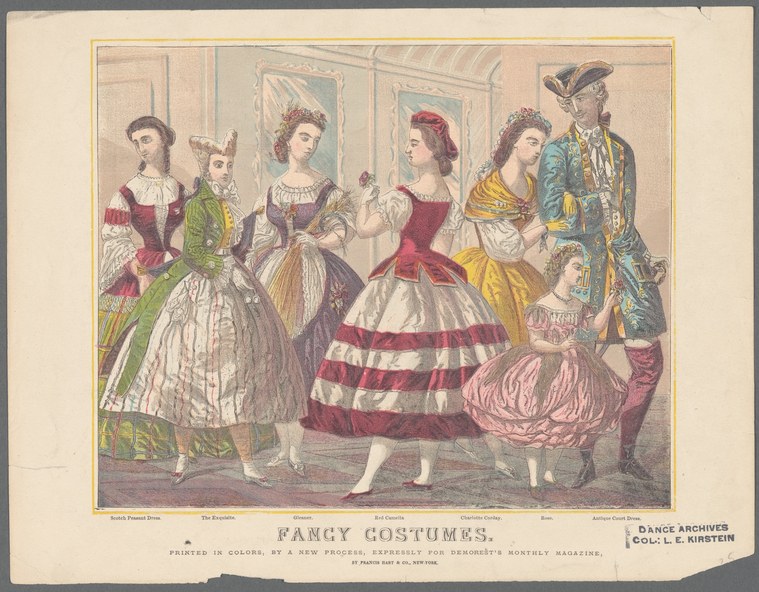
A formal parlor or drawing room scene depicting six women and one man in elaborate mid-19th-century dress, arranged as if for a social gathering or dance. The women wear voluminous crinolined skirts in jewel tones—burgundy, gold, and cream—trimmed with contrasting satin bands and decorated with floral accessories. The standing figures display the silhouettes of the 1850s: tightly corseted waists, sloped shoulders, and bell-shaped skirts that extend to the floor. At center, a woman in a striped cream and burgundy dress stands in profile, her posture upright and composed. A man in formal dress with a blue coat and gold trim stands at right; a small child in a pink dress sits at the lower right. The setting is indicated by architectural elements—paneled walls, what appear to be mirrors or frames in the background—suggesting an interior of some refinement. The composition is orderly and hierarchical, more display than narrative action.
The dancing
The figures are arranged in a formal, presentational line rather than in active dance positions. Their bodies are vertical and restrained; none show the bent knees, dynamic weight shifts, or arm extensions that would characterize an actual dance moment. The woman at center holds a slight forward tilt of the torso, but her weight appears centered and static. The man stands apart, his posture formal and upright. The overall impression is of figures posed for display rather than captured mid-movement—this is costume presentation, not choreography.
The dance depicted
This print does not depict dance in action. It is a fashion plate—a costume study designed to show the silhouettes, trims, and accessories of fashionable dress of the mid-19th century. The title 'Fancy Costumes' confirms this is about dress for social occasions (of which dancing was one), but the figures are stationary models, not dancers. The print belongs to the tradition of fashion and costume documentation rather than to dance imagery proper.
How it was made
This is a color-printed engraving or lithograph, likely from the 1850s-60s, produced for a women's periodical (the imprint credits 'Godey's Monthly Magazine,' a major American women's publication of the era). The hand-coloring and engraved fineline detailing indicate reproductive printmaking for mass circulation. Such prints were the chief visual medium for disseminating fashion information to a domestic audience; they reached thousands of subscribers and served both as inspiration for home dressmaking and as records of elite style.
About this work
This is a fashion plate from Godey's Monthly Magazine—a printed and hand-colored engraving showing costume styles for mid-19th-century social occasions. Though titled 'Fancy Costumes,' it documents dress rather than dance; the figures are motionless models arranged to display the silhouettes, trims, and accessories that defined fashionable appearance. Fashion plates are crucial visual documents of period style and social aspiration. This particular print demonstrates the crinoline-era silhouette and the codes of gender, age, and rank expressed through dress in antebellum America.
How to look at it
Attend to the silhouettes: note the extreme narrowness of the waist, the slope of the shoulders, the absolute bell shape of the skirts. Observe the trim—the bands of contrasting fabric at the hem and the placement of bows and flowers—which directed the eye and created visual emphasis. The figures are arranged in a shallow frieze, in profile and three-quarter view, the conventional poses of fashion presentation; they are models, not actors. The hand-coloring shows which colors were fashionable (the jewel tones of the skirts, the precise shades of the trims) in a way that a line engraving alone could not convey.
The artist
The imprint names 'N. Mendal Shafer, Philada.' as the credit, identifying this as a published print produced for Godey's, a Philadelphia-based magazine. Godey's employed a house team of illustrators and engravers; individual attribution within such productions is often unclear. The style is consistent with American fashion-plate engraving of the 1850s-60s.
The period
This print dates to the height of the crinoline era, when the hoop skirt or crinoline petticoat created the bell-shaped silhouette seen here. In social dancing of this period—cotillions, quadrilles, waltzes—women danced in such dress; the constraints of the crinoline defined the aesthetic of restraint, verticality, and gliding movement characteristic of mid-century ballroom style. Fashion plates were the primary medium by which metropolitan style was disseminated to provincial audiences and by which manufacturers, seamstresses, and genteel households learned what to make and wear.
Where it lives
This print is part of the NYPL's collection of dance-related prints. It comes from Godey's Monthly Magazine (also known as Godey's Lady's Book), a leading American women's periodical published in Philadelphia from 1830 to 1898, which included fashion plates in every issue.
Questions about this work
Is this actually a dance scene?
No. Though the title refers to 'fancy costumes' suitable for social occasions (including dances), the figures are posed as still models, not captured in movement. This is a fashion plate, not a record of choreography or performance.
What could dancers actually move in these skirts?
The crinoline petticoat created substantial volume and weight, especially at the hem. Dancers in this period typically moved with small, gliding steps; the skirt itself was moved by the lower leg and foot rather than controlled throughout its length. The silhouette prioritized vertical line and restrained grace over large, expansive motion.
Why is this in a dance collection?
Fashion and dance are inseparable in social history. These garments were what dancers wore; understanding period dance requires understanding what bodies were clothed in and how that shaped movement. Fashion plates document the visual and physical constraints dancers navigated.
What does 'Godey's' mean on the imprint?
Godey's Monthly Magazine (Godey's Lady's Book) was the most widely circulated women's periodical in mid-19th-century America. Every issue included hand-colored fashion plates like this, making it the primary medium through which fashionable dress was disseminated beyond urban centers. Subscribers used these plates as guides for home dressmaking and as records of elite style.
More dance artwork





