49 works in this view — arrow keys or swipe to move between them.
Dance in Art
Les nouveautés parisiennes
Unknown artist
- Collection:
- Prints depicting dance
- Source:
- New York Public Library
- Rights:
- Public domain — free to use, share and adapt.
- Recorded as:
- Public Domain
Fashion plates reveal how severely late-nineteenth-century dress restricted women's movement, and this example shows that constraint in the very setting—the ballroom—where women were expected to dance. The massive sleeves and rigid corsetry depicted here would have fundamentally altered how a woman could move, pivot, and hold her arms in waltz, polka, or quadrille, yet the fashion industry presented these garments as ideal. Understanding how fashion enforced immobility is essential context for understanding what late-Victorian dance actually looked like and felt like for the women performing it.
What you are looking at
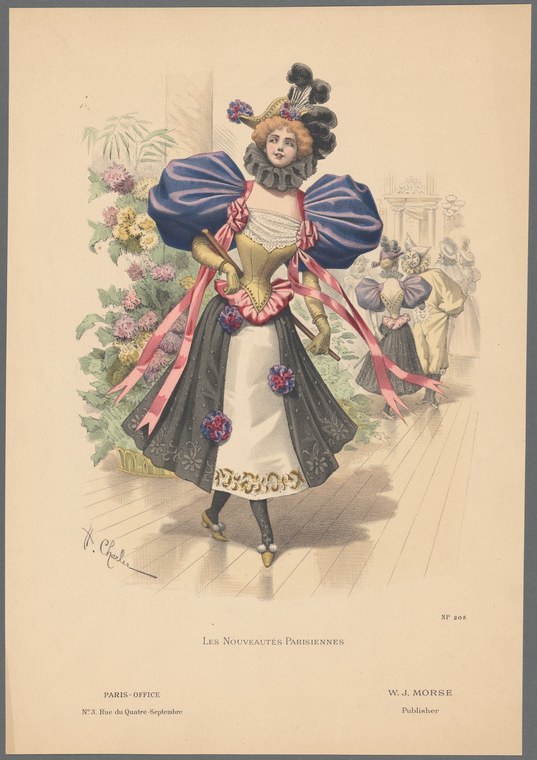
A fashionable young woman stands in an elegant interior, wearing the exaggerated silhouette of late 1890s dress. Her corseted figure is compressed dramatically at the waist, with the characteristic leg-of-mutton sleeves puffed enormously at the shoulder and fitted from elbow to wrist. Over a white chemise she wears a dark overskirt with elaborate lace trim and pink silk bows cascading down the front. Most striking is her enormous black feathered hat, crowned with tall ostrich plumes and positioned at a rakish angle. She stands in a posed, weight-shifted stance with one foot slightly forward, her body angled to show off the fashionable profile. In the background, other fashionably dressed figures promenade in what appears to be a ballroom or salon, rendered in lighter tones. Potted flowering plants and classical architectural details frame the scene. The title at the bottom reads "Les Nouveautés Parisiennes" (The Latest from Paris), establishing this as a fashion plate celebrating the newest styles.
The dancing
The central figure's pose is that of a mannequin displaying dress rather than a dancer in motion. Her weight is balanced, one leg slightly bent, shoulders held back to present the silhouette. Her arms hang naturally at her sides with hands visible, not engaged in any dance hold or partner connection. The body position suggests the restrained, upright carriage demanded by the period's corsetry and fashion ideals rather than the mobility required for active dance. The other figures in the background are similarly posed for display of dress, standing rather than moving.
The dance depicted
This is not a depiction of active dance but rather a fashion illustration disguised within or adjacent to dance contexts. The work presents idealized female beauty and fashionable dress of the 1890s, shown in the ballroom setting where such dress would have been worn, but the central figure is stationary and posed for visual consumption rather than captured in movement. The stance and presentation suggest the formal, restricted posture required by the extreme corseting and sleeve construction of the period, which would have severely limited active dance movement.
How it was made
This is a hand-colored lithograph or color-printed fashion plate, as evidenced by the relatively flat color application, the delicate tonal gradations in the background, and the combination of printed outlines with watercolor or color printing. The technique allowed for detailed rendering of textile textures—the lace, silk ribbons, feathers, and fabric weights are carefully distinguished through layered color and fine line work. The signature "V. Gribaud" or similar appears to be present. This printing method was the standard for mass-produced fashion plates in the 1890s, allowing circulation to a wide middle-class audience interested in current styles, and distinguishes the work as commercial illustration rather than fine art.
About this work
This is a Parisian fashion plate from the 1890s, depicting the extreme silhouette and elaborate ornamentation of that decade's high fashion. Although the figure is shown in a ballroom setting where dance would occur, and the title references 'the latest from Paris,' the work is fundamentally a fashion illustration designed to display women's dress rather than to document actual dance movement or social practice. The exaggerated proportions—the compressed waist, massive sleeves, and oversized hat—were the defining visual markers of the period's elite femininity, and the artist has prioritized the display of these fashionable elements over any suggestion of bodily freedom or movement. The work belongs in a dance archive not as evidence of choreography or dance technique, but as a document of how fashion constrained women's bodies and mobility during a period when ballroom dance remained central to social life.
How to look at it
Attend first to the silhouette and construction details: measure the ratio of shoulder width to waist width, note the precise tailoring of the sleeves, observe the layering of fabrics and trims. Then consider the pose—the woman is not captured mid-step or in a dance frame, but positioned frontally as if for a photographer or mirror. Notice how her posture is rigidly upright despite her weight being slightly forward; this is the posture the corsetry enforces. Finally, look at the background: the other figures are similarly static and posed, suggesting this is a display scene rather than an active social moment. The contrast between the lively setting (the ballroom) and the frozen, display-oriented poses of the figures reveals the print's true purpose: to sell a vision of fashionable beauty rather than to document social dance.
The artist
The signature on the work suggests authorship by V. Gribaud, a Parisian fashion illustrator of the 1890s, though the artist remains incompletely documented. The work is published by W. J. Morse, a Paris-based publisher, indicating professional commercial production. The catalogue record lists the source as the New York Public Library Prints collection and notes the publication address as 3 Rue du Quatre Septembre in Paris, suggesting this was a widely distributed print meant for middle-class consumption.
The period
The 1890s witnessed the apex of the Victorian silhouette before the S-bend corset and Edwardian fashions of the early 1900s. This was simultaneously the height of ballroom dance culture in urban Europe and America, when waltz, polka, cotillion, and quadrille were central to respectable courtship and social display. The contradiction between the fashion ideal shown here and the actual physical demands of ballroom dancing is one of the period's defining tensions. Ballroom etiquette manuals of the decade repeatedly address the challenge of dancing in such heavy, restrictive garments, suggesting that the visual ideal of fashionable dress and the physical reality of ballroom movement were in perpetual conflict.
Where it lives
The work is held in the New York Public Library's Prints collection (catalog number 49 103), catalogued as a dance print but more accurately classified as a fashion plate. It was published in Paris by W. J. Morse at 3 Rue du Quatre Septembre and circulated as a mass-produced commercial print in the 1890s.
Questions about this work
Is this a picture of a dance?
Not really. Although it is set in a ballroom and the figure is wearing the dress worn for ballroom dancing, she is posed statically for display rather than shown moving or dancing. Fashion plates of this era often used ballroom and courtship settings as backdrops to display dress, but the figures are mannequins rather than dancers.
Could someone actually dance in clothes like that?
Yes, but with severe restrictions. The corsetry compressed the waist and restricted breathing; the leg-of-mutton sleeves limited arm movement and raised the arms naturally into a stiff position; the skirts were heavy and full. Contemporary dance manuals and etiquette guides confirm that late-Victorian dancers could perform standard ballroom dances in such dress, but the movement would have been constrained and the experience physically punishing.
What is the artist trying to show?
The newest fashions from Paris, with emphasis on the distinctive silhouette and details—the massive sleeves, the cinched waist, the elaborate hat, the layered skirts and ribbons. The ballroom setting signals that this is evening dress for fashionable society, but the focus is entirely on the garment as a commercial object to be desired and imitated, not on the social or physical reality of ballroom life.
What is 'V. Gribaud'?
A signature, apparently of the illustrator, though this artist is not well documented in standard fashion history references. The work was published commercially in Paris in the 1890s by W. J. Morse.
More dance artwork





