49 works in this view — arrow keys or swipe to move between them.
Dance in Art
Mode journal, Wiener chic
Unknown artist
- Collection:
- Prints depicting dance
- Source:
- New York Public Library
- Rights:
- Public domain — free to use, share and adapt.
- Recorded as:
- Public Domain
Fashion plates document the movement vocabulary and bodily ideals of their moment. The poses, lines, and silhouettes shown here informed how women moved and carried themselves in ballrooms and social gatherings, conditioning what dances were possible and how they were performed. Understanding the constraints and aesthetics of Gilded Age dress is essential to understanding how the period's dances—waltzes, cotillions, quadrilles—were actually executed.
What you are looking at
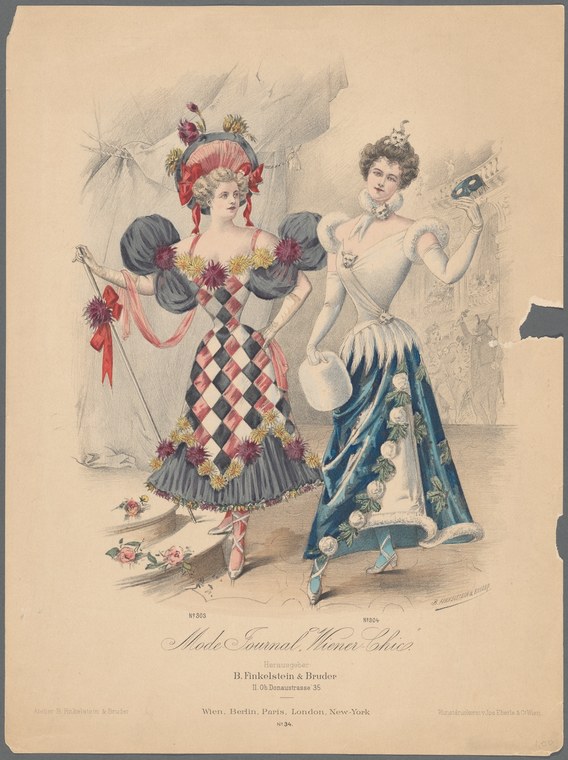
Two fashionably dressed women are depicted in an elegantly composed fashion illustration. The figure on the left wears a striking black taffeta dress with voluminous puffed sleeves, adorned with red and gold floral garlands across the bodice and skirt. Her hair is arranged in an elaborate upswept style crowned with a red feathered hat. The figure on the right stands in a contrapposto pose, wearing a deep blue cape or cloak lined with white, draped over her arm, and displays a lighter undergarment. Both women are positioned against a softly rendered interior setting with suggestions of architectural elements and draping in the background. The composition emphasizes the silhouette and fall of the fabrics, with the women's postures suggesting the leisure and display typical of Gilded Age fashion presentation. Scattered flowers appear at their feet, reinforcing the decorative, theatrical quality of the scene.
The dancing
The two figures stand in relaxed, presentational poses rather than in active movement. The left figure's weight rests evenly, with arms positioned to frame and display the garment's architectural puffed sleeves. The right figure adopts a more languid stance, her body angled in three-quarter view with the cape draped gracefully over one arm—a pose that suggests movement arrested, as if mid-promenade. Neither figure demonstrates active choreographed movement or a defined dance hold; instead, their bodies are arranged for maximum visibility of costume and line, as befits fashion plate illustration.
The dance depicted
This image does not depict dance in the sense of active choreographic movement or recognizable social dance steps. Rather, it illustrates the performative display of high fashion from the Gilded Age (c. 1890s), when fashionable dress itself was understood as a form of embodied presentation and social performance. The women's poses—the sideways tilt, the strategic drape, the architectural silhouette—reference the aesthetic principles of theatrical dress and the 'beautiful pose' valued in turn-of-century society. This is fashion as spectacle, not dance as such.
How it was made
This is a hand-colored fashion plate, almost certainly a lithograph or color lithograph given the registration of the figure work and the subtle tonal gradations visible in the background. The medium allowed for mass reproduction of high-quality color fashion illustrations, essential to the distribution of style advice through periodicals and fashion albums in the 1890s. The delicate handling of the women's faces, the precise definition of jewelry and trim, and the sophisticated use of white highlights suggest the work of a skilled fashion illustrator working from a lithographic stone. The printing and hand-coloring process gave these plates both the authority of mechanical reproduction and the luxury of hand finish.
About this work
This is a Gilded Age fashion plate from *Mode journal: Wiener chic*, a periodical publication from Vienna and distributed by H. Finkelstein & Broder of Vienna, Paris, London, and New York. It documents the haute couture silhouettes and ornamental ideals of the 1890s haute bourgeoisie. Although not a dance document per se, it belongs in a gallery about dance because it captures the non-dance movement vocabulary, the bodily presentation, and the aesthetic of repose and display that were cultivated in social spaces where dance took place. The exaggerated silhouettes and carefully composed poses represent a form of social choreography—the performance of status and taste through the body and dress. For historians of dance and theatre, such fashion plates are evidence of the embodied ideals of an era.
How to look at it
Attend first to the silhouettes: the way the puffed sleeves create a structured, architectural line; the taper from the corseted waist to the hem; the dramatic fall of the cape. These are not organic body shapes but constructed ones, achieved through boning, padding, and weight. Notice the poses the illustrator has chosen: not standing at rest, but angled, tilted, and arranged to catch light and shadow in a way that suggests graceful movement even in stillness. The scattered flowers at the feet reference the theatrical tradition of showering performers with bouquets—a hint that this is a form of display and spectacle. The soft background and warm interior setting position these fashionable figures not as abstractions but as women in a social space, ready to move through it.
The artist
The illustration is credited to H. Finkelstein & Broder, a Vienna-based publishing and distribution house with branches in Paris, London, and New York. They were active in the 1890s as major distributors of European high fashion to transatlantic audiences. The artist's hand is not individually credited in the catalogue record; such plates were often produced by house artists or freelance illustrators working to the publisher's commercial brief. The unsigned status was typical of fashion periodical work.
The period
The 1890s saw an explosion of fashion periodicals and fashion plates as technologies of mechanical reproduction (lithography, chromolithography) made high-quality color illustration affordable and distributable at scale. *Mode journal: Wiener chic* positions Vienna—which rivaled Paris as a center of fashion authority—as a source of sophisticated style for international audiences. The silhouettes shown here—the exaggerated mutton-chop sleeves, the corseted waist, the dramatic draping—are quintessential late-Victorian. In the ballroom, these same silhouettes constrained and enabled specific kinds of movement; the voluminous sleeves, for instance, limited the arm positions possible in closed dance positions, while the weight of the skirts demanded a particular carriage and sway.
Where it lives
This work is held in the New York Public Library's Prints collection, catalogued under 'Prints depicting dance.' The publication *Mode journal: Wiener chic* was distributed by H. Finkelstein & Broder from Vienna and exported to major fashion capitals; this copy circulated in New York, a major market for European high fashion.
Questions about this work
Is this a dance print?
Not strictly. It is a fashion plate—a commercial illustration from a fashion magazine. However, it documents the bodily ideals, silhouettes, and poses of an era when women danced in exactly these garments. The poses show the kinds of carriage and bearing that were cultivated in ballroom society. For dance historians, fashion plates are essential primary sources for understanding how the body moved and was expected to move.
Who are these women?
They are generalized fashion types, not portraits of identifiable individuals. They represent the fashionable ideal of the Viennese haute bourgeoisie in the 1890s. The print was intended as a style guide for women of means who wanted to adopt these silhouettes and aesthetic values.
Why are the poses so artificial and stiff?
The poses are not stiff but *composed*—carefully arranged to show off the construction and drape of the garments. Fashion illustration prioritizes silhouette and line over naturalistic movement. The slight contrapposto and the theatrical positioning of the cape show training in academic life drawing and theatrical composition, referencing the aesthetic values of fine art to elevate commercial fashion work.
More dance artwork





