49 works in this view — arrow keys or swipe to move between them.
Dance in Art
Marie Taglioni
Unknown artist
- Collection:
- Prints depicting dance
- Source:
- New York Public Library
- Rights:
- Public domain — free to use, share and adapt.
- Recorded as:
- Public Domain
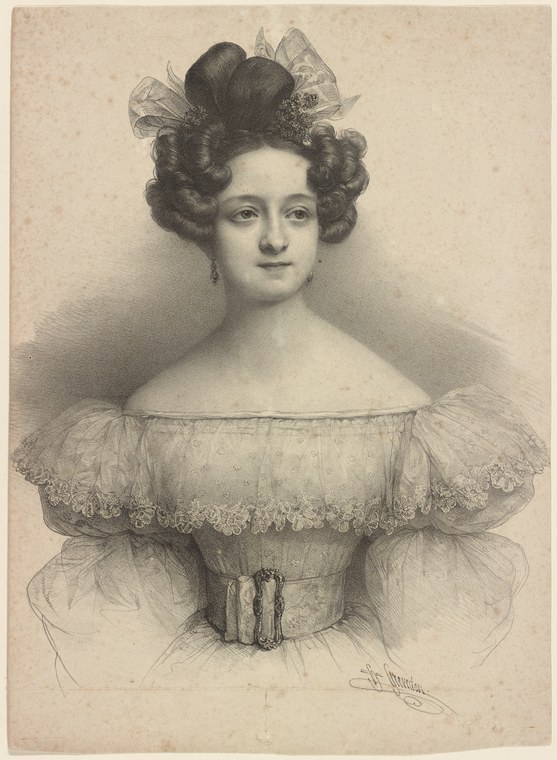
Taglioni revolutionized ballet by perfecting the pointe technique and embodying the Romantic ideal of otherworldly, weightless femininity. This portrait, though not showing her dance, is a primary document of how she was seen and celebrated in her own time—evidence of her status as both an artist and a fashion icon. For historians of dance and visual culture, it illuminates the relationship between theatrical stardom and contemporary portraiture in the nineteenth century.
What you are looking at
A half-length portrait of a young woman in Romantic-era dress, rendered in fine graphite or chalk on paper with delicate stippled shading. She faces the viewer directly with a serene, composed expression. Her dark hair is arranged in the fashionable style of the 1830s-1840s, parted in the center and looped into ringlets at either side of her face, crowned with an elaborate bow of sheer fabric—possibly tulle or silk ribbon—that stands vertically above her head. Her bare shoulders and upper chest emerge from a wide, off-the-shoulder neckline typical of the Romantic period. The bodice is densely gathered or smocked with fine vertical pleating, and immense puffed sleeves of sheer material billow from the shoulder, their volume emphasized by the artist's careful rendering of shadow and texture. The overall effect is one of ethereal lightness and aristocratic refinement, the kind of formal portrait that would have been circulated among educated viewers familiar with the Parisian ballet world.
The dancing
A single seated or standing figure shown from the waist up, with arms at rest at the sides or only minimally visible. The posture is erect and formal, the head held level, the gaze direct and frontal. There is no suggestion of movement or dance pose—this is a fashion portrait, not a study of motion. The bearing is that of a young woman of social rank, composed and self-possessed. The artist demonstrates careful attention to the planes of the face and neck, with particularly fine modeling around the cheekbones and jaw to suggest lifelike volume and refinement.
The dance depicted
The catalogue identifies this as a portrait of Marie Taglioni, the legendary Swedish-Italian ballerina who became the defining figure of Romantic ballet in the 1830s and 1840s. Taglioni pioneered the pointe technique and embodied the ethereal, weightless ideal of Romantic choreography, most famously in *La Sylphide* (1832). However, this portrait does not depict her dancing or in theatrical costume. Instead, it shows her in formal contemporary dress—the kind she would have worn in Parisian society off-stage. The image preserves her public identity as a celebrity and celebrated artist, but documents her as a fashionable woman of her era rather than as a performer in action.
How it was made
This is a finely executed graphite or chalk drawing on paper, likely a finished work rather than a sketch. The medium allowed for the precise rendering of fine detail—the intricate pleating of the bodice, the delicate texture of the sheer sleeves, the subtle modeling of the face—while maintaining an elegant, understated quality appropriate to a portrait of a refined subject. The stippled shading technique creates soft atmospheric effects and a sense of luminosity. The work appears to be a professional studio portrait, the kind that would have been engraved for circulation in periodicals, albums, or as a standalone print for collectors. A signature mark is visible at the lower right, though the artist's name is not recorded in the catalogue.
About this work
This is a formal portrait drawing of Marie Taglioni, the preeminent Romantic ballet dancer of the nineteenth century, shown in fashionable society dress rather than in theatrical costume or performance. The work documents her identity as a celebrated public figure and trendsetter in 1830s-1840s Paris, at the height of her fame. It belongs in a gallery of dance imagery not because it depicts dancing, but because it preserves the image of one of the most influential dancers in history and shows how she was represented to the public during the Romantic era—as a woman of refinement, beauty, and social consequence, not merely as a performer. The portrait is characteristic of the celebrity culture surrounding ballet in this period, when the private images and likenesses of star dancers were collected and circulated as fashion and cultural documents.
How to look at it
Observe the artist's choices in presenting Taglioni. She is shown not as a sylph in motion, but as a composed, serene presence—a mature, confident woman of society. The enormous puffed sleeves and elaborate coiffure were the height of fashion in the 1830s-1840s, and their rendering here is meticulous; the artist has taken care to show her as elegant and fashionable. The ethereal quality comes not from any suggestion of dance or flight, but from the delicate, almost luminous quality of the graphite work and the sheer fabrics rendered in fine, careful lines. Pay attention to the directness of her gaze and the symmetry of her pose—she faces you calmly, presenting herself as a person of consequence. This is a woman being shown to the world, not a dancer captured in the act of dancing.
The artist
The artist is not recorded in the available catalogue information. The quality of execution and the care taken with detail suggest a professional portrait draftsman working in Paris during the 1830s-1840s, likely someone with access to or direct contact with Taglioni herself or her circle. The signature at lower right could be consulted to identify the hand, but such attributions are not yet established in the record.
The period
This portrait dates to the Romantic era in ballet and visual arts, a period when dancers—particularly female dancers—became objects of intense public fascination and collectors' appetite for their likenesses. The 1830s saw the triumph of Taglioni in *La Sylphide* and the consolidation of ballet as a major art form centered on female virtuosity and ethereal beauty. In visual culture, the period witnessed an explosion of printed portraits, lithographs, and engravings of famous performers, distributed through periodicals, theatrical programs, and dedicated albums. Fashion prints and society portraits of the same era adopted similar conventions—the three-quarter or full-frontal pose, the emphasis on dress and coiffure, the delicate linear technique—making celebrity dancer portraits indistinguishable in format from portraits of aristocratic women. This democratization of portraiture reflected the rise of the performer as a new kind of public figure.
Where it lives
The work is held in the Prints collection of the New York Public Library, catalogued under the broader subject of prints depicting dance. The catalogue record provides no information on date, artist, medium, or prior provenance beyond the holding collection. The print is part of a larger assemblage of theatrical and dance-related images from the nineteenth century, many of which document the celebrity culture surrounding performers of the era.
Questions about this work
Is this Taglioni dancing?
No. This is a formal portrait of her in fashionable street dress, the kind she would have worn off-stage in Parisian society. It documents her as a celebrity and trendsetter, not as a performer. Many other contemporary images do show her in theatrical roles and costume, but this is not one of them.
Why include a non-dancing portrait in a gallery about dance?
Because Taglioni was one of the most influential dancers in history, and this portrait is a primary document of how she was seen and celebrated during her lifetime. It reveals the relationship between theatrical stardom and celebrity culture in the nineteenth century. Dancers of her rank were public figures whose likenesses were collected and circulated like fashion images, blurring the line between performer and society woman.
When was this made?
The catalogue record does not record a date. Based on the fashion (the style of the bodice, sleeves, and coiffure, which correspond to the 1830s-1840s), and the fact that Taglioni was most famous during this period, the portrait likely dates to the height of her career, roughly 1830-1850. A more precise date would require consultation of the artist's signature or additional research.
Who drew this?
The artist is not identified in the catalogue record, though a signature is visible at the lower right of the print. This kind of formal portrait would have been commissioned by Taglioni or her representatives and executed by a professional studio artist in Paris. The identity of the artist could be established by consulting the signature or checking contemporary records of portraitists working in the city during this period.
More dance artwork





