49 works in this view — arrow keys or swipe to move between them.
Dance in Art
Dance cartoons
Unknown artist
- Collection:
- Prints depicting dance
- Source:
- New York Public Library
- Rights:
- Public domain — free to use, share and adapt.
- Recorded as:
- Public Domain
This work documents the visual language of social satire in the 19th century and the role of the sketch or cartoon in capturing comedy and social observation. It is valuable for understanding how dance imagery and bodily gesture were used in non-theatrical contexts to convey character and social dynamics.
What you are looking at
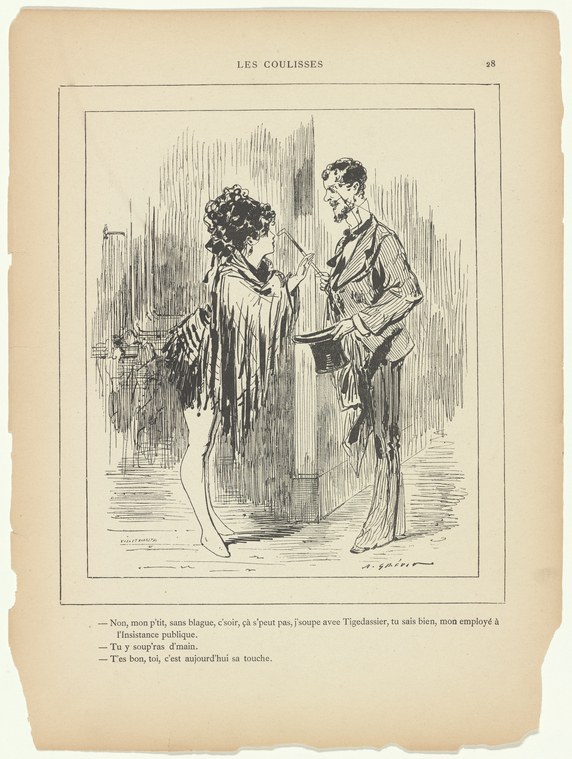
A man and woman face each other in conversation in what appears to be an interior domestic setting, suggested by architectural elements in the background. The woman, wearing a long draped gown with voluminous sleeves, stands with her weight forward in an engaged posture. The man, in a fitted jacket and trousers, leans slightly toward her. The space between them is intimate but not touching. The artist has rendered the figures with loose, expressive linework typical of mid-19th-century French satirical drawing, with heavy cross-hatching in the background creating depth. The mood is one of social interaction—flirtation or negotiation—rather than formal dance.
The dancing
Both figures are in upright stance rather than dance frame. The woman's right arm is raised and extended toward the man in a gesture of address or restraint; her left arm hangs at her side. The man stands with both arms at his sides, his posture slightly deferential. Neither figure shows the alignment, turn-out, or balletic deportment typical of theatrical dance. The composition emphasizes conversational exchange over movement or technical display.
The dance depicted
This is not a depiction of dance. The figures are engaged in social interaction—possibly a scene of courtship, negotiation, or social comedy—but neither their posture, frame, nor the setting suggests choreographed movement. The title 'Dance cartoons' appears to refer to the genre (satirical cartoon illustration) rather than the subject matter.
How it was made
This is a pen-and-ink drawing or engraving, reproduced in a printed publication. The technique employs bold outlines, parallel hatching for shadow, and minimal detail in the faces—characteristic of 19th-century journalistic or literary illustration. The loose, economical line suggests the work was created for rapid reproduction in a periodical or illustrated book rather than as a finished artwork for exhibition. The subject is labeled in French at the bottom, confirming publication in a French-language source.
About this work
This is a satirical illustration in pen and ink from a 19th-century French publication, depicting two figures in an interior setting engaged in social dialogue. The work exemplifies the tradition of social comedy in graphic art—capturing a moment of domestic or courtship negotiation through gesture and spatial relationship. It bears the character of editorial or literary illustration: economical, witty, and designed for rapid consumption by readers of a periodical or book. The catalogue designation as 'dance cartoons' refers to the illustration genre, not the dance content.
How to look at it
Attend to the raised arm of the woman and the slight forward lean of the man: these gestures carry the entire emotional and narrative weight of the scene, conveying social tension or negotiation without movement. Note the artist's economy of line—the figures are defined not by detail but by silhouette and the relationship of body to space. The cross-hatched background serves to push the figures forward and focus attention on the interaction between them.
The period
This is a product of 19th-century French print culture, most likely mid-century (c. 1840–1880), when satirical periodicals such as La Caricature and Le Charivari were at their height. The tradition of social satire through exaggerated gesture and costume had roots in Daumier and Gavarni. The style—economical line, bourgeois interior setting, and focus on courtship or social negotiation—is consistent with the illustrations that accompanied serialized fiction and social commentary in these publications. The reference to 'indemnité publique' in the caption suggests a topical or political subtext.
Where it lives
The work is held in the New York Public Library's collection of prints depicting dance. It is a page from a bound or loose publication, indicated by the page number (28) and the title header ('LES COULISSES') visible at the top of the page.
Questions about this work
Is this actually a dance illustration?
No. The figures are engaged in social conversation, not choreographed movement. The title 'Dance cartoons' refers to the medium (satirical cartoon illustration) and the publication context, not the subject matter. The work belongs in a dance collection by virtue of its provenance and cataloguing history, but it does not depict dance technique or performance.
What is the French text at the bottom?
The caption reads: 'Non, mon p'tit, sans blague, c'est l'pauv'avec l'indemnité publique, tu sais bien, non emploi à l'assistance publique. Tu y soup'çes d'moin. T'es bon, toi, c'est aujourd'hui que ça touche.' This is colloquial 19th-century French satirizing bureaucratic employment and public benefit, typical of the social comedy found in illustrated periodicals.
Who is the artist?
The artist is not recorded in the catalogue. The signature at the bottom right of the illustration is difficult to read in reproduction. Attribution would require consultation of the original print or of indices to 19th-century French periodical illustration.
More dance artwork





