49 works in this view — arrow keys or swipe to move between them.
Dance in Art
Dance cartoons
Unknown artist
- Collection:
- Prints depicting dance
- Source:
- New York Public Library
- Rights:
- Public domain — free to use, share and adapt.
- Recorded as:
- Public Domain
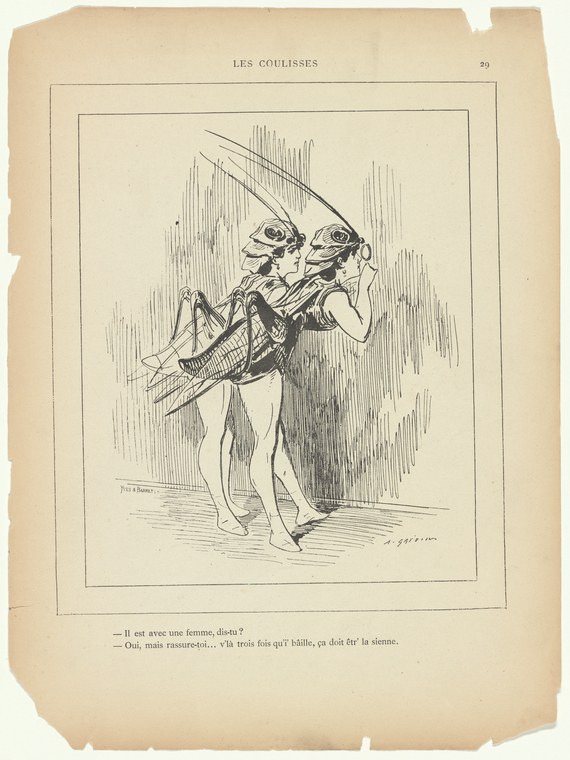
Satirical images of dance reveal period attitudes toward the body, propriety, and social aspiration that documentations of 'real' dance cannot. This print shows that 19th-century audiences found something absurd or ridiculous about the intimate embrace of ballroom dancing, and it documents the specific visual language—the close hold, the mirrored positioning—through which that dance was recognized and mocked.
What you are looking at
A satirical engraving depicts two figures with exaggerated insect heads—one with prominent antennae and the other with long, whip-like appendages—in an intimate dance embrace. The figure on the left, rendered with human female form and bare legs, supports or is supported by the figure on the right in a tight, comedic hold suggesting romantic entanglement. Both have grotesquely enlarged heads and insectoid features that dominate the composition. The background is rendered in dense parallel hatching that creates depth and shadow, emphasizing the absurdist character of the scene. The work is a print, most likely an engraving or etching, with fine line work throughout. The overall effect is one of burlesque humor: the human bodies paired with insect heads create visual incongruity, suggesting this is social commentary rather than documentation of actual dance practice.
The dancing
The two figures stand in close contact, their bodies leaning into each other in a tight embrace. The left figure's arm wraps around the right figure's body in an intimate hold, while both seem to be in mid-sway or pivot. Their leg positions suggest weight shifting—the left figure's stance is slightly splayed, as if bearing or receiving weight. The oversized heads and antennae create visual instability that contrasts with the grounded, partnered positioning of the lower body. This pairing of naturalistic human form below with fantastical heads above is deliberate and central to the composition's satirical effect.
The dance depicted
The work does not document an actual dance style but rather uses dance—specifically the intimate partner dance typical of 19th-century social ballroom contexts—as a vehicle for visual satire. The close embrace and body contact suggest waltz, quadrille, or another form of fashionable couple dance of the era. However, the insectoid heads appear to mock or parody something about the dancers themselves: their pretension, their physical characteristics, or their social position. Without inscription or title visible, the specific target of the satire is unclear, though the work is plainly caricature rather than representation.
How it was made
This is a line engraving or etching, executed with fine parallel hatching to create tone and shadow, particularly visible in the background. The technique is consistent with commercial satirical prints of the mid-19th century—precisely controlled line work with no color, designed for mass reproduction and circulation in periodicals or as loose prints. The medium's demand for clear, legible forms made it ideal for caricature, where exaggeration reads quickly and memorably. The page header 'LES COULISSES' and page number 29 indicate this is a page from a bound publication, likely a French humor or theatrical periodical.
About this work
This is a satirical engraving from a 19th-century French periodical, using the aesthetics of intimate social dancing to create a grotesque visual joke. Two human figures with insectoid heads embrace in a close dance hold, their bodies rendered naturalistically but their heads exaggerated into fantastical forms with prominent antennae and appendages. The work belongs in a dance gallery because it documents how dance—specifically the partner dances of the ballroom—functioned in visual culture as a vehicle for social commentary and satire. Satirical prints like this reveal what audiences found ridiculous, aspirational, or worth mocking in the dance practices of their era.
The print comes from 'Les Coulisses,' a French periodical whose very title (referring to backstage theater space) signals its interest in the world of entertainment, fashion, and social pretension. By placing insectoid creatures in the posture of fashionable dancers, the artist invites viewers to laugh at the dancers themselves—perhaps at their vanity, their mechanical repetition, or their transformation into something less than human through the rituals of dance.
How to look at it
Attend first to the incongruity at the heart of the composition: the naturalistic rendering of human legs and torsos contrasted with the grotesque, oversized heads. This visual strategy—keeping the dancing body recognizable while rendering the head unrecognizable—is what makes the satire work: we recognize the dance before we recognize the mockery. The artist has chosen a moment of maximum intimacy and physical contact, showing the close embrace fully, so that the comedy depends entirely on the heads. Notice also the elaborate background hatching, which was time-consuming to execute and signals that this was a carefully crafted, premium print rather than a quick sketch.
The period
This engraving dates from the era of the waltz and quadrille's dominance in European ballroom culture—the mid-to-late 19th century. The waltz in particular provoked moral anxiety and satire due to its close embrace, which was considered scandalous compared to earlier country dances and cotillions. French satirical periodicals like *Les Coulisses* thrived during this period, publishing weekly or monthly commentary on entertainment, fashion, and social life through prints and text. The print's appearance in a bound publication indicates a sophisticated, literate audience with access to cultural periodicals—the urban middle and upper classes most invested in ballroom dancing and most likely to find satire of it entertaining.
Where it lives
This print is held by the New York Public Library as part of a collection titled 'Prints depicting dance.' It appears as page 29 in a bound volume of 'Les Coulisses,' a French periodical that published theatrical and social satire. The page header and numbering indicate it is an integral part of a publication rather than a loose print.
Dance in this work
Questions about this work
What is the source of the insectoid imagery?
The engraving does not indicate a source through visible inscription. The insect heads may reference a specific scandal, caricature subject, or performance that would have been immediately recognizable to the periodical's original audience but is not identifiable from the image alone. Alternatively, they may be purely fantastical—a device to suggest that dancers are inhuman, mechanical, or creatures of appetite.
Why would satirical prints of dance matter to dance historians?
Satire reveals period anxieties and values that 'straight' documentation does not. The fact that this artist found the close ballroom embrace ridiculous enough to caricature tells us that the waltz and similar dances were still controversial or novel enough to provoke mockery. The visual clarity with which the artist renders the dance hold—the embrace, the body contact—means we can read period dance technique and aesthetics even through the lens of mockery.
Is this actually a depiction of a real dance?
Not of a real, named dance style—but it is a representation of real dance practice. The close embrace and body positioning are consistent with waltz or similar ballroom dances of the period. The satire lies in the heads, not the bodies.
More dance artwork





