49 works in this view — arrow keys or swipe to move between them.
Dance in Art
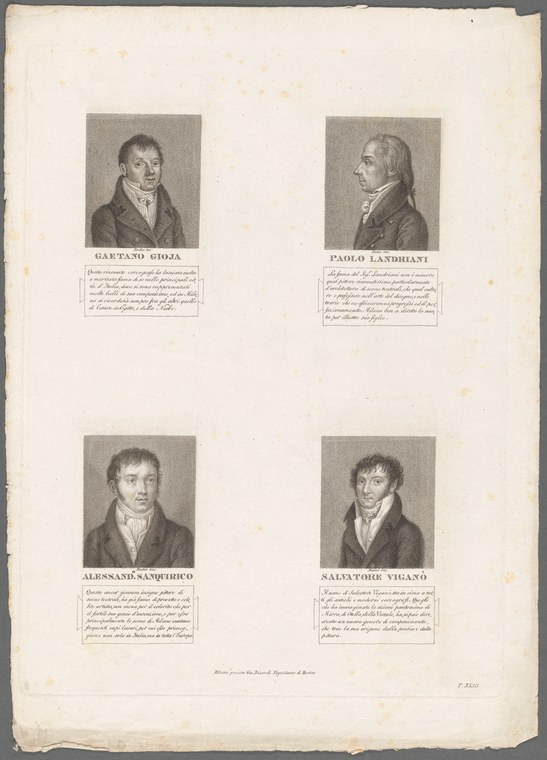
Gaetano Gioja; Paolo Landriani; Alessand[r]o Sanquirico; Salvatore Viganò
Unknown artist
- Collection:
- Prints depicting dance
- Source:
- New York Public Library
- Rights:
- Public domain — free to use, share and adapt.
- Recorded as:
- Public Domain
This engraving is valuable evidence of how early 19th-century dance culture valued and commemorated its artists through print. Viganò's inclusion alongside Gioja and Landriani—both significant Milan-based figures—suggests the centrality of the Milanese school to European dance history of this period. For anyone studying the professionalization of dance or the reputation of Romantic-era choreographers, this type of commemorative engraving reveals which artists were considered canonical in their own time.
What you are looking at
This engraving presents four portrait heads arranged in a 2×2 grid, each labeled with the name of a celebrated dancer or choreographer in Italian script. The figures are rendered in stippled engraving technique against a plain background, each shown in profile or three-quarter view wearing the formal dress of the early 19th century—dark coats with high collars and cravats. The portraits are finely detailed and dignified in presentation, with careful attention to facial features and the texture of hair. Below each portrait runs a line of small italic text, likely biographical or attributive information now difficult to read at this reproduction size. The overall composition is orderly and hierarchical, presenting these four figures as subjects of equal importance within a single commemorative sheet.
The dancing
The four men are shown from the shoulders up, in formal portrait style rather than in dance posture. Three are shown in profile or near-profile (Gioja on upper left, Landriani upper right, Sanquirico lower left), while Viganò (lower right) turns slightly more toward the viewer. Their postures are static and composed, appropriate to engraved portraiture of the period. There is no depiction of movement, hold, or dance technique; these are honorific likenesses of the named individuals rather than representations of dance in action.
The dance depicted
This is a portrait engraving commemorating four significant figures in early 19th-century dance: Gaetano Gioja (Milan), Paolo Landriani (Milan), Alessandro Sanquirico (Spanish dancer and choreographer), and Salvatore Viganò (Milan, 1769–1821), one of the most influential choreographers of the Romantic era. Viganò, in particular, is known for developing *coreodrama*—a form of narrative dance-mime that prefigured Romantic ballet and exercised enormous influence across Europe. The engraving itself contains no choreographic information; its purpose is biographical commemoration rather than documentation of technique or style.
How it was made
This is a stipple engraving, identifiable by the fine dotted texture throughout the image, which creates tonal modeling and subtlety of form impossible in line engraving. Stipple was a labor-intensive technique favored in the late 18th and early 19th centuries for high-quality portrait reproduction, especially for commemorative or biographical collections. The technique's precision and tonal range made it suitable for circulation in printed books, journals, and collected portfolios aimed at educated audiences interested in the history of dance and theater. The work is unsigned in the visible portion of this reproduction.
About this work
This engraving is a commemorative group portrait of four major figures in early 19th-century dance, three Milanese and one Spanish, rendered in the formal stipple technique of the period. It belongs to a European tradition of honoring dancers and choreographers through collected engravings—often assembled in biographical dictionaries or dance histories. The selection of these four figures (particularly the inclusion of Viganò, whose coreodrama was internationally celebrated) suggests this sheet was part of a larger reference work or tribute to the major creative figures of Romantic-era dance. The work documents not a dance itself but the historical importance of these individuals at a moment when dance was gaining recognition as a serious art form worthy of biographical and artistic commemoration.
How to look at it
Approach this as a historical document of reputation rather than as a representation of dance itself. Notice how the engraver has differentiated the four faces while maintaining a consistent formal dignity—each man is presented as a subject of historical importance. The small text beneath each portrait would originally have contained biographical or attributive information; examine the italic script carefully if legibility permits. This type of commemorative grouping was common in printed collections and reveals which artists were considered essential to dance history by curators and publishers of the period.
The artist
The artist of this engraving is not recorded. The work is part of the New York Public Library's collection of dance-related prints, which suggests it originated in a European biographical or theatrical publication and was later acquired as a historical document. The stipple technique and formal presentation are consistent with early 19th-century Continental dance history publishing.
The period
This engraving dates to the early decades of the 19th century, when Romantic ballet was emerging as a dominant theatrical form and dance was beginning to be treated as a subject worthy of serious biographical and artistic attention. The inclusion of Salvatore Viganò (1769–1821) suggests a terminus ante quem near or shortly after his death. This was the era of *La Sylphide* (1832) and the codification of Romantic ballet vocabulary; it was also a moment when dance histories and biographical dictionaries of performers and choreographers began to be systematically compiled. The prevalence of stipple-engraved portraits in such publications reflects both the technical sophistication available and the market demand from educated audiences for visual documentation of celebrated artists.
Where it lives
This engraving is held in the New York Public Library as part of its collection of prints depicting dance. It is likely one leaf from a larger biographical or historical publication, possibly a dance encyclopedia or theater history. The source cataloguing does not identify the original publication or date with precision.
Questions about this work
Who were these four dancers?
Gaetano Gioja and Paolo Landriani were significant figures in Milanese ballet during the late 18th and early 19th centuries. Alessandro Sanquirico was a Spanish dancer and choreographer of the same era. Salvatore Viganò (1769–1821) was perhaps the most influential, known for creating *coreodrama*, a synthesis of dance and mime that profoundly influenced the development of Romantic ballet across Europe.
Why were these four chosen together?
Three of the four were based in Milan, which was a major center of dance innovation in this period. Viganò's international fame and influence likely elevated the entire grouping; his inclusion suggests this engraving was created as a historical document of major figures in early Romantic dance. The selection reflects curatorial judgment about which artists deserved commemoration.
What does the text under each portrait say?
The italic text below each portrait is rendered too small to read reliably in this reproduction. It likely contained brief biographical information, dates, or attributions. The original publication would have been legible to its contemporary audience.
Is this engraving signed?
No artist signature is visible in this reproduction. The engraver's name is not recorded in the catalogue. Such commemorative engravings were sometimes produced anonymously or by workshop assistants.
More dance artwork





