49 works in this view — arrow keys or swipe to move between them.
Dance in Art
Dance cartoons
Unknown artist
- Collection:
- Prints depicting dance
- Source:
- New York Public Library
- Rights:
- Public domain — free to use, share and adapt.
- Recorded as:
- Public Domain
This image documents the intersection of dance history and social history: it preserves not the steps of formal dance but the embodied conventions of courtship and flirtation that structured everyday interaction. For historians of social dance and gesture, it offers a record of how artists understood and represented the non-virtuosic movement of ordinary people in moments of attraction and negotiation.
What you are looking at
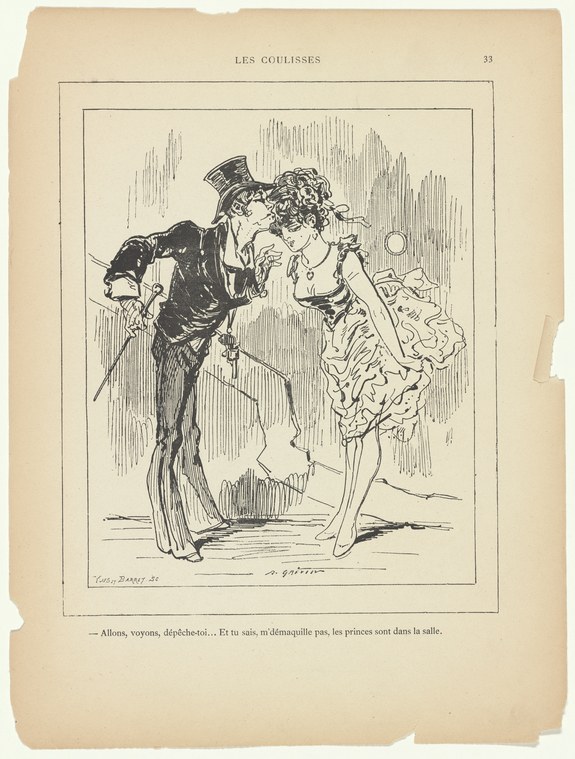
A man in formal evening dress—top hat, tailcoat, and cane—leans toward a woman in a light, ruffled dress in a flirtatious encounter. The woman tilts her head back with an exaggerated, coquettish expression, her body angled away from the man even as she engages with him. The composition is intimate and close, with both figures animated by bold, energetic line-work. Vertical hatching fills the background, creating depth and focusing attention on the two figures. The drawing style is loose and gestural, capturing a moment of social interaction rather than formal dance instruction. The woman's light dress contrasts sharply with the man's dark suit, emphasizing the gender dynamic of the scene.
The dancing
The man stands upright with his weight forward, leaning into the woman with his cane held casually. His posture is confident and proprietary. The woman's body curves away from him in a pose of mock resistance or playful evasion, her head thrown back and her arms positioned to suggest both rejection and engagement. Neither figure displays the formal frame or alignment of ballroom dance; instead, their positions suggest the improvisational, socially coded movement of courtship or flirtation rather than steps learned in a dance studio.
The dance depicted
This is not a depiction of formal dance technique but rather social movement in a moment of courtship or street encounter. The image captures the repertoire of gesture and posture that structured interaction between men and women in urban social life—the lean, the tilt, the play of advance and retreat. If this belongs to any tradition of dance, it is the vernacular language of flirtation and social negotiation that precedes or frames courtship, rather than a named dance form. The exaggeration and caricatural quality suggest this is a satirical or comedic observation of social conventions rather than documentation of performed dance.
How it was made
This is a pen or ink drawing, likely reproduced as a lithograph or line engraving for publication. The bold, decisive line-work and the parallel hatching in the background are characteristic of 19th-century newspaper or magazine illustration. The technique allows for rapid, economical rendering of gesture and expression, and the loose handling of the line conveys movement and spontaneity. This medium and style place the work in the tradition of satirical or observational social commentary, which circulated widely through illustrated periodicals and collected volumes of caricatures.
About this work
This is a satirical social scene captured in loose, energetic drawing: a moment of urban flirtation between two figures of contrasting dress and deportment. Rather than depicting the formalized steps of a ballroom or stage dance, it records the gestural language of social interaction—the coded movements of courtship and attraction that constituted a kind of choreography in their own right. The work belongs to the tradition of 19th-century social caricature, which used exaggeration and wit to comment on the rituals and conventions that governed public and semi-public social life.
How to look at it
Attend to the contrast between the man's forward lean and the woman's backward tilt: the drawing captures a moment of negotiation and play within a social convention of masculine approach and feminine retreat. Notice how the artist uses line to convey movement and attitude—the woman's exaggerated posture and expression suggest both resistance and engagement, a double message that was itself part of the social script. The caricatural quality (the elongated limbs, the emphatic features) is not a failure of representation but a deliberate tool for satirizing the artificiality of social conventions.
The period
This work belongs to the tradition of 19th-century satirical and observational social art, in which artists used caricature and exaggeration to comment on contemporary manners and social conventions. The period saw a flourishing of illustrated periodicals and published collections of social caricatures, particularly in France. The style and subject matter are consistent with the mid-to-late 19th century, when such imagery was widely circulated and consumed as both entertainment and social commentary. The focus on the interaction between fashionably dressed urban figures reflects the growing interest in depicting modern social life and the rituals of courtship and attraction.
Where it lives
This work is held by the New York Public Library as part of its collection of prints depicting dance and social scenes. It appears to be a page from a bound volume or periodical, as indicated by the page number (33) and running header visible at the top of the image.
Questions about this work
Is this a depiction of an actual dance?
Not in the formal sense. This is a scene of social flirtation rendered as caricature, capturing the gestural language of courtship rather than the steps of a named dance form. It documents the choreography of everyday social interaction—the coded movements of attraction and resistance that structured urban social life.
What is the drawing style and why does it matter?
The work is rendered in bold, confident line-work characteristic of 19th-century satirical illustration. This technique was ideal for capturing and exaggerating gesture and expression, and the style suggests the work was reproduced in a periodical or collection for wide circulation. The looseness of the line conveys movement and spontaneity.
What is the social context of this image?
The work records a moment of urban social interaction in the 19th century, when the rituals of courtship were highly codified and subject to both observation and satire. The contrast in dress—the man's formal evening wear and the woman's light, ruffled dress—reflects the social conventions of the period and the gendered nature of the courtship ritual.
More dance artwork





