49 works in this view — arrow keys or swipe to move between them.
Dance in Art
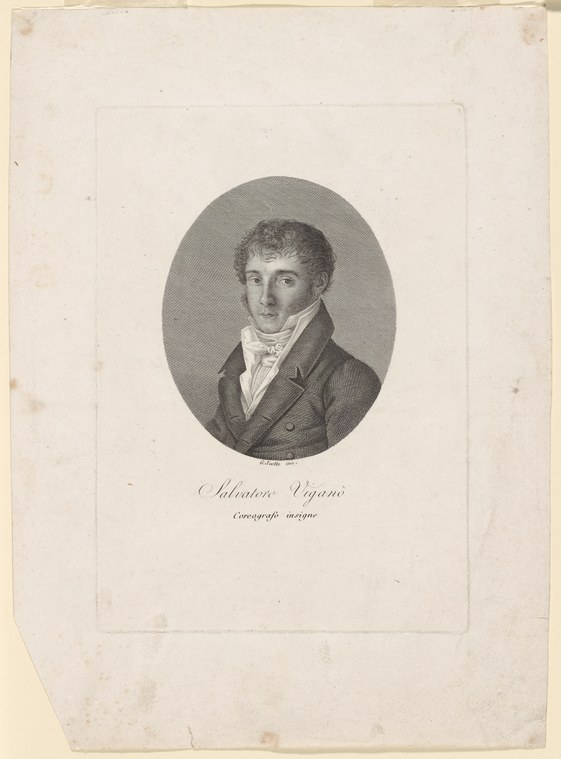
Salvatore Viganò. Coreografo insigne
Unknown artist
- Collection:
- Prints depicting dance
- Source:
- New York Public Library
- Rights:
- Public domain — free to use, share and adapt.
- Recorded as:
- Public Domain
Viganò is essential to the history of ballet because he was among the first to treat choreography as a serious compositional art with the same structural and dramatic complexity as music or literature, not merely as courtly entertainment or divertissement. This portrait circulated his image as proof of his cultural legitimacy during a period when dance was fighting for recognition as a major art form. Any study of 19th-century ballet reform must account for Viganò's innovations and influence.
What you are looking at
This is a portrait engraving of a man identified by the inscription as Salvatore Viganò, a celebrated choreographer. The figure is shown as a bust-length portrait within an oval frame, wearing early 19th-century dress: a dark coat with a high white collar and neckerchief, rendered in fine detail against a toned background. The engraving employs careful cross-hatching and stippling to model the face and suggest volume, creating a three-dimensional effect typical of portrait engravings of the period. The sitter's expression is formal and composed, gazing slightly past the viewer with the dignified bearing expected of a cultural figure of significance. The inscription beneath the oval reads "Salvatore Viganò" followed by "Coreografo insigne" (distinguished choreographer), establishing his profession and status.
The dancing
The portrait shows no active dance movement; this is a commemorative bust-length study rather than a scene of performance. The single figure sits with upright posture, shoulders square, the body still and formal in the manner of early 19th-century portraiture. The head is turned slightly, the gaze held level. The artist has captured the refined, stationary bearing appropriate to a man of artistic authority rather than a moment of physical action.
The dance depicted
Salvatore Viganò (1769–1821) was one of the most innovative and influential choreographers of the late 18th and early 19th centuries, a reformer who fundamentally transformed ballet from its courtly conventions toward dramatic spectacle and mimetic storytelling. He is best known for his development of "coreodrama"—extended choreographic narratives performed to symphonic music, often based on classical or contemporary literature. This portrait celebrates him as "coreografo insigne," emphasizing his standing as a master of his art during a period when choreography was beginning to be recognized as a serious compositional discipline on par with music and painting. The engraving itself does not depict dance but rather serves to immortalize Viganò as a public intellectual and artistic innovator.
How it was made
This is an engraving, identifiable by its precise linear technique, fine parallel lines, and tonal modeling through cross-hatching and stipple work. The oval format was standard for portrait engravings of the Napoleonic and early Restoration era, designed for circulation in print form—in books, journals, or as individual sheets for collectors. The quality of execution and the careful attention to dress and physiognomy suggest this was a professional commission by a skilled engraver, likely published to circulate Viganò's image among educated audiences and patrons of the performing arts. Engravings of this type functioned as both artistic works and documentary records of notable figures.
About this work
This engraved portrait commemorates Salvatore Viganò, the Venetian-born choreographer whose reforms of ballet and invention of coreodrama reshaped European dance in the early 19th century. The work documents not a moment of dance itself but rather the cultural elevation of the choreographer as an intellectual and compositional artist worthy of portraiture and circulation. Viganò worked primarily in Milan and Vienna, creating grand narrative ballets that integrated dance with music, drama, and spectacular design—a model that influenced ballet for generations. The engraving's inclusion in a collection of dance imagery reflects the historical importance of Viganò as a transformative figure whose choreography defined an era, even though the portrait itself shows him in stillness rather than motion.
How to look at it
This portrait asks you to recognize Viganò as an intellectual and cultural authority, not as a performer. Notice the formal dress, the composed expression, and the dignified bearing—these signal that the subject is a creator and thinker, not an entertainer. The fine engraving technique itself conveys respect and permanence; this is not a casual sketch but a carefully executed work meant to last. The inscription below the portrait is as important as the image itself: it tells you how Viganò wanted to be remembered—not as a dancer, but as "Salvatore Viganò, distinguished choreographer."
The artist
The engraver is not identified in the catalogue record. The quality of line work and portraiture suggests a skilled professional working in the 1810s–1820s, the period of Viganò's greatest fame, likely in Milan, Vienna, or another major European center where his work was celebrated. Portrait engravings of performers and artists were a significant market during this period, and the presence of the inscription "Coreografo insigne" indicates this was an official or semi-official commission designed for circulation among patrons of the arts.
The period
This engraving dates to the era of Viganò's maturity and celebrity, roughly 1810–1830. It emerges during a period when ballet was undergoing radical transformation in response to Enlightenment ideas about art and expression. Viganò's work was part of a broader movement to elevate dance from entertainment to serious drama, comparable to reforms happening in opera and spoken theatre. The Napoleonic Wars and the opening of borders had created new opportunities for artistic exchange, and Viganò's ballets—performed across Italy and Austria—became models for the emerging Romantic ballet aesthetic that would reach its apex in works like Giselle (1841) and Swan Lake (1895).
Where it lives
This engraving is held in the New York Public Library's collection of prints depicting dance, a collection that gathers documentary and artistic images related to choreography and performance from across centuries and cultures. As a print, it would have been distributed during or shortly after Viganò's lifetime, making it both an artwork and a historical document.
Questions about this work
Why is this portrait in a dance collection if there's no dancing in it?
Because Salvatore Viganò is one of the most important figures in dance history, and this engraving documents his cultural status as a major artistic innovator. Dance history includes not only images of dancing but also images of the choreographers, composers, and institutions that shaped it. This portrait circulated during Viganò's lifetime to establish his reputation and authority.
What was coreodrama?
Coreodrama was Viganò's invention: extended, narrative ballet works with integrated music, set design, and mime, based on literary or historical subjects and structured with the dramatic complexity of opera or spoken theatre. They replaced the 18th-century convention of short dances inserted into plays or other entertainments. Viganò's coreodrama La créazione del mondo, performed in Milan in 1815, is considered a landmark in ballet history.
When and where did Viganò work?
Salvatore Viganò was born in Venice in 1769 and died in Milan in 1821. He worked primarily in Italy and Austria, with major positions in Venice, Rome, and especially Milan, where he was ballet master at La Scala for the final decade of his life. His influence extended across Europe through touring companies and through other choreographers who adapted his methods.
More dance artwork





