49 works in this view — arrow keys or swipe to move between them.
Dance in Art
Dance cartoons
Unknown artist
- Collection:
- Prints depicting dance
- Source:
- New York Public Library
- Rights:
- Public domain — free to use, share and adapt.
- Recorded as:
- Public Domain
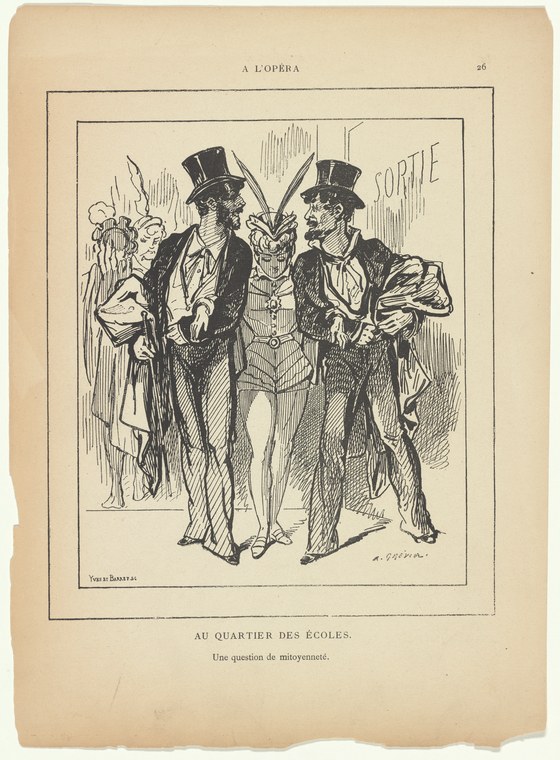
This engraving documents the ballroom not as a place of actual dancing but as a stage for social performance, satire, and courtship ritual. It reveals how 19th-century visual culture understood the gap between the elegance promised by ballroom fashion and the pretense underlying it. For dance historians, it is evidence of how contemporaries perceived ballroom society—not as natural movement but as elaborate, rule-governed theater.
What you are looking at
A satirical engraving shows three fashionably dressed men at a social gathering, positioned center-stage against a loosely sketched background of onlookers. The central figure is a woman in a corseted dress with a dramatically high waistline, flanked by two men in tailcoats and top hats striking exaggerated poses. The word "SORTIE" (exit) appears in the upper right, suggesting this captures a moment of departure or social maneuvering at a ballroom or theater foyer. The loose, gestural hatching in the background and the caricatural treatment of the figures indicate this is social satire rather than documentary—the bodies are elongated and poses theatrical, the expressions knowing. The medium is engraving or lithography, rendered in black line on aged paper with the characteristic wear of 19th-century print circulation.
The dancing
The central woman stands upright with arms extended and slightly raised, as if in a moment of social display or greeting; her posture is rigid and stylized rather than naturalistic. The flanking men adopt contrasting stances—the figure on the left leans forward with weight shifted, while the one on the right appears to turn or pivot away, creating a compositional tension. None of the three are engaged in actual dance movement; their gestures are social and performative, a frozen tableau of ballroom etiquette rather than choreography. The elongated proportions and exaggerated arm angles are characteristic of caricature, emphasizing the artificiality of social posturing over bodily reality.
The dance depicted
This is not a depiction of dance in the technical sense but of ballroom social performance and courtship ritual. The scene captures the theater of 19th-century urban social life, where fashionable dress and mannered gesture were themselves a form of display. The engraving satirizes the posturing and pretense of salon culture, with bodies arranged in a mockery of courtly elegance. While ballroom dances like the waltz and quadrille were the context for such encounters, the image focuses on social maneuvering rather than the actual steps or holds of ballroom dancing.
How it was made
This is an engraving or possibly a lithograph, executed in black line on laid paper typical of 19th-century French print production. The technique employs bold, economical line work and vigorous cross-hatching in the background to create volume and atmosphere without naturalistic detail. The signature appears lower left ("Valet Barbiér" or similar), identifying the artist within a tradition of satirical social commentary. The work shows the wear characteristic of period prints—slight discoloration, edge damage—suggesting active circulation and use as a consumable commodity in popular visual culture rather than a precious object.
About this work
This is a satirical social engraving from the 19th century, likely French, depicting the performative rituals of ballroom society rather than dance itself. The image captures the artifice of courtship and social display at the moment of theatrical exit—a criticism of mannered elegance rendered through caricatural distortion. The work belongs to a rich tradition of social satire in printmaking, where the ballroom served as a setting for commentary on fashion, class aspiration, and the gap between social pretense and human authenticity.
The engraving's value lies not in documenting actual choreography but in revealing the performative nature of ballroom culture itself. The elongated figures and exaggerated poses invite us to see social dancing as ritualized theater, a world of strict codes and artificial gestures. For historians of dance as social practice, this image is as revealing as one showing actual steps: it shows us what ballroom society looked like from the outside, how contemporaries understood its artificiality, and how satire could expose the mechanics of gendered courtship and class performance.
How to look at it
Notice the artist's choice to freeze not an actual dance step but a moment of social transaction—the exchange of looks and the performance of elegance at the ballroom's edge. The elongation of the figures and the exaggeration of the poses signal satire: this is not how bodies actually move, but how society pretends they do. Look at the contrast between the central woman's formal, nearly rigid posture and the men's shifting weight and turned heads—the image captures social game-playing in miniature. The loose, gestural background of onlookers emphasizes that this is a public performance, staged for an audience of peers.
The artist
The artist is credited as Valet Barbiér (or similar), a figure in 19th-century French satirical printmaking whose work appeared in publications like *L'Opéra* and other periodicals devoted to social commentary. Little is documented about the artist's biography, but their practice belongs to a well-established tradition of social caricature and salon satire in French graphic arts. The work's appearance in a periodical or collection of prints indicates it was part of a mass-produced commentary on contemporary manners.
The period
The engraving dates to the mid-to-late 19th century, a period when the ballroom was at its zenith as a site of social aspiration and elaborate etiquette. The waltz, quadrille, and cotillion dominated fashionable dance, and the ballroom was central to courtship and marriage markets across Europe. Simultaneously, rapid urbanization and the rise of a commercial leisure class created anxiety about authenticity and social climbing—precisely the target of social satirists. Visual satire flourished in this context, with prints circulating widely in journals and collections aimed at educated urban audiences. The image reflects both the hegemony of ballroom culture and growing skepticism about its claims to refinement.
Where it lives
The work is held in the New York Public Library's collection of satirical prints and dance imagery. It appears to have been part of a period periodical or print collection devoted to social commentary, likely distributed commercially in 19th-century France. The catalogue description is minimal, but the object's condition and presentation suggest it was a consumable item in urban print culture rather than a precious artwork.
Dance in this work
Questions about this work
Is this actually showing a dance?
Not in the technical sense of choreography or steps. The figures are arranged in a social tableau at the moment of departure or greeting at a ballroom. What the image satirizes is the performative aspect of ballroom society—the mannered gestures, the rigid postures, the courtship rituals—rather than the actual dances (waltz, quadrille) that would have been performed. It is a commentary on ballroom culture as theater.
What is the word 'Sortie' doing in the upper right?
Sortie means 'exit' in French, and it labels this moment as one of departure or social maneuvering. The title may suggest this is the moment when dancers or social participants leave the ballroom floor, a transitional moment of heightened social performance. It anchors the satire: the image captures the artificial, theatrical nature of even leaving a social gathering.
Who was Valet Barbiér?
Very little is documented about this artist beyond their work in 19th-century French satirical printmaking. They contributed to publications like *L'Opéra* that specialized in commentary on theater, fashion, and ballroom society. Their identity and biographical details remain obscure, but their practice was firmly within the tradition of social caricature and urban satire.
What does the engraving tell us about ballroom dancing?
It reveals that 19th-century observers saw the ballroom as a site of artificial, rule-governed performance rather than natural movement. The exaggeration and satire suggest skepticism about ballroom culture's claims to elegance and refinement. For historians, it is evidence of how contemporaries understood the gap between ballroom society's pretensions and social reality.
More dance artwork





