49 works in this view — arrow keys or swipe to move between them.
Dance in Art
La cachucha
Unknown artist
- Collection:
- Prints depicting dance
- Source:
- New York Public Library
- Rights:
- Public domain — free to use, share and adapt.
- Recorded as:
- Public Domain
The cachucha was one of the defining dances of Romantic theatre, a solo vehicle that required technical brilliance, speed, and theatrical presence. For anyone studying how the Romantic period understood Spanish or exotic dance, or how theatrical stardom and mass-market imagery intersected in the 19th century, this print is primary evidence of what audiences actually saw and how the dance was promoted.
What you are looking at
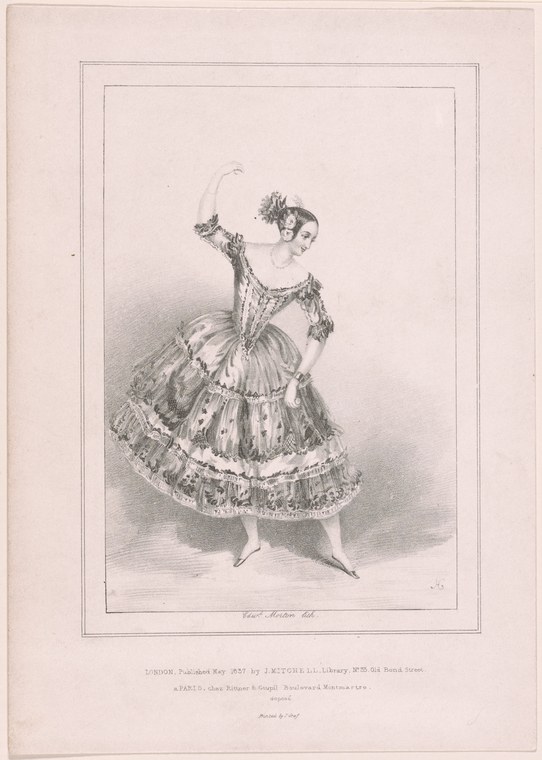
A single female dancer dominates the composition, posed in a moment of exuberant movement against a plain background. She wears an elaborate mid-19th-century dress with a fitted bodice and deeply flounced skirt decorated with horizontal stripes and appliqué detail; the skirt is caught and lifted to reveal her legs and feet. Her posture is energetic and theatrical: the left arm is raised with a slight bend, the right arm extends outward, and her body leans into the movement with confidence. Her head is turned slightly, and she appears to be mid-step or mid-turn. The dress, hair styling with what appears to be a decorative ornament, and the overall presentation suggest a professional theatrical dancer of some renown, likely a principal dancer from a major opera house or theatre.
The dancing
The dancer's weight appears to be shifting onto the right leg, with the left leg extended or lifting. Both arms are raised and extended in an open frame—neither clasped nor in closed hold, as befits a solo dancer. The torso is upright and energized, the shoulders are relaxed, and the overall posture suggests facility and control rather than strain. The raised skirt reveals the line of the leg and suggests rapid movement or a turning motion; the viewer is shown a dancer actively performing, not posing statically.
The dance depicted
This is almost certainly a representation of the *cachucha*, a Spanish solo dance of the 1830s–1840s that became a major vehicle for celebrated theatrical dancers across Europe. The cachucha was characteristically performed by a single female dancer in a richly decorated costume, often with castanets, and featured rapid footwork, pirouettes, and sharp arm and head movements. The dress style, the solo presentation, the energetic mid-movement pose, and the arm carriage all align with how the cachucha was depicted in prints and theatrical imagery of this era. The dance was performed with great success by dancers including Fanny Elssler and became a signature of Romantic-era theatrical dance.
How it was made
This is a lithograph, a technique allowing mass production through the printing of stone. Lithographs were the dominant medium for theatrical imagery in the 19th century—cheaper and faster than engravings, they reached a broad middle-class audience hungry for images of popular performers. The medium allowed fine detail in the costume and permitted soft modeling of light and shadow across the figure, particularly visible in the shading of the skirt and the background. The double border frame and the inscription at the foot are typical of commercial theatrical prints of this era.
About this work
This is a theatrical print documenting the *cachucha*, a Spanish solo dance that became one of the defining dances of the Romantic ballet era. It captures a dancer mid-performance, in the energetic, open-armed pose that made the cachucha famous across European stages in the 1830s–1840s. The work belongs to the rich tradition of commercial theatrical lithography that documented and promoted the star dancers of the era, making vivid movement and costume instantly available to the public. The cachucha was a crucial bridge between Spanish folk tradition and European theatrical sophistication, and this print preserves the look of the dance and the splendor of its stage presentation.
How to look at it
Notice the arrested mid-action moment: the artist has frozen the dancer at a point of maximum energy and elegance, not at rest. The raised arm and open frame are characteristic of how 19th-century prints presented the cachucha—as a display of technical facility and theatrical presence. The costume is rendered in careful detail, with particular attention to the flounced skirt and its ornamental trim; this specificity suggests the print was made to celebrate a particular production or performer. The pose is simultaneously naturalistic (the weight shift, the engaged limbs) and theatrical (the open frame, the energized carriage, the moment chosen).
The artist
The artist is not recorded. The print was produced by a London publisher and distributed commercially. Such prints were often created by staff lithographers working from descriptions or sketches of famous dancers in performance; the quality suggests a professional hand with experience in theatrical imagery, but individual attribution was not always recorded or preserved in the commercial theatre-print trade.
The period
The 1830s–1840s were the peak of Romantic ballet and the star system in European theatre. Dancers like Fanny Elssler and Marie Taglioni were international celebrities; their successful roles were reproduced in prints, illustrations, and descriptions distributed to fans across multiple countries. The cachucha in particular became a craze—a dance Spanish in origin but transformed and elevated by theatrical presentation into something that satisfied European taste for exoticism, technical display, and female star power. Commercial lithography made such images affordable and widely accessible, turning individual performances into repeatable visual spectacles.
Where it lives
This lithograph is held in the New York Public Library's collection of prints depicting dance. It is a commercial theatrical print, the type mass-produced and sold to theatre audiences as souvenirs and collectibles; such prints documented the major roles and star performers of the era and circulated knowledge of theatrical dance well beyond those who attended performances.
Dance in this work
Questions about this work
What is the cachucha?
The cachucha is a Spanish solo dance of the 1830s–1840s that became a major sensation in European Romantic theatre. It features rapid footwork, turns, and sharp arm and head movements, often performed with castanets. Theatrical dancers like Fanny Elssler made it famous, and it became a signature role for celebrated ballerinas of the era.
Who was this dancer?
The artist and subject are not identified in the catalogue record. However, the quality of the costume and the professional presentation suggest this was a well-known dancer of the 1830s–1840s. If the print originally carried a caption or the dancer's name, that information is no longer attached to this copy.
Why does she have her skirt raised?
The raised skirt was part of the theatrical presentation of the cachucha. It revealed the dancer's footwork and the line of the leg, showcasing the rapid, intricate steps and turns that were central to the dance. This was an exciting innovation for the period—previously, long skirts had obscured the feet and legs of performers.
How do we know this is a lithograph?
Lithographs have a distinctive appearance: soft tonal gradation, fine detail achievable on a prepared stone, and the characteristic printing look. The technique allows for the delicate modeling of light and shadow visible here, especially in the fabric and background. Lithography was the dominant medium for theatrical prints in the 19th century.
More dance artwork





