49 works in this view — arrow keys or swipe to move between them.
Dance in Art
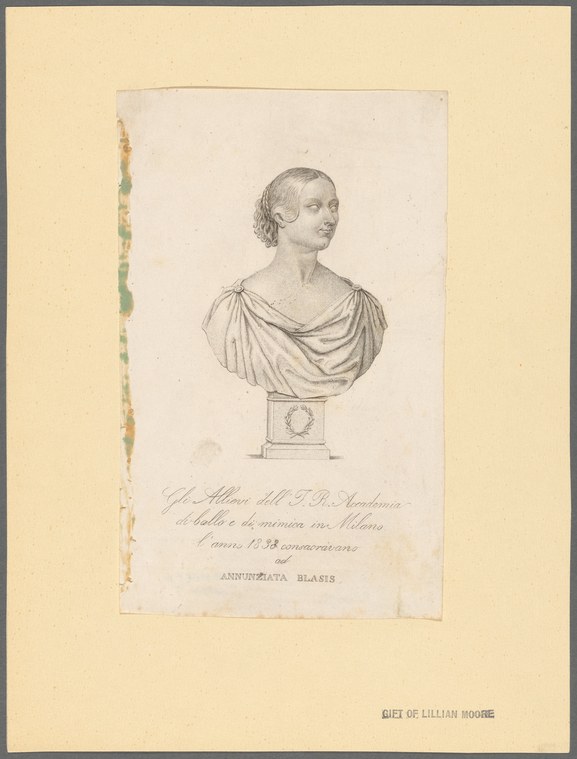
Gli Allievi dell' I.R. Accademia di ballo e di mimica in Milano l'anno 1838 consacravano ad Annunziata Blasis
Unknown artist
- Collection:
- Prints depicting dance
- Source:
- New York Public Library
- Rights:
- Public domain — free to use, share and adapt.
- Recorded as:
- Public Domain
Annunziata Blasis was part of the Blasis dance family, and this engraving is a rare contemporary record of a woman pedagogue in dance at a prestigious European academy. The work documents the esteem in which advanced dance instruction was held in early 19th-century Milan, a major centre of ballet after the Napoleonic era.
What you are looking at
This is a neoclassical bust portrait rendered in fine line engraving. A young female figure is depicted from the shoulders up, her head turned slightly to the viewer's left in three-quarter view. She wears a draped classical garment with the neckline gathered at the shoulder—a style evoking Greco-Roman dress—and her hair is arranged in a simple upswept style typical of early 19th-century portraiture. The bust sits on a plain rectangular plinth with a central oval cartouche, against a white ground. The inscription beneath names the subject and dedicates the work to the students of the Imperial Royal Academy of Dance and Mime in Milan in 1838. The execution is precise and delicate, with soft modelling of the face and careful attention to the drapery folds.
The dancing
The figure is static and frontal, posed as a commemorative portrait rather than a dancer in motion. The head is slightly inclined and turned, the shoulders relaxed and square. This is not a study of bodily movement or dance technique, but a formal portrait monument to an individual. The neoclassical style deliberately suppresses any suggestion of action or emotional display.
The dance depicted
This is not a depiction of dance itself, but a commemorative engraving honouring Annunziata Blasis, likely a celebrated dancer or teacher of the early 19th century. The dedication to the students of the Imperial Royal Academy of Dance and Mime in Milan indicates she was a significant figure in Italian dance pedagogy or performance. The fact that students commissioned this portrait suggests she held considerable standing in the dance world of the 1830s. The neoclassical style of the portrait—with its allusions to antique sculpture—was a conventional way to confer dignity and permanence on performers in this period.
How it was made
This is a line engraving, a reproductive intaglio process well suited to fine detail and wide circulation. The delicate parallel lines and careful cross-hatching create subtle modelling without heavy shadows. Line engraving was the standard medium for commemorative and portrait prints in the early 19th century, allowing affordable multiple impressions for distribution among students, colleagues, or patrons. The technique implies this work was created for institutional circulation within the Milan dance academy or its networks.
About this work
This is a neoclassical commemorative portrait engraving dedicated to Annunziata Blasis by students of the Imperial Royal Academy of Dance and Mime in Milan in 1838. Rather than depicting dance itself, it honours an individual central to Italian dance education in the early 19th century through the formal language of bust portraiture. The work belongs in a gallery of dance imagery because it documents the institutional infrastructure of professional dance training and the status accorded to dance pedagogy in this period—recording not a movement or performance, but the person whose teaching shaped dancers.
How to look at it
Observe the formal conventions of the commemorative bust: the turn of the head, the classical drapery, the austere setting. These choices convey authority and permanence rather than vitality or motion. The inscription is integral to meaning—it is the dedication that transforms a portrait into a historical document. The engraving technique itself, with its fine lines and controlled gradations of tone, suggests refinement and careful craft, qualities the academy wished to associate with its teaching.
The artist
The artist is not recorded. The engraving was likely commissioned by the academy and executed by a professional printmaker in Milan. The style and quality suggest a competent reproductive engraver working within the neoclassical portrait convention, rather than an artist of independent renown.
The period
The early 19th century saw the consolidation of ballet as a codified art form with formal training institutions across Europe. The establishment of the Imperial Royal Academy of Dance and Mime in Milan reflected the Austro-Hungarian administration of Lombardy and the region's importance as a centre of Romantic ballet. Commemorative engravings of this kind were customary tributes to senior teachers and performers, creating a visual archive of the profession and its practitioners. The neoclassical style—referencing ancient sculpture and antique ideals—was deliberate, elevating dance instruction to the status of a classical discipline.
Where it lives
The work is held in the Prints depicting dance collection at the New York Public Library. The inscription indicates it was created in 1838 by students of the Milan academy, likely as a collective gift. It is labelled as a gift of Lillian Moore, a major dance historian and collector of the 20th century.
Questions about this work
Who was Annunziata Blasis?
She was a dance pedagogue at the Imperial Royal Academy of Dance and Mime in Milan in the early 19th century. The dedication by her students in 1838 attests to her prominence in Italian dance instruction, though detailed biographical records are sparse. She may have been a relative of the celebrated choreographer Carlo Blasis, who was influential in Milan.
Why is this a bust portrait and not a dance scene?
Commemorative engravings of this period often took the form of neoclassical busts to confer dignity and permanence on the subject. This format was used to honour distinguished teachers and performers, presenting them as classical ideals rather than recording them in motion. The work honours Blasis as an institution-builder and pedagogue, not as a performer.
What was the Imperial Royal Academy of Dance and Mime in Milan?
It was a major training institution for ballet and pantomime in Lombardy during the Austro-Hungarian rule of northern Italy. The academy was a centre of Romantic ballet in the 1830s–1840s and played a key role in transmitting Italian ballet technique across Europe.
How do we know this is an engraving?
The fine parallel lines, precise detail, and subtle tonal modelling are characteristic of line engraving. The technique is evident in the handling of the drapery folds, the soft shading on the face, and the sharp definition of the inscription. The even, delicate line is typical of reproductive engravings of this period.
More dance artwork





