49 works in this view — arrow keys or swipe to move between them.
Dance in Art
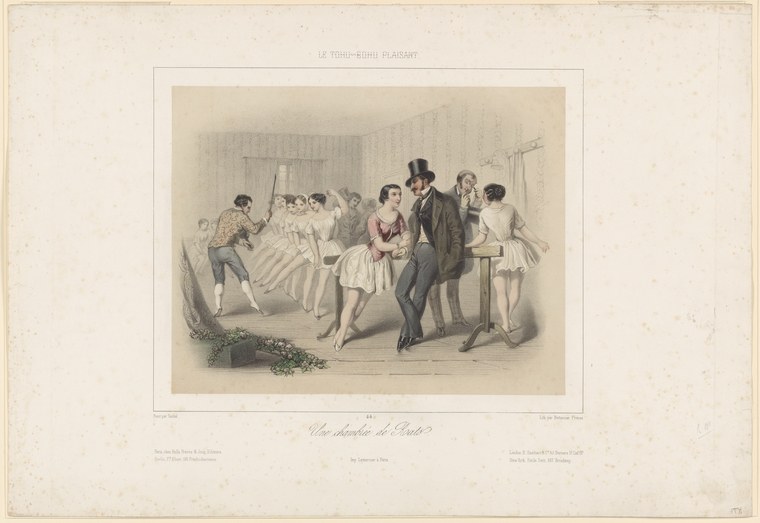
Une chambrée de Rats
Unknown artist
- Collection:
- Prints depicting dance
- Source:
- New York Public Library
- Rights:
- Public domain — free to use, share and adapt.
- Recorded as:
- Public Domain
This image is valuable evidence of the gap between formal ballroom dance technique and the way ordinary people actually danced in private or semi-public settings. It documents the social context and body language of popular dance in the early nineteenth century, including the role of music, alcohol, and flirtation. The work shows how dance was represented in popular visual culture for a non-elite audience, offering a counterpoint to the idealized depictions of dance in academic or aristocratic art.
What you are looking at
A crowded, lively interior scene depicts a group of young people dancing and socializing in what appears to be a modest bedroom or lodging room. The space is rendered with vertical striped wallpaper, and figures are scattered throughout in various states of engagement. In the center, a couple dances in an energetic embrace, the man in dark coat and top hat, the woman in a white chemise or nightdress. To the left, a figure in yellow plays a musical instrument (possibly a violin or similar). Around the periphery, other figures watch, gesture, or participate—some seated on a bed with striped mattress visible at left, others standing and gesturing animatedly. The composition is crowded and dynamic, with overlapping figures creating depth. The mood is one of youthful exuberance and informal merrymaking, the kind of scene that suggests working-class or student revelry. The title 'Une chambrée de Rats' (A Room of Rats—using 'rats' as slang for young rogues or dissolute youths) reinforces this sense of boisterous informality.
The dancing
The central dancing couple stands in a loose, energetic embrace typical of early nineteenth-century popular dance—the man upright in his coat and hat, the woman leaning into him, their bodies close. The woman's white chemise and bare arms are prominent, suggesting either undress or the casual attire of a servant or working-class woman. Around them, other figures adopt theatrical poses: hands raised in gestures of excitement, bodies angled toward the action, some seated and leaning forward. The overall frame is one of spontaneous, uninhibited movement rather than the formal frame of ballroom dance. There is no evidence of the controlled closed hold or upright posture of classical ballroom technique.
The dance depicted
This appears to depict a scene of popular, vernacular dance among young working-class or student figures—the kind of informal, energetic social dance that would have occurred in modest lodgings or cabarets in early nineteenth-century France. The title's use of 'rats' (a slang term for young bohemians or dissolute youths) suggests this is not a formal ballroom setting but rather a scene of popular revelry. The woman's state of undress and the bedroom setting indicate this is intentionally depicting informal, private dancing, possibly with flirtation or seduction as a subtext. The style of the dance itself—close, energetic, without rigid posture—is consistent with popular social dances of the 1820s-1840s period, possibly a early variant of the waltz or a quadrille danced in popular style, but the informality and context make precise identification difficult.
How it was made
This is a hand-colored engraving or lithograph, executed in soft tones of sepia, blue, and flesh tones typical of the Romantic period. The medium allowed for satirical or genre scenes to circulate widely among a popular audience—this appears to be a commercial print rather than a fine art work. The soft modeling of the figures, the careful stippled shading, and the composition suggest lithography, which by the 1820s-1830s had become the dominant medium for satirical genre prints in Paris. The technique of hand coloring after printing allowed for a range of tonal effects and permitted rapid, economical production of multiple impressions.
About this work
This is a genre print depicting informal social dancing among young working-class or bohemian figures in an early nineteenth-century French interior. The scene captures a moment of popular revelry and flirtation, with a couple dancing energetically in the center while companions watch and gesture animatedly around them. The work belongs to the tradition of Romantic-era genre satire—prints that documented and often gently mocked the manners and amusements of different social classes. It represents an important historical document of how popular dance was actually practiced outside the formal ballroom: energetic, close, uninhibited, and embedded in scenes of social intimacy and courtship. The print format and commercial circulation suggest this was mass-produced entertainment for a broad urban audience.
How to look at it
Attend to the contrast between the energetic, close-bodied dance of the central couple and the formal ballroom dances visible in contemporary dance manuals and paintings. Notice the woman's state of undress and the bedroom setting—these signal that this is private, intimate dancing rather than public performance. Observe how the artist has captured movement through gesture: the musician's bent posture over his instrument, the raised hands and leaning bodies of the spectators, the man and woman's interlocked embrace. The crowding and overlapping of figures creates a sense of spontaneous, uninhibited sociability. The print's satirical mode is gentle rather than biting; the 'rats' are depicted with sympathy and humor rather than contempt.
The artist
The artist is not recorded. The style and subject matter are consistent with the work of French satirical printmakers of the 1820s-1840s, a period when lithography enabled the rapid production of genre scenes aimed at urban popular audiences. The treatment of the subject—slightly mocking but sympathetic, with careful attention to social detail—is typical of the Romantic-era tradition of genre satire practiced by artists like Honoré Daumier, Paul Gavarni, and others associated with illustrated journals and popular prints.
The period
This print was created during the early Romantic period in France, when social dancing was undergoing significant transformation. The waltz and the quadrille were becoming fashionable in ballrooms, but these formal dances coexisted with older, more energetic popular dances performed in working-class venues, cabarets, and private gatherings. The print documents this world of informal popular dance, distinct from the ballroom world depicted in contemporary dance manuals and academic paintings. The emphasis on youth, flirtation, and bohemian excess reflects broader Romantic interests in authenticity, passion, and the lives of working and marginal social groups. The medium of the satirical print itself was at its height as a form of mass communication and social commentary in Paris during this period.
Where it lives
This is a hand-colored engraving or lithograph held in the NYPL's collection of prints depicting dance. It is identified as part of a series or genre of satirical French prints from the early nineteenth century. The catalogue record provides minimal information, but the inscription at the bottom of the print ('Une chambrée de Rats') is visible in the image.
Questions about this work
What does 'Une chambrée de Rats' mean?
'Rats' was nineteenth-century French slang for young bohemian or dissolute men, and the title can be translated as 'A Room of Rats' or 'A Den of Rogues.' The term had associations with student life, military barracks, and bohemian cafes. The title signals that this is a scene of youthful, informal, mildly disreputable revelry.
Why is the woman partially undressed?
The woman's state of undress (wearing what appears to be a chemise or nightgown rather than a dress) indicates that this is a private, intimate scene—possibly her bedroom or lodging. It may also suggest that she is a servant or working-class woman. The undress is part of the scene's visual code for informality, privacy, and the social position of the participants.
What kind of dance is this?
The dance is not formally identifiable from the image, but the energetic, close-bodied embrace suggests a popular variant of social dance from the 1820s-1840s—possibly an informal waltz or quadrille. The key point is that this is vernacular social dance, performed without the rigid posture and technique of formal ballroom dance, and embedded in a scene of drinking, music, and flirtation.
Who made this print and when?
The artist is not recorded, but the style, subject matter, and technique are consistent with French satirical prints from the 1820s-1840s. The work appears to be a lithograph or engraving that was mass-produced and hand-colored for circulation among a popular urban audience.
More dance artwork





