49 works in this view — arrow keys or swipe to move between them.
Dance in Art
Equestrian exercises
Unknown artist
- Collection:
- Prints depicting dance
- Source:
- New York Public Library
- Rights:
- Public domain — free to use, share and adapt.
- Recorded as:
- Public Domain
Haute école is often invisible in dance history, yet it was one of the most technically demanding and theoretically discussed movement practices of its era, and it directly influenced the development of ballet technique. Dancers and historians should recognize that the discipline of the mounted body taught the same virtues—uprightness, collection, the subordination of effort to appearance—that define classical ballet, and that the study of movement in the early modern period encompassed both.
What you are looking at
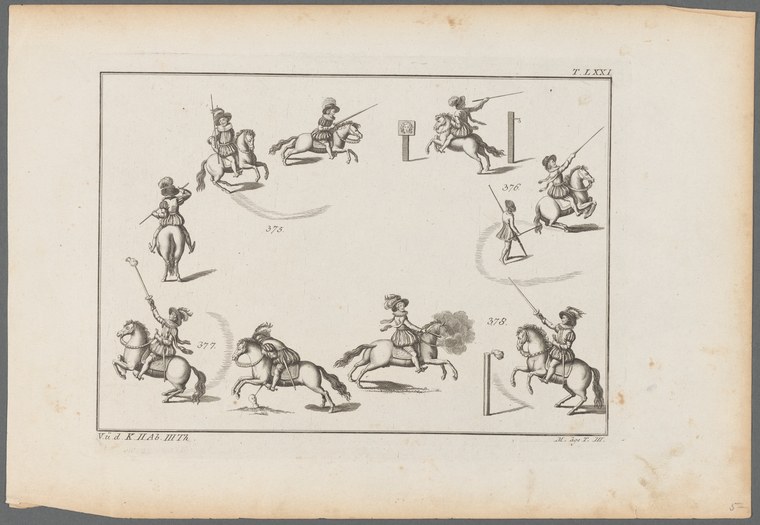
A pedagogical illustration of equestrian dressage or haute école movements, arranged in a grid format showing ten distinct mounted figures against a plain background. Each figure demonstrates a different classical horse-and-rider exercise or posture, labeled with small numerals. The riders wear military or court dress—fitted jackets, breeches, and caps—and sit atop horses in various attitudes of collection and elevation. Some horses rear or leap; others execute controlled lateral movements or passage steps. The composition is didactic rather than narrative: no landscape, no spectators, no dramatic moment—only the systematic display of technical positions. The engraving style, with fine parallel lines for shading, suggests this is an instructional manual or a codification of riding technique rather than a depiction of a single event or performance.
The dancing
Each rider maintains an upright, formal seat characteristic of classical horsemanship, with the legs positioned beneath or slightly behind the body for balance and communication with the horse. The horses themselves display the hallmarks of haute école: collected gait, arched necks, elevated carriage of the forequarters, and in several instances the characteristic rearing or leaping attitude known as levade or courbette. The bodies of the riders and horses work as a single unit; there is no slack or casual posture. The variety across the ten examples suggests a graded progression of difficulty or a taxonomy of movements, each isolating a particular technical demand.
The dance depicted
This is not social dance or theatrical dance, but classical equestrian dressage—specifically haute école or high school riding, the disciplined art of training a horse to execute movements derived from military cavalry training and refined into an aristocratic performance tradition. Haute école reached its codified form in the Renaissance and was systematized further in the Baroque and later periods through printed manuals and academies. The riders here appear to be military or court-trained horsemen demonstrating the school movements: passage, piaffer, levade, courbette, and other advanced collected movements. The instructional, non-narrative format suggests this is from a riding manual or treatise rather than a satirical or social comment.
How it was made
This is an engraving, identifiable from the fine hatching and the even, linear quality of the line work. The technique allowed for precise, repeatable illustration of technical form—essential for a teaching manual where clarity of position and movement matters more than atmosphere or drama. Engravings could be printed in large numbers and circulated among the educated classes, making them the standard medium for equestrian instruction books and anatomical or military manuals throughout the 17th and 18th centuries. The grid layout and the uniform treatment of each figure emphasize that this is functional pedagogy, not fine art.
About this work
This engraving documents classical equestrian dressage—haute école—one of the oldest codified movement systems in European culture and one that shares the disciplinary rigor and courtly status of ballet. Although not commonly grouped with dance history, haute école is a performance art of movement, balance, and the communication of control through the human body. The image belongs in a dance archive precisely because it shows an aristocratic movement tradition that parallels ballet in time, patronage, and technical refinement. The equestrian academy and the ballet academy were often interlinked in court culture; riding masters and ballet masters shared similar pedagogical methods and served the same elite audiences. This print is evidence that the codification and teaching of movement—whether on foot or mounted—was a central concern of early modern European civilization.
How to look at it
Examine each numbered figure as a discrete study rather than a sequence. Notice how the artist has captured the moment of maximum collection or elevation—the instant when the horse's body is most compressed and controlled, and the rider's position most clearly visible. The uniformity of treatment across all ten figures, despite the diversity of postures, suggests that they form a scale of difficulty or a logical taxonomy. This is the visual language of a textbook: clarity, repetition, and the isolation of each technical element so that a student can understand and imitate.
The period
This engraving likely dates from the 17th or 18th century, when haute école instruction was at its peak in Europe and printed manuals were the primary means of codifying and spreading technique. The royal courts of France, Spain, Austria, and Italy all maintained riding academies where noble youth were trained in dressage and classical horsemanship as a marker of status and military readiness. The same period saw the emergence of ballet as a formalized art at court, and the two disciplines shared teachers, patrons, and aesthetic values. By the 18th century, however, haute école was becoming increasingly specialized and removed from everyday military training, relegated to the imperial stables and elite academies—a trajectory similar to that of court ballet.
Where it lives
This engraving is held in the New York Public Library's Prints collection, catalogued under the broad heading of dance imagery. It arrived without attribution or detailed dating, but the style and content place it within the European tradition of equestrian instruction manuals.
Questions about this work
Is haute école a dance?
Haute école is mounted dressage—the art of training a horse to execute refined, controlled movements. It is not dance in the strict sense, but it is a codified performance art of the body that shares the discipline, the courtly context, and the pedagogical rigor of ballet. For historians and dancers, it offers insight into how movement was conceived and taught in the early modern period.
Why would this be in a dance collection?
Dance collections often include equestrian imagery because high school riding and ballet were closely linked in aristocratic education and courtly display. Both involved the body's command over a difficult medium—gravity and weight in ballet, weight and inertia in riding—and both were taught through progressive, systematic training. Understanding one illuminates the other.
When was haute école at its height?
Haute école was systematized and celebrated during the Renaissance and reached its peak in the 17th and 18th centuries. The Spanish Riding School in Vienna, founded in 1572, is the oldest continuously operating school and still trains riders in these classical movements. By the 19th century, it was primarily an aristocratic or military tradition rather than a universal skill.
More dance artwork





