49 works in this view — arrow keys or swipe to move between them.
Dance in Art
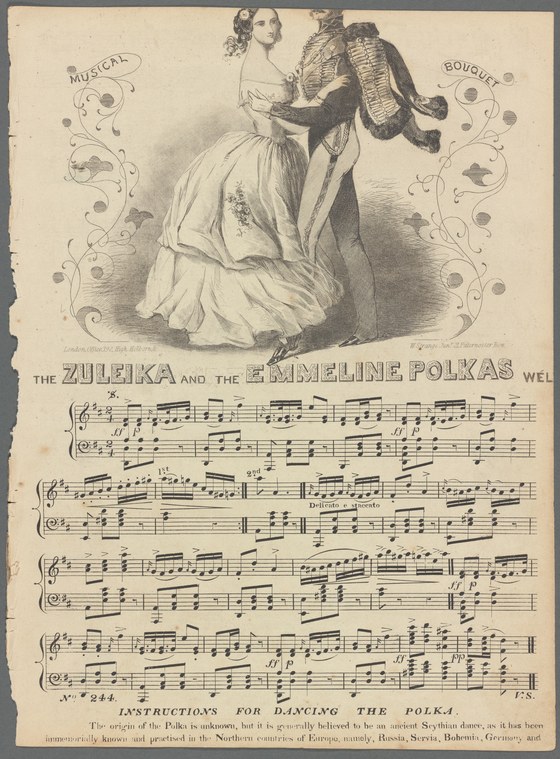
The Zuleika and the Emmeline polkas
Unknown artist
- Collection:
- Prints depicting dance
- Source:
- New York Public Library
- Rights:
- Public domain — free to use, share and adapt.
- Recorded as:
- Public Domain
The polka was the first truly international social dance craze, spreading from Bohemia across Europe and America in the 1840s–50s. Images like this one document not just the step patterns (which the instructions convey) but the *style* of performance—the posture, the energy, the emotional tone—that made the polka distinct from the waltz or quadrille. For historians of ballroom dance and nineteenth-century popular culture, such teaching prints are primary sources for understanding how dances were actually taught and performed at social level, beyond concert stages.
What you are looking at
A romantic couple occupies the center of this engraved sheet music cover, frozen in the moment of a dance. The woman, wearing a full-skirted white ball gown with off-shoulder neckline, leans back in the man's arms, her posture open and trusting. The man, dressed in a military-style jacket with elaborate braiding and frogging, supports her with one arm while gesturing expressively with the other. The composition is framed by delicate ornamental scrollwork in the corners, with musical notation visible at bottom. The woman's skirt billows around them, capturing the energy of motion; her upswept hair and the man's profile suggest the moment mid-turn. The engraving employs fine cross-hatching to model the fabrics and faces, creating a sense of genteel domesticity—this is ballroom dancing, not spectacle.
The dancing
The couple adopts a closed ballroom hold, with the man's right arm around the woman's waist and his left arm extended at shoulder height. The woman's weight appears to be supported almost entirely by her partner; her body arcs backward in an attitude of surrendered elegance. Their positioning suggests a turning movement, with the woman's voluminous skirt displaced by centrifugal force. The holding suggests formal European ballroom technique of the nineteenth century—upright torso for the male dancer, fluid and responsive frame for the female.
The dance depicted
This is a polka, one of the most popular social dances of the mid-to-late nineteenth century. The title refers to two polka variants or pieces: the 'Zuleika' polka and the 'Emmeline' polka, both named for their pieces. The polka is a couple dance in 2/4 time, characterized by small, quick steps and frequent turns. The image captures its intimate, energetic character: the turning action, the close hold, and the theatrical tilt backward were all hallmarks of polka performance. The inclusion of printed instructions at the base confirms this as a teaching document, meant to help ballroom dancers learn or refine the step patterns.
How it was made
This is an engraving or lithographic print, evidenced by the fine line work, the cross-hatching for tonal modeling, and the registration of text and musical score on the same sheet. The print combines three elements: an ornamental illustrated vignette at top, musical notation in the middle, and printed instructions for dancing at the base. This format was common for popular dance instruction sheets and commercial sheet music of the nineteenth century, particularly for fashionable social dances. The quality of the engraving and the inclusion of musical notation suggest it was a published commercial product, likely sold to middle-class dancers and music students.
About this work
This is a nineteenth-century dance instruction sheet for two polka pieces, combining an engraved romantic illustration with printed music and step instructions. The image exemplifies how popular social dances were disseminated: through sheet music sold to amateur dancers and musicians who wanted to learn the latest fashions from the ballroom. The couple depicted embodies the polka's character—lively, intimate, and oriented toward turning—and the woman's theatrical backward lean became iconic in polka imagery of the period. The work sits at the intersection of commercial print, musical publishing, and social dance pedagogy.
How to look at it
Notice the woman's pose: her backward lean is not accidental but a signature element of polka style, expressing both the power of the male dancer and the female dancer's responsive elegance. The turning motion implied by the swirl of her skirt and the positioning of the couple's bodies shows the artist understood that the polka was a dance of continuous rotation, quite unlike the more linear movements of earlier social dances. Observe also the military styling of the man's jacket—fashionable dress for formal evening wear in the 1850s. The presence of music below and instructions at the bottom grounds this as a functional teaching object, not merely a sentimental image.
The artist
The artist is not recorded. The work is a commercial engraving, likely produced by a London publisher (the collection provenance suggests British origin). Such sheets were typically created by specialist engravers working for music publishers; individual artist attribution was often not preserved or valued. The style and quality suggest a competent professional engraver familiar with ballroom imagery and the conventions of romantic illustration.
The period
The polka erupted as a social dance phenomenon in the 1840s, arriving in Europe from Bohemia and spreading with extraordinary speed. By the 1850s, it had become a staple of ballroom life in Britain, France, and America. Socially, the polka represented a democratization of dance: it was less formal and hierarchical than the quadrille, more energetic and playful than the waltz, and accessible to middle-class dancers without extensive training. The backward-leaning pose of the woman became a standard trope in polka imagery, representing the surrender and responsiveness expected of female dancers. The fashion for instructional dance prints grew in parallel with the proliferation of public and private dances; publishers recognized a market in teaching people the newest steps at home.
Where it lives
The work is held in the New York Public Library's Prints collection, catalogued as a dance-related image. It is one of many such instructional sheets and lithographic prints that circulated widely in the nineteenth century, sold through music publishers, dance halls, and general bookshops. Its survival in a research library reflects the growing recognition that such ephemeral commercial objects are important historical documents.
Dance in this work
Questions about this work
What is a polka and why was it so popular?
The polka is a lively couple dance in 2/4 time, characterized by quick small steps and continuous turning. It originated in Bohemia and became an international craze in the 1840s–50s because it was more accessible than older formal dances like the quadrille—less hierarchical, more playful, and easier to learn. Both men and women enjoyed dancing it, and it became a symbol of modernity and social progress.
Why is the woman leaning so far backward?
The backward lean was a signature element of polka performance, especially in romantic imagery. It expressed the dynamic power of the male dancer and the female dancer's responsiveness and trust. While instructional sources don't emphasize an extreme tilt, the theatrical version became standard in polka imagery and was often exaggerated for dramatic effect in prints and illustrations.
What are the instructions at the bottom for?
The printed instructions explain how to execute the polka step patterns, allowing dancers to learn from the sheet at home or with a partner. Such instructional prints were a primary means of disseminating new dances before the era of photographs and film; people relied on written descriptions and engravings to understand the step vocabulary and style.
Who would have bought this print?
Middle-class amateurs, music teachers, and dance instructors would have purchased such sheets. They were sold alongside sheet music and targeted people who wanted to stay current with fashionable ballroom dancing or teach others. The relatively high quality of the engraving suggests it was a commercial product aimed at consumers with disposable income and social ambitions.
More dance artwork





