49 works in this view — arrow keys or swipe to move between them.
Dance in Art
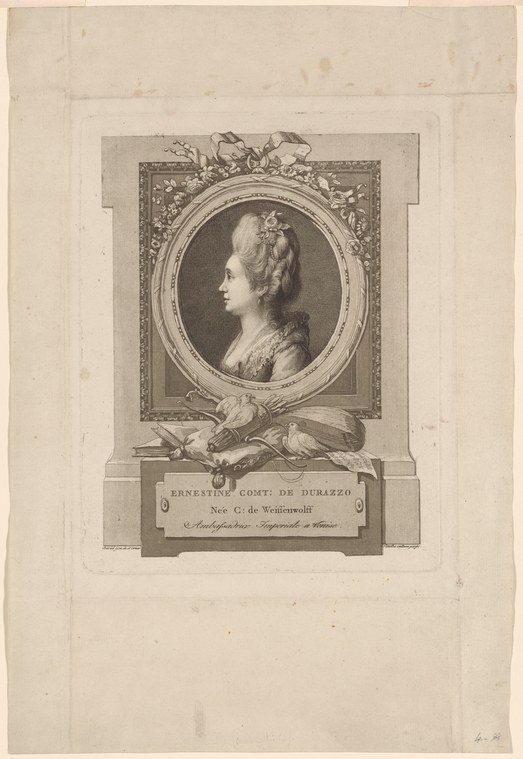
Ernestine comt: de Durazzo née C: Weissenwolff ambassadrice imperiale a Venise
Unknown artist
- Collection:
- Prints depicting dance
- Source:
- New York Public Library
- Rights:
- Public domain — free to use, share and adapt.
- Recorded as:
- Public Domain
This work matters primarily as a document of eighteenth-century aristocratic portraiture and diplomatic history, not as dance imagery. For a reader seeking visual evidence of how dance was performed, taught, or understood in this period, this portrait offers no information.
What you are looking at
This is an engraved portrait in the eighteenth-century style, showing a woman in profile facing left within a formal oval frame. She wears her hair elaborately dressed and powdered, styled high on her head in the fashion of the 1770s–80s, with curled ringlets framing her face. Her shoulders are bare or nearly bare, draped in what appears to be a filmy, decorative garment. The oval portrait is set within an ornate rectangular border featuring rococo ornaments—flowering urns or cornucopiae at the top and bottom, with delicate foliate scrollwork filling the architectural frame. Below the portrait runs an inscription plate identifying the sitter. The engraving technique produces fine hatching and subtle tonal gradations that model the face and neck with considerable delicacy. The whole composition sits on a plain ground, suggesting a formal presentation of status and refinement.
The dancing
A single figure, shown from the bust upward in strict profile. The head is held erect with the chin slightly lifted, a posture of aristocratic bearing. The shoulders slope naturally, with the upper torso relaxed. There is no active bodily movement or dance position—the figure is entirely static and posed for a formal portrait.
The dance depicted
This is not a depiction of dance. The image shows a portrait of a named individual—Ernestine, Countess of Durazzo—and contains no evidence of movement, performance, or dance activity. The inscription identifies her as a member of the imperial diplomatic service in Venice, suggesting her significance lay in court and political standing rather than in dance practice or performance.
How it was made
This is an engraving, identifiable from the fine parallel lines (hatching) used to create shadow and modeling, the clean linear quality of the contours, and the even tonal range characteristic of eighteenth-century reproductive engraving. The technique allowed for precise rendering of facial features and costume detail, and the work was likely circulated among the aristocratic and diplomatic circles of the Holy Roman Empire as a formal record of a notable woman's appearance and status. The New York Public Library catalogue identifies it as a print, consistent with the engraved line-work visible throughout.
About this work
This work is a formal portrait engraving of an eighteenth-century noblewoman, created in the refined rococo style typical of Central European aristocratic portraiture from the 1770s–80s. Ernestine, Countess of Durazzo, was a member of the imperial diplomatic corps and a woman of considerable social standing. The engraving documents her appearance and status through the conventions of formal dress and pose, conveying the elegance and refinement associated with her rank.
The work belongs in a gallery of dance in art only marginally, if at all. While the collection is entitled *Prints depicting dance*, this print does not depict dance, movement, or performance. It is a static portrait of a named individual. Its presence in the collection may reflect either cataloguing practice, a broader historical interest in the social world from which dance patrons and performers came, or an archival accident. The image itself contains no choreographic, kinetic, or performance content.
How to look at it
Observe the extreme refinement of the engraving technique, particularly in the modeling of the face and the subtlety of the hair arrangement. Note the rococo ornamental vocabulary framing the portrait—the urns, scrollwork, and floral motifs—which situate this woman within a world of cultivated taste and aesthetic refinement. The strict profile view and immobile posture follow the formal conventions of diplomatic and aristocratic portraiture, emphasizing dignity and timelessness rather than personality or movement.
The artist
The artist is not recorded in the catalogue. Based on the style, technique, and refinement of execution, this is the work of a professional engraver working within the rococo tradition of German-speaking Central Europe in the late 18th century, but attribution would require further research.
The period
This engraving dates stylistically to the 1770s–1780s, a period of high rococo refinement in portraiture across the Habsburg domains. During this era, formal portraiture in engraved form served as a primary tool for documenting and circulating the likenesses of the diplomatic and aristocratic elite. Dance itself flourished in the courts of this period—minuets, contredanses, and the emerging quadrille were central to aristocratic social life—but this portrait does not engage with that visual or performative world. The inscription's reference to Durazzo's role as *ambassadrice imperiale* indicates her position within the international political machinery of the period.
Where it lives
The work is held by the New York Public Library in its collection titled *Prints depicting dance*. It is an 18th-century engraving, likely German or Austro-Hungarian in origin, based on style and subject matter.
Questions about this work
Why is this portrait in a dance collection?
The catalogue record titles the collection *Prints depicting dance*, but this engraving does not depict dance or movement. It is a formal aristocratic portrait. Its inclusion may reflect broader historical collecting practices that document the social and cultural world of dance patronage, or it may be a cataloguing artifact.
Who was Ernestine, Countess of Durazzo?
According to the inscription, she held the title of imperial ambassadress (*ambassadrice imperiale*) to Venice. This indicates she was a member of the Habsburg diplomatic service and the aristocratic elite. The engraving was produced to circulate her likeness as a formal document of her rank and appearance.
What does the rococo frame tell us?
The ornamental border of urns, scrollwork, and foliate designs reflects the aesthetic tastes of the mid-to-late 18th century in German-speaking Europe. These elements frame the portrait as a luxury object and signal the sitter's refined social position.
More dance artwork





