49 works in this view — arrow keys or swipe to move between them.
Dance in Art
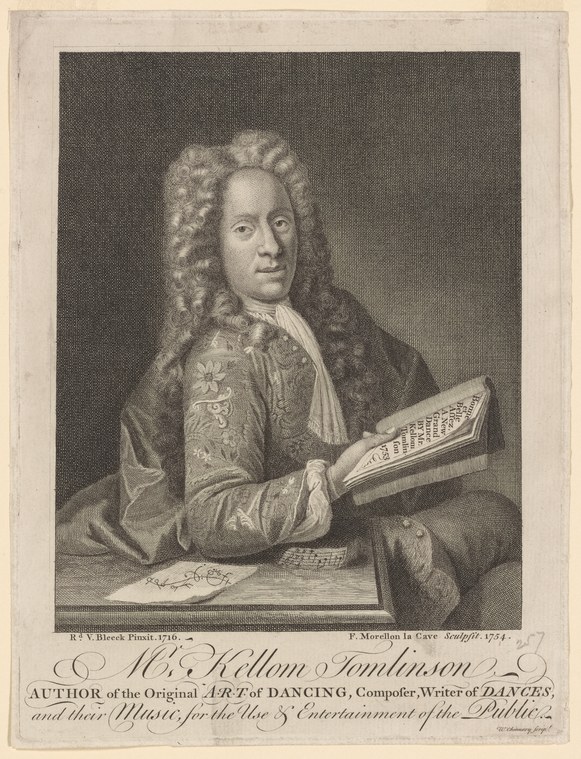
Mr. Kellom Tomlinson, author of the original Art of dancing, composer, writer of dances, and their music for the use & entertainment of the public
Unknown artist
- Collection:
- Prints depicting dance
- Source:
- New York Public Library
- Rights:
- Public domain — free to use, share and adapt.
- Recorded as:
- Public Domain
Tomlinson's *Art of Dancing* was one of the first systematic attempts to record and codify dance movement through notation, making it a foundational text in dance pedagogy and notation history. This engraved portrait, which may have served as a frontispiece or advertisement for the work, documents the emergence of the dancing master as a figure of intellectual authority—a shift that would reshape dance education and practice throughout the 18th century. For historians and practitioners, the image is essential evidence of how dance was conceived, valued, and transmitted in the early Georgian period.
What you are looking at
A three-quarter-length portrait of a man seated at a table, shown from the left side, holding an open book or manuscript of musical notation. He wears the fashionable dress of the early 18th century: an ornately embroidered coat with floral or scrollwork patterns, a long curled wig in the style of the period, and a white cravat or neck cloth. His right hand rests on the open score while his left hand lies on the table before him. The background is a plain dark wash, placing all emphasis on the figure and his engagement with the musical text. The composition is typical of engraved portrait prints of the period, with the figure positioned against an austere ground that throws the elaborate dress and careful attention into sharp relief.
The dancing
The man is seated in a composed, dignified pose. His posture is upright but relaxed, with his torso turned slightly toward the viewer and his head in three-quarter profile, looking down at or toward the manuscript. The shoulders are square and open. His hands are delicately positioned—one steadying the score, one resting—in the manner of a gentleman scholar or musician rather than a dancer. This is a portrait pose of intellectual authority, not a dancing figure.
The dance depicted
This is not a dance image. The inscription identifies the subject as Kellom Tomlinson, author of *The Art of Dancing* and composer of dances and their music, and the manuscript he holds appears to be an example of his notated choreography or musical score. Tomlinson was a significant figure in English dance pedagogy of the early 18th century. The portrait documents him as a theorist and writer of dance, not as a dancer in motion. It is an image of dance authorship and the codification of dance through notation.
How it was made
This is an engraving, executed with fine parallel lines (hatching and cross-hatching) to model form and shadow—a technique characteristic of reproductive engraving in the early 18th century. The signature or date mark visible in the lower left suggests it was produced by a professional print workshop, likely for circulation among educated patrons. Engraved portraits of this type were a primary means of disseminating images of notable figures and were often bound into books, collections, or sold individually. The technical sophistication suggests a skilled hand working from a drawn or painted original.
About this work
This is an engraved portrait of Kellom Tomlinson, an influential English dancing master and theorist, shown holding a manuscript of his choreographic notation. Rather than depicting dance itself, the image presents dance as a codifiable, transmissible practice—one that could be written down, studied, and taught. Tomlinson's *Art of Dancing*, first published in 1735, was a landmark effort to systematize and record dance technique and choreography in notation, and this portrait advertises that achievement. The work belongs in a gallery of dance in art because it documents a pivotal moment in dance history: the emergence of dance as a subject worthy of theoretical writing and the authority of the dancing master as author and pedagogue.
How to look at it
Attend to the book or manuscript Tomlinson holds: it is the focal point of the portrait, positioned prominently and rendered with care, signaling that notation and written knowledge are central to his identity and legacy. The elaborate embroidered coat and fashionable wig are markers of his status as a gentleman and a person of cultivation, not theatrical extravagance. The calm, studied pose and the careful arrangement of hands convey intellectual authority rather than physical virtuosity. The artist has chosen to present Tomlinson as a theorist and author, not as a performer—a significant choice that reflects how dance was being reconceived in this period.
The artist
The engraver is not recorded in the catalogue. The style and quality of the work suggest a skilled reproductive engraver working in London in the 1730s–1740s, a period when such prints were essential to the promotion of books, teachers, and artistic authority. The signature or inscription visible in the lower margin would identify the original artist (possibly a painter) and the engraver, but neither is legible or recorded here.
The period
The early 18th century saw the emergence of dance as a subject of written theory and systematic instruction in England. Raoul Auger Feuillet's choreographic notation system, developed in France in the 1690s, had begun to circulate in England by the early 1700s, enabling dances to be recorded and transmitted through print. Tomlinson was part of a generation of English dancing masters—including John Weaver—who sought to elevate dance from a courtly accomplishment to a respectable, teachable discipline with a documented canon of steps and dances. The portrait aligns with a broader 18th-century movement toward the professionalization and theorization of dance.
Where it lives
The work is held in the New York Public Library's collection of prints depicting dance. It is a reproductive engraving, likely produced as a frontispiece, advertisement, or standalone portrait print for sale or distribution among educated patrons and students of dance.
Questions about this work
Who was Kellom Tomlinson?
Tomlinson was an English dancing master and theorist active in the early 18th century. He is best known for *The Art of Dancing*, published in 1735, one of the first English-language treatises to systematically describe and notate dance technique and choreography. He taught both country dance and the more formal dances of the ballroom and theater.
What is the manuscript he is holding?
The open book appears to be a score or notated choreography—likely an example of Feuillet notation or a similar system for recording dance movement. It demonstrates Tomlinson's method of codifying and transmitting dance knowledge through written text and notation rather than solely through oral instruction or apprenticeship.
Why is this portrait important for dance history?
The image documents a crucial shift in how dance was conceived and practiced: the emergence of the dancing master as an author and theorist whose knowledge could be systematized, written down, and circulated through print. It marks the transition from dance as an oral, body-to-body tradition to dance as a codified discipline with documented principles and notation.
What was Feuillet notation?
Feuillet notation was a system of recording dance steps and patterns developed in France in the 1690s. It used symbols and markings on a staff resembling musical notation to indicate direction, step type, and rhythm. Tomlinson and other English dancing masters adapted and promoted this system in England during the early 18th century.
More dance artwork





