49 works in this view — arrow keys or swipe to move between them.
Dance in Art
Dancing monkeys
Unknown artist
- Collection:
- Prints depicting dance
- Source:
- New York Public Library
- Rights:
- Public domain — free to use, share and adapt.
- Recorded as:
- Public Domain
For historians of visual culture and dance representation, this print shows how movement and gesture were enlisted to embody ideas in an age before mass literacy. It demonstrates that 'dance' in early modern art encompassed far more than codified social or theatrical forms—it included allegorical play, spontaneous gesture, and the moving body as a text to be read. The work is also a reminder that not all dancing bodies in historical images were human, and that putti and cherubs became a standard visual language for expressing freedom, joy, and the playful exercise of divine will.
What you are looking at
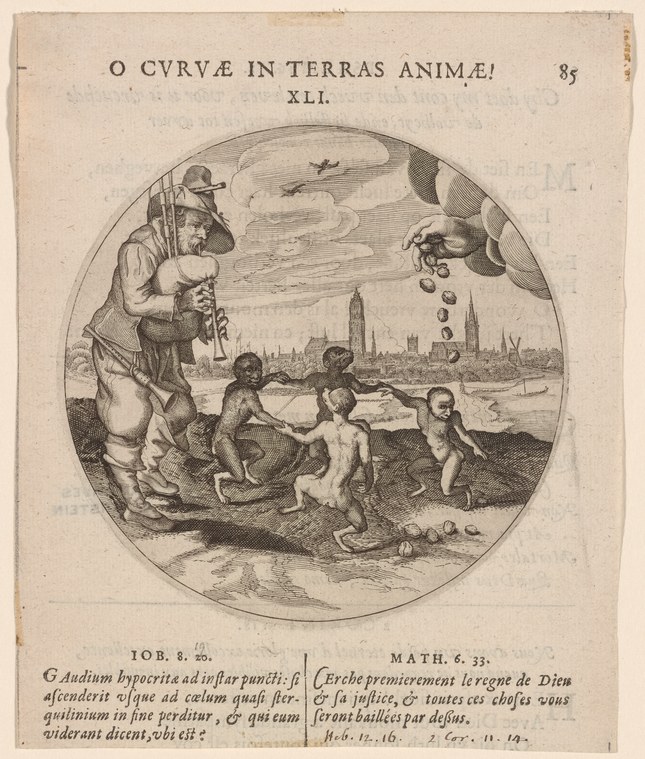
A winged allegorical figure—Cupid or a putto—stands at left holding arrows and gesturing toward a distant cityscape (recognizable as London, with its spires and Thames visible). In the foreground, four nude or lightly draped infant figures cavort on a riverbank or meadow, their bodies arranged in playful poses of movement and interaction. The composition is circular, framed by a neat border. The engraving is dated and numbered (XLI, page 89), and Latin inscriptions appear below, identifying this as part of a numbered series on the theme of divine or allegorical love operating in earthly affairs. The light is uniform, typical of printwork, with careful hatching establishing form and depth. The mood is didactic rather than narrative—the image illustrates a moral or religious proposition about Cupid's influence over human affairs.
The dancing
The four infant figures occupy the lower register in varied poses: two sit or squat facing each other, one stands with arms raised or extended, and one gestures or reaches toward the standing putto at left. Their bodies show the soft, rounded modeling characteristic of putti or cherubs. None stand in formal dance positions or hold established partner holds. Their postures suggest spontaneous play or frolic rather than codified choreography—weight shifts, asymmetrical stances, and individual rather than coordinated movement.
The dance depicted
This is not a depiction of recognizable historical dance but an allegorical tableau using the gestures and playful movement of infants to represent Cupid's agency in the mortal world. The 'dancing' here is visual metaphor—the scattered, uninhibited movement of children stands for divine love operating freely among humans. The work belongs to a genre of emblem prints and allegorical engravings common in Renaissance and early modern printmaking, where abstract ideas were given bodily form through arranged figures. The print's instructional captions confirm its function as a visual sermon on love's power, not a record of actual dance practice.
How it was made
This is an engraving—a print made from a metal plate, likely copper, incised with fine lines to create tone and form through hatching and cross-hatching. The circular composition and the serial numbering (XLI) indicate this is one plate from a larger set, probably a published book of emblems or allegories. Engravings allowed for wide circulation and were the primary medium for didactic and moralizing prints in this period. The precision and legibility of line made them ideal for prints meant to be read and contemplated, often bound into volumes for study.
About this work
This is an allegorical engraving from a numbered series on love and divine agency, most likely from a 16th or early 17th-century emblem book or religious/moral treatise. The image uses the unconstrained movement of putti—child-angels—as a visual argument about Cupid's influence over earthly affairs, with a distant cityscape anchoring the scene to the human realm. It belongs in a dance gallery not as a record of actual dance technique but as evidence of how Renaissance and early modern artists deployed the moving body—particularly the child's body—as a vehicle for allegorical meaning. The print exemplifies a widespread artistic convention in which dance-like, playful gesture became a language for expressing abstract theological or philosophical concepts.
How to look at it
Pay attention to the contrast between the gesturing putto at upper left—authoritative, armed, commanding—and the scattered, responsive infants below. The composition stages a relationship of influence: the distant city reminds us these are figures standing for human concerns. Notice how little the four putti coordinate their movements; they are playing independently rather than dancing together, which reinforces the idea that Cupid's arrows operate on individuals, not collectives. The Latin inscriptions are essential: they anchor the visual allegory in theological or philosophical argument, telling you this image was meant to be read, not simply enjoyed.
The period
This engraving belongs to the tradition of emblem books and allegorical prints that flourished in Renaissance and early modern Europe, particularly in the 16th and 17th centuries. Such prints were often bound into educational and devotional volumes, functioning as visual aids to moral and theological instruction. They drew on classical iconography—Cupid, allegorical figures, landscape settings—to make abstract concepts visible. During this period, the print became the primary medium for disseminating images and ideas across Europe, and allegorical imagery was a sophisticated language understood by educated readers. The serial numbering and Latin captions suggest this work was part of a systematic exploration of love, desire, and divine agency in human affairs.
Where it lives
This engraving is held in the New York Public Library's collection of prints depicting dance. It is part of a numbered series (XLI, page 89 in the original numbering), indicating it was one plate in a bound or sequential publication. The Latin inscriptions and the formal engraving technique suggest a 16th or early 17th-century publication, likely from a printed emblem book or allegorical treatise on love.
Questions about this work
Are these figures actually dancing?
Not in the sense of recognizable historical dance steps or choreography. They are posed in playful, gestural attitudes meant to represent uninhibited, joyful movement—the visual language of Cupid's free agency in the mortal world. For Renaissance allegorical prints, such posed gesture functioned as a kind of dance without needing to follow established dance conventions.
Why are there baby figures in a dance image?
Putti (child-angels or cherubs) were a standard allegorical device in Renaissance and early modern art, and Cupid in particular was always depicted as a winged infant or youth. Their youthfulness, innocence, and freedom from adult constraint made them ideal symbols for divine love or desire operating among humans without rational restraint.
What do the Latin inscriptions say?
The visible captions reference Job and Matthew, anchoring the image in theological argument. They are instructions for reading the allegory—telling the viewer that this image illustrates divine or moral truths about love's agency in human affairs. This was standard practice in emblem books, where text and image worked together as a single instructional unit.
Where does this series come from?
Without the original publication, we cannot say with certainty, but the numbering (XLI), the engraving technique, the allegorical subject, and the Latin inscriptions all point to a 16th or early 17th-century emblem book or religious/moral treatise, likely published in Northern Europe or Italy. Such works were widely produced and circulated.
More dance artwork





