49 works in this view — arrow keys or swipe to move between them.
Dance in Art
Pierrot: quadrille très facile
Unknown artist
- Collection:
- Prints depicting dance
- Source:
- New York Public Library
- Rights:
- Public domain — free to use, share and adapt.
- Recorded as:
- Public Domain
Pierrot quadrilles reveal how theatrical character dance permeated early 19th-century social dancing, and how professional choreography was adapted for amateur performance. The image documents a specific moment in the history of dance commercialization: the quadrille as a framework flexible enough to hold both abstract geometric patterns and narrative character work, distributed as printed sheet music for reproduction in homes across France.
What you are looking at
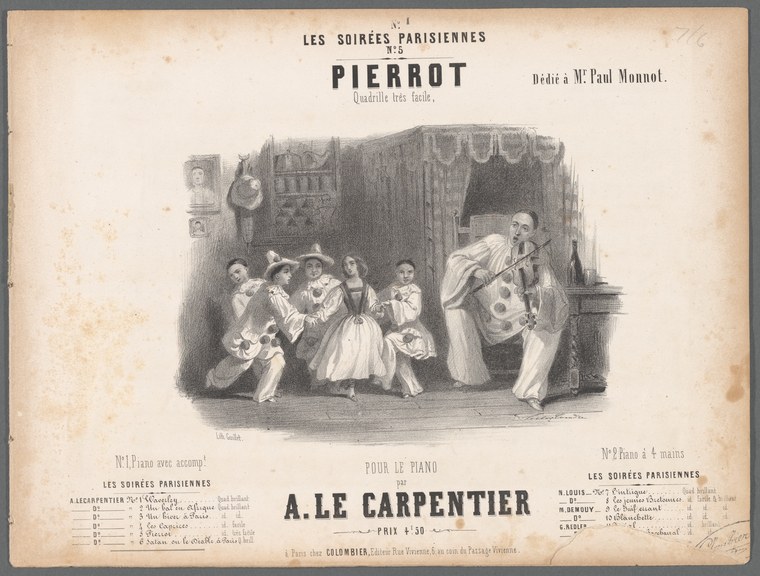
A theatrical interior scene of an elegant Parisian salon or ballroom, rendered in fine lithographic detail. A group of dancers in flowing white gowns and period dress occupies the center, arranged in a loose semi-circle around a central female figure. The women wear the high-waisted empire silhouettes and long skirts characteristic of early 19th-century fashion. A male figure in dark clothing leans dramatically from the right, his body angled sharply inward as if caught mid-gesture or mid-fall. The setting includes period architectural details—drapery, what appears to be a fireplace or alcove, and decorative wall elements—rendered in the delicate grays and blacks of the lithographic medium. The lighting is soft and diffused, typical of interior gaslit or candlelit spaces of the era. The composition suggests a choreographed moment rather than a naturalistic gathering: the figures are positioned with theatrical intent, their poses suggesting movement and narrative.
The dancing
The central female dancer stands relatively still, becoming the axis around which the male figure gestures. The male dancer's posture is striking: his torso is deeply bent or arched, his arm extended or raised, suggesting abandonment or emotional intensity—a gesture more associated with pantomime or character acting than pure movement. The surrounding women are in varied poses of observation or participation, some appearing to move or turn, though the exact footwork is unclear in the medium. The figures wear neither pointe shoes nor the hard slippers of classical dance, and their carriage suggests the demi-caractère vocabulary of early 19th-century theatrical dance rather than pure ballet technique.
The dance depicted
This is a *Pierrot* quadrille, a theatrical quadrille set to the character of Pierrot (the melancholic comic servant from commedia dell'arte tradition). The title's note that it is "très facile" (very easy) indicates this is a simplified arrangement for social dancers or students. Pierrot quadrilles were popular in Parisian ballrooms and theatres in the 1830s–1850s, often performed by professional dancers in character costume but also danced socially. The dramatic male pose—almost recumbent or despairing—is consistent with Pierrot's character: amorous, rejected, physically comedic. The work depicts not pure ballet but theatrical character dance embedded in the quadrille form, a four-couple social dance popular in the period.
How it was made
This is a lithograph, identifiable by its soft tonal gradations, fine linear detail, and the characteristic surface quality of stone printing. Lithography allowed rapid, inexpensive reproduction and wide circulation; this work's inclusion in a series ("Les Soirées Parisiennes") and the notation "Pour le Piano" (For Piano) suggest it was published as a sheet-music cover or theatrical souvenir, meant for domestic or ballroom use. The technique permitted both the fine architectural detail in the background and the tonal modeling of the figures' skirts and the dramatic shadow work around the male dancer. This was a commercial medium, aimed at the urban middle class.
About this work
This is a French lithographic print depicting a theatrical quadrille in the Pierrot character, likely from the 1830s–1840s era when such dances were fashionable in Parisian society. It belongs to a series, *Les Soirées Parisiennes*, and carries a dedication to Paul Maraot (or similar). The work sits at the intersection of professional theatre, social dance, and commercial print culture: it documents a real choreographic form (the quadrille) animated by theatrical character (Pierrot) and sold as a domestic commodity for piano-players and dancers in parlors and ballrooms. It is neither pure ballet nor pure social dance, but a hybrid form characteristic of the period—dance that brought theatrical character and narrative into the ballroom. The lithographic medium ensured wide circulation and made this image accessible beyond the theatre itself.
How to look at it
Notice the male dancer's extreme, almost prostrate posture—this is not technical display but character expression, the visual language of Pierrot's melancholy and comic despair. Observe how the surrounding women create a frame or audience for his gesture, positioning the viewer to read the scene as a theatrical moment, not a geometric pattern. The lithographer has chosen to freeze a moment of emotional intensity rather than formal line work, suggesting the narrative and pantomime that were as much part of the quadrille as the steps. The soft, atmospheric rendering of the interior space places the dancers in a specific social location: a private ballroom or theatre interior where genteel society enacted these coded character roles.
The artist
The print is credited to A. Le Carpentier and dedicated to Monsieur Paul Maraot. Beyond these names, the artist's biographical context is not recorded. The work belongs to a commercial publishing enterprise—likely a Parisian music or theatrical print house—producing affordable dance-related prints for the leisure market. Such works were often drawn and lithographed by minor theatrical artists or dance illustrators whose names are now lost.
The period
In the 1830s–1850s, the quadrille dominated Parisian ballrooms and was the primary social dance of the prosperous middle class. Simultaneously, the theatre was developing character dances—codified comic or national characters incorporated into opera, ballet, and vaudeville. The Pierrot character, inherited from commedia dell'arte but reinterpreted in the Romantic era, became a vehicle for expressive, sometimes pathos-tinged movement. Publishing houses capitalized on the appetite for dance by issuing choreographies, music arrangements, and didactic prints for the home market. This print sits within a broader phenomenon: the professionalization and domestication of dance knowledge in the early 19th century.
Where it lives
The print is held in the New York Public Library's collection of prints depicting dance. It is part of a published series, *Les Soirées Parisiennes*, and carries publication information suggesting it was issued as a lithographic sheet—likely as sheet-music cover or stand-alone theatrical souvenir—in early 19th-century Paris.
Dance in this work
Questions about this work
What is a Pierrot quadrille?
A quadrille (a four-couple social dance in five figures) that incorporated the character of Pierrot, the sad, amorous clown from commedia dell'arte. The male dancer(s) would perform this character—often with exaggerated, melancholic gestures—while the quadrille's geometric form was retained. It was a hybrid of theatrical narrative and ballroom pattern, popular in Parisian society from the 1830s onward.
Why would a quadrille be advertised as 'très facile' (very easy)?
Parisian publishing houses marketed choreographies at different skill levels for domestic consumption. A 'très facile' version would have simplified figures or reduced complexity, making it accessible to amateur dancers in parlors and at private balls. This note was a marketing tool for the sheet-music or souvenir market.
What does the notation 'Pour le Piano' mean?
It indicates that piano music accompanies the choreography—or that this print was issued as a cover for a piano arrangement of the dance music. The quadrille had a standard musical form, and the print would guide dancers while the piano provided the tempo and phrasing.
How does Pierrot quadrille differ from classical ballet?
A Pierrot quadrille is not ballet; it is social dance (the quadrille form) with theatrical character overlaid. There is no pointe work, formal line, or the rigorous technique of ballet. The male dancer's pose here—bent, expressive, gestural—belongs to pantomime and character dance, not the turned-out, lifted aesthetic of ballet.
More dance artwork





