49 works in this view — arrow keys or swipe to move between them.
Dance in Art
The Scotch musician
Unknown artist
- Collection:
- Prints depicting dance
- Source:
- New York Public Library
- Rights:
- Public domain — free to use, share and adapt.
- Recorded as:
- Public Domain
For historians of folk dance and social dance practice, this image provides rare evidence of how traditional music reached rural communities and how children encountered and learned dance repertory—not in formal classes but through street performance and mimicry. It also documents the figure of the travelling musician as a carrier of cultural knowledge in the pre-recording era.
What you are looking at
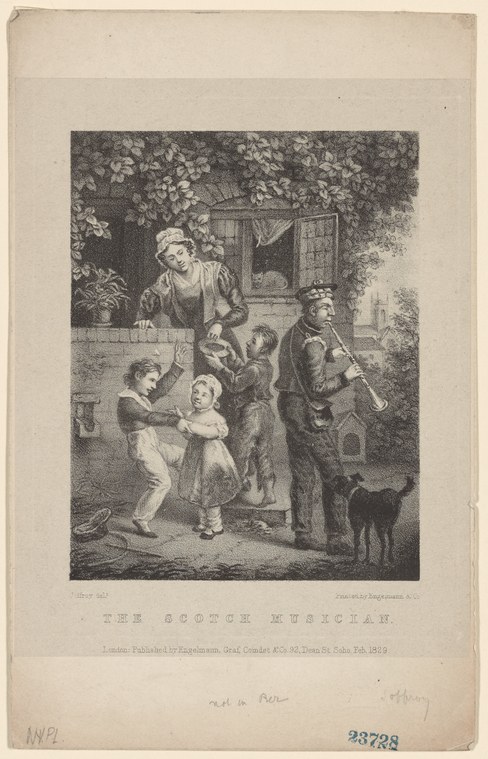
A Scottish musician in travel dress sits on a stone wall playing bagpipes, while three children in early 19th-century clothing gather around him in animated postures. The musician wears a cap and jacket; the children—two boys and a girl—are barefoot or in simple shoes, their bodies angled toward the piper in attitudes of listening and response. Behind them stands a cottage with a latticed window and ivy-covered walls, suggesting a rural Highland or Lowland setting. The composition is intimate and domestic, capturing what appears to be an impromptu street or village performance. The light is even and comes from the front, modeling the figures clearly against the cottage backdrop. A small dog rests in the lower left corner, adding to the genre-scene naturalism.
The dancing
The children's postures suggest they are responding to the music rather than executing formal steps—the nearest boy leans forward with bent knees in an attitude of excitement or listening, the girl stands upright with arms at her sides, and the farther boy appears to be in motion or mid-gesture. Their stances are relaxed and informal, the weight distributed naturally through the legs. None adopt the balletic turnout or frame of formal dance training; these are untrained children reacting to live music in a village setting. The piper sits anchored, his upper body bent slightly forward over the instrument.
The dance depicted
This is not a depiction of any codified dance form, but rather a street or village scene in which music is performed and children respond to it. Scottish bagpiping was a vehicle for traditional folk dance—reels, strathspeys, and jigs—but nothing in the image suggests the children are executing steps in those forms. They appear to be listening, watching, or moving spontaneously in reaction to the piper. The scene captures an informal moment of cultural transmission: music-making in a rural community and the engagement of young listeners.
How it was made
This is a black-and-white engraving or etching, likely from the early 19th century, rendered with fine cross-hatching to model form and suggest texture and shadow. The technique allows precise detail in the figures' clothing and facial expressions and in the architectural elements of the cottage. The even, descriptive line work is characteristic of Romantic-era print reproduction and suggests this was made for a broad audience through publication or circulation as a print—not a unique work. The composition and subject matter are consistent with popular graphic narratives of the period depicting rural life and folk culture.
About this work
This engraving depicts a Scottish piper performing in a village setting while children gather to listen. It is neither a ballet nor a codified folk dance, but a social-realist scene of musical performance and popular response—the kind of street theatre that was integral to early 19th-century rural life and that furnished the melodies and energy for traditional Scottish dance. The work belongs in a dance archive because it documents the lived context in which folk dances were learned, performed, and transmitted: the piper as a cultural worker, the gathering of listeners, the social and musical world in which terpsichorean practice was embedded.
How to look at it
Attend to the children's postures and the informality of their engagement with the music. None stands in ballet position or executes a visible step-pattern; all lean, watch, and listen as children do around a street performer. The artist has chosen not a moment of choreographed dancing but the moment of musical encounter—the instant before or alongside any dancing might begin. The engraving thus preserves not a dance form but the social matrix in which dance knowledge circulated: the musician, the gathering, the attention of the young.
The artist
The artist is not recorded. The style and technique are consistent with British popular engraving of the 1810s–1830s, the period of high Romantic interest in folk culture, Scotland, and rural life. The subject matter aligns with the interests of publishers like Rudolf Ackermann and the appetite for prints depicting picturesque or ethnographic scenes of British provincial life.
The period
This print was made in the early 19th century, a moment of acute fascination with Scotland and Scottish culture in British and European art, literature, and music. The Napoleonic Wars and romantic nationalism had kindled interest in folk traditions and regional identity. Simultaneously, the industrialisation of Britain was making rural and folk cultures appear endangered or quaint, prompting artists and publishers to document them. In dance history, this was the era in which formal ballet was crystallising (Romantic ballet) while folk and social dances remained largely uncodified, transmitted orally and by imitation through village musicians and street performers like the man depicted here.
Where it lives
The work is held in the New York Public Library's collection of prints depicting dance. It is catalogued as 'The Scotch Musician' and bears a publication line indicating it was engraved and published in London, circa 1810–1820. No artist or engraver is recorded.
Dance in this work
Questions about this work
Is this a depiction of Scottish dance?
Not directly. The image shows a bagpiper performing in a village setting while children listen and respond, but no formal dance steps or positions are visible. However, the bagpipes were the primary vehicle for Scottish reels, strathspeys, and jigs, so this image documents the musical context in which those dances were learned and performed.
Are the children dancing?
They appear to be listening and responding to the music informally rather than executing steps. Their postures are relaxed and unselfconscious, consistent with spontaneous reaction to live performance rather than trained or choreographed movement.
Why is this in a dance collection if no one is dancing?
Dance history includes the study of how dances were learned, taught, and transmitted in communities. This engraving documents a key vector for that transmission—the street musician and the informal gathering of listeners—and shows the bagpiper as a cultural figure central to Scottish folk practice.
More dance artwork





