49 works in this view — arrow keys or swipe to move between them.
Dance in Art
Closerie des lilas
Unknown artist
- Collection:
- Prints depicting dance
- Source:
- New York Public Library
- Rights:
- Public domain — free to use, share and adapt.
- Recorded as:
- Public Domain
The work offers rare documentary evidence of the waltz as a mass social practice in mid-century Paris, showing the dance not as it appeared on the theatrical stage but as it was performed by ordinary middle-class people in public. It demonstrates that dancing was central to urban leisure and identity, worthy of being commemorated in fine engravings for sale to the public. The composition also captures the gendering of the dance floor—women's bodies and fashions dominate the visual field, while men function partly as partners and partly as witnesses to a spectacle organized around female display.
What you are looking at
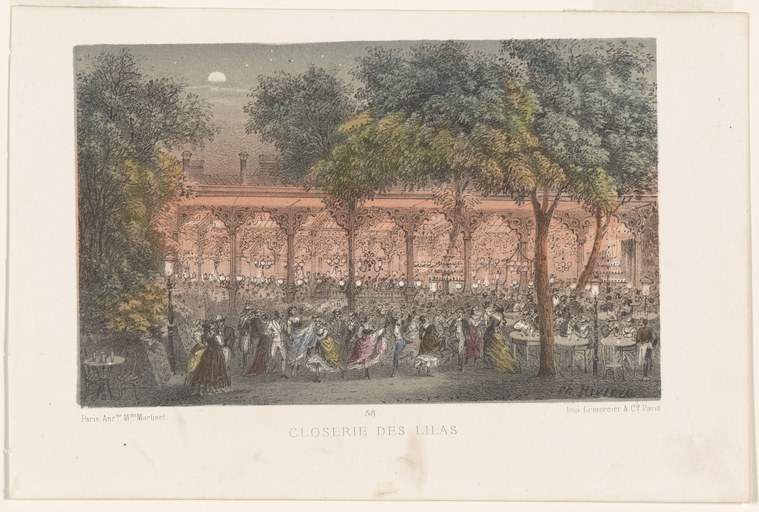
A hand-colored engraving depicting an outdoor evening social gathering, likely from the mid-19th century. The scene is set beneath a large pergola or pavilion with elegant columns and ornamental ironwork, beneath which dozens of fashionably dressed figures mingle, dance, and promenade. The foreground shows figures in animated conversation and movement; the middle ground fills with dancers and spectators in silhouette and lighter tones; the background recedes into darkness punctuated by the warm glow of gas lamps. Large trees frame both sides of the composition, their foliage rendered in dark green and yellow tones. The dress is consistently that of the 1840s–1860s: women in full skirts with fitted bodices, many wearing bonnets or evening headdresses; men in tailcoats and trousers. The lighting suggests dusk or early evening, with the architectural structure serving as both venue and canopy. The overall impression is of refined leisure, movement, and social spectacle—this is the Parisian public garden at its moment of greatest fashionable occupation.
The dancing
The dancers visible throughout the composition are engaged in what appear to be ballroom dances—closed-hold couple dances with upright posture. The women's full skirts dominate the visual field, their silhouettes marked by the characteristic bell shape and fullness of mid-Victorian evening wear. Several couples are clearly in motion in the center and right of the composition, their bodies at angles suggesting rotation or forward progression typical of the waltz. The density of figures—some dancing, others stationary in conversation—creates a layered social hierarchy: the active dancers occupy the middle space, while observers and promenaders fill the foreground and background. No footwork detail is visible, but the overall frame and carriage suggest the upright, closed-partner aesthetic of Romantic-era ballroom dancing.
The dance depicted
The primary dance depicted is the waltz, the dominant ballroom form of the mid-19th century. The closed holds, upright posture, and the formal evening dress all point to this. Waltzes were the signature dance of public gardens like the Closerie des Lilas, where they were performed in vast numbers by the fashionable public each evening during the social season. The composition captures not a staged performance but rather the lived social practice of ballroom dancing in an urban leisure setting—this is how middle and upper-class Parisians actually danced together in public. The work documents the waltz as a social ritual, not a theatrical spectacle.
How it was made
This is a hand-colored engraving or aquatint, likely from a Parisian publishing house. The technique allowed for fine linear detail in the architecture and the distant figures, while the hand-coloring—visible in the greens of the foliage, the flesh tones of the figures, and the warm glow of the gas lamps—gives the scene temporal specificity and atmosphere. Engravings of this type circulated widely among the middle-class public and were often collected in bound volumes of city views or social scenes. The technique's capacity to render both architectural precision and atmospheric effect made it ideal for documenting the fashionable leisure spaces that were central to mid-19th-century urban life.
About this work
This hand-colored engraving documents the Closerie des Lilas, one of Paris's most celebrated public gardens, during an evening of social dancing in what appears to be the 1840s or 1850s. The work captures the moment when the waltz had become the emblematic leisure-class dance, performed nightly by hundreds of fashionably dressed couples beneath gas lamps and pergolas. It is a record of dance as lived social practice rather than theatrical performance—the everyday spectacle of urban modernity. The image belongs in a dance gallery because it shows us how and where waltzes were actually danced, by whom, in what dress, and under what conditions. It is also an artifact of the visual culture that documented and celebrated dancing as an essential marker of modern urban refinement.
How to look at it
Attend to the composition's organization around movement and stillness: the dancers occupy the center, while spectators and promenaders create a frame around them. Notice how the artist has rendered the women's skirts as the primary visual unit—their fullness and the variety of their positions create much of the image's sense of animation. The architectural setting is as much a subject as the dancing itself; the pergola and gas lamps are markers of modern urban leisure and refinement. The hand-coloring, especially the warm tones of the lamps and the varied greens of the foliage, creates an atmosphere of evening ease and spectacle. This is not a moment of climactic drama but of habitual, repeated social pleasure.
The period
The Closerie des Lilas was established in the 1840s and became one of Paris's most fashionable open-air dance venues during the Second Empire and Belle Époque. It was part of a broader mid-19th-century phenomenon of public gardens designed as spaces of leisure, sociability, and commercial entertainment for the expanding middle class. The waltz, which had scandalized conservative society in the 1810s–1820s, had by mid-century become the quintessential expression of modern urban refinement and heterosexual social mixing. Public garden dances like those at the Closerie were documented extensively in prints and popular literature, reflecting anxiety and fascination about unregulated urban public space and female participation in leisure. This engraving participates in that visual culture of documentation and celebration.
Where it lives
The work is held in the New York Public Library's collection of prints depicting dance. It is indexed in the Library's catalogue record without attribution or precise date.
Dance in this work
Questions about this work
Where was the Closerie des Lilas?
It was a public garden in Paris, famous in the 19th century as a venue for evening dances, refreshments, and promenade. It became a gathering place for the fashionable middle classes during the social season.
What kind of dance is being shown?
The primary dance is the waltz, identifiable from the closed-hold couple formations and the upright carriage of the figures. The waltz was the dominant ballroom dance of the mid-19th century and the signature dance of public garden venues like this one.
How can you tell this is from the 1840s–1860s?
The women's dress—full skirts, fitted bodices, bonnets and evening headdresses—is consistent with mid-Victorian fashion. The gas lamps suggest a date after c. 1830 but before electric lighting became standard. The style of the pergola and the overall aesthetic of leisure and refinement point to the mid-19th century.
Why are there so many women and so few visible men?
The composition emphasizes female bodies and fashions, which were the primary visual spectacle of ballroom dancing and urban leisure. Women's full skirts dominate the visual field, while men are often rendered more schematically or in silhouette. This reflects both the period's fascination with female display and the gender dynamics of public dance spaces.
More dance artwork





