49 works in this view — arrow keys or swipe to move between them.
Dance in Art
La polka
Unknown artist
- Collection:
- Prints depicting dance
- Source:
- New York Public Library
- Rights:
- Public domain — free to use, share and adapt.
- Recorded as:
- Public Domain
Polka prints like this are primary documents of how a dance traveled and was adopted. They circulated in the thousands, shaping public expectation of how the dance should be done and what it meant socially. For anyone studying the polka's arrival in European culture or the role of visual media in dance history, images like this are indispensable.
What you are looking at
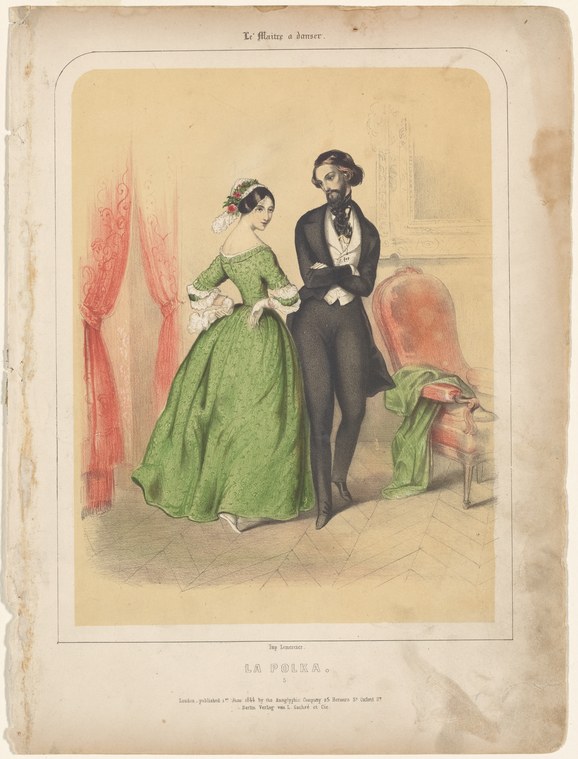
A couple dances in an elegantly appointed interior, likely a ballroom or salon. The woman wears a vibrant green silk gown with a full skirt and white lace trim at the bodice and sleeves; her dark hair is adorned with flowers or feathers. The man is dressed formally in black tailcoat, white waistcoat, and dark trousers. Both figures are captured mid-movement in an animated pose suggesting the bouncing, energetic character of the polka. The setting is defined by rich red velvet curtains to the left, pale walls, and what appears to be upholstered furniture. The lithograph's hand-coloring emphasizes the luxury of the scene—the jewel tones of the woman's dress, the warmth of the curtains—while the subtle shading in the floor and architectural details grounds the couple in a specific social space. This is a moment of fashionable leisure among the urban middle or upper class.
The dancing
The couple stands in close proximity but not in a ballroom closed hold; their postures are upright and animated rather than formally structured. The woman's body leans slightly as though caught mid-step, her skirt flared to show movement, while the man inclines toward her with an engaged, attentive bearing. Both figures display the weight distribution and leg extension typical of a sprightly, hopping step rather than the glide of a waltz. The artist has captured a moment of vivacity and social ease rather than the precise frame of a formal standard.
The dance depicted
The title and the couple's dress and comportment identify this as a polka, the Central European dance that swept European and American ballrooms from the mid-1840s onward. The polka is characterized by a quick, bouncy step in 2/4 time—quite different from the three-beat waltz that had dominated earlier in the century. The image captures the dance's social energy: it was danced by couples but with a more casual, playful dynamic than the waltz, and it was associated with youth, modernity, and democratic informality. The woman's animated pose and the couple's apparent pleasure in the moment are hallmarks of how the polka was understood—as a cheerful, accessible, even flirtatious dance.
How it was made
This is a hand-colored lithograph, a medium that allowed rapid production and wide circulation of fashionable imagery. The artist has drawn the composition on stone and applied a black or dark gray base print, then tinted it by hand with watercolor or gouache—the imprecision visible in places (the woman's sleeve, the curtain edge) is characteristic of commercial hand-coloring rather than a defect. Lithography was the primary medium for popular prints of ballroom and social dance in the mid-19th century, making such images accessible to the middle-class dancing public who bought them as records of current fashion and etiquette.
About this work
This hand-colored lithograph documents the polka during its peak years of European fashion—probably the 1840s–1850s, when the dance was new and wildly popular. It is a straightforward representation: a fashionable couple captured in the moment of dancing, with attention to dress, deportment, and setting. The image belongs in a dance collection because it shows not only what the polka looked like in the ballroom, but also how it was marketed and understood—as a modern, sociable, stylish pleasure. The work is typical of a large and important category of visual evidence for social dance: the commercial print made for a dancing public, not for an art collection.
How to look at it
Notice the woman's skirt: it is flared and caught in motion, rising slightly as though the dancer has just lifted. This is the polka's characteristic bounce—a hop-step quite unlike the smooth glide of the waltz. The couple's facial expressions convey pleasure and engagement rather than formal propriety. The setting—the opulent curtains, the fashionable dress, the intimate scale of the room—places the polka in a specific social world: not the aristocratic court, but the modern ballroom where the rising middle class danced.
The period
The polka emerged in Prague around 1830 and became a craze across Europe and America by the mid-1840s. It represented a democratic turn in ballroom dance: faster, simpler to learn, and less formal than the waltz, it was embraced by younger dancers and the urban middle class. The same decades saw an explosion of commercial prints—fashion plates, ballroom scenes, caricatures—as lithography made image-making cheap and fast. Dance instruction manuals, music scores, and ballroom prints poured from presses in Paris, London, and Vienna, each city developing its own visual style. This print belongs to that commercial flood, recording a moment when a new dance was still novel enough to be newsworthy.
Where it lives
The work is held in the New York Public Library's collection of prints depicting dance, likely acquired as part of a broader effort to document social and theatrical dance in the 19th century. It is a commercial print product—one of thousands made—rather than a unique artwork, but it is exactly this kind of mass-produced evidence that allows us to understand how dance looked and what it meant to its contemporary audience.
Dance in this work
Questions about this work
When did the polka arrive in Europe?
The polka originated in Prague around 1830 but did not become a widespread ballroom craze until the 1840s. It reached London and Paris by the mid-1840s and had crossed the Atlantic to New York and Boston by 1844–1845. Within a few years it was danced everywhere and had largely displaced the cotillion and quadrille as the dance of fashionable balls.
How is the polka different from the waltz?
The waltz is a three-beat dance in which a couple moves smoothly around the room in a closed embrace. The polka is in 2/4 time and has a bouncy, hopping character—the dancers push off and lift slightly on each beat, giving it an energetic, almost playful quality. It was also considered less formal and more accessible to younger or less experienced dancers.
What does the woman's dress tell us?
The full silk skirt, fitted bodice, and lace trim are typical of fashionable daywear or ballroom dress in the 1840s–1850s. The flowers or feathers in her hair are a sign of occasion and formality. The dress is expensive and well-made, indicating that both dancers belong to the prosperous urban middle or upper-middle class—the primary audience for polka dancing and for the prints that documented it.
Who made this print and why?
The artist is not recorded, which is typical for commercial dance prints of this era. Prints were made by publishing houses in Paris, London, Vienna, and other cities, often based on designs by staff artists or anonymous illustrators. They were sold as fashion plates, souvenirs of balls, or aids to learning steps—products for a paying public interested in current social trends.
More dance artwork





