49 works in this view — arrow keys or swipe to move between them.
Dance in Art
Emilie Hoguet-Vestris
Unknown artist
- Collection:
- Prints depicting dance
- Source:
- New York Public Library
- Rights:
- Public domain — free to use, share and adapt.
- Recorded as:
- Public Domain
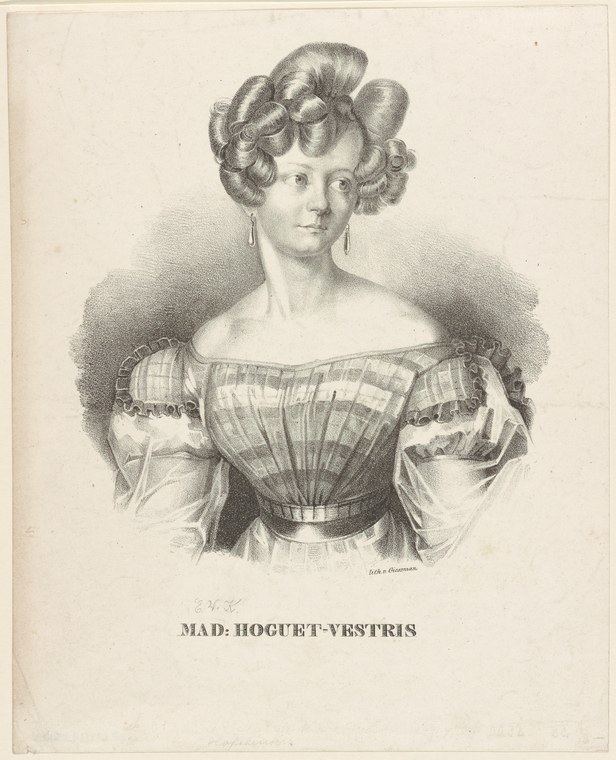
For a dance gallery, the image is significant because it captures the appearance and dress of a woman from the celebrated Vestris performing family during the Romantic period, offering a window into how dancers of that era presented themselves in formal, non-theatrical contexts. The engraving also exemplifies the print culture surrounding notable theatrical families of the early 19th century, where portrait engravings served as vehicles for celebrity and social prestige.
What you are looking at
A three-quarter-length portrait of a woman in early 19th-century dress, shown from the waist up against a plain background. She wears a fashionable day dress with a low, wide neckline and short, full sleeves gathered at the shoulder—a silhouette characteristic of the Regency period. The bodice is fitted with vertical pleating or corset lines that emphasize the high waistline. Her hair is arranged in the elaborate ringlets and loops typical of the 1820s–30s, pulled back from her face and styled close to the crown. She gazes directly outward with a composed, dignified expression. The engraving employs fine cross-hatching to model the form, creating soft shadow on the face and shoulders and suggesting the texture of fabric. There is no indication of movement or dance; this is a formal portrait study.
The dancing
A single standing figure shown in stillness, not in motion. The pose is frontal and composed, the shoulders level and relaxed. Her arms are not visible, being outside the frame. There is no contrapposto, no weight shift, no indication of the body prepared for or engaged in movement. This is a portrait posture, not a dance posture.
The dance depicted
The image does not depict dance. While the sitter's name includes 'Vestris'—a celebrated family of dancers and choreographers active from the 18th century into the 19th—nothing in the visual content of the print indicates she is performing or is captured in a dance moment. She is dressed in fashionable daywear, not stage costume, and stands in a formal portrait attitude. The catalogue record may reflect her identity or family connection rather than the subject matter of the image itself.
How it was made
This is an engraving, likely a steel or copper-plate engraving executed by hand. The technique is evident in the fine parallel hatching lines used to build tone and shadow, the precise contour lines defining form, and the overall monochromatic linear vocabulary. The formal quality and refined execution suggest this was a commercial print, possibly issued as a portrait for sale or circulation among the gentry. Engraving allowed for multiple impressions and relatively wide distribution compared to painted portraiture.
About this work
This is a formal engraved portrait of a woman identified as Emilie Hoguet-Vestris, rendered in the style of early 19th-century portrait printmaking. The subject is shown in fashionable Regency-era dress—a low-necked gown with characteristic short, full sleeves and an elaborate upswept hairstyle. She is presented not as a performer but as a woman of social standing in her daytime finery. The print belongs to a tradition of engraved portraits—often of notable families—that served as objects of consumption and display in the homes of the educated classes. While the Vestris family was closely associated with dance and theatre, this particular image is a society portrait rather than a stage or dance documentation.
How to look at it
Attend to the dress: the low neckline, the short gathered sleeves, and the high waist are precise markers of the Regency aesthetic, roughly 1815–1835. The hairstyle—the ringlets and loops—is equally specific to that decade. Note the stillness of the pose and the absence of any suggestion of stage costume or theatrical presentation. This is a woman at rest, in daytime dress, presented for the viewer's regard as a portrait subject, not as a performer. The direct gaze and composed bearing emphasize her status and respectability.
The artist
The artist is not recorded in the catalogue. The engraving bears what appears to be a signature or mark in the lower right, but it is not legible in the image. The style and finish are consistent with London print production of the 1820s–30s, a period when numerous commercial engravers were producing portraits of actresses, dancers, and society women.
The period
In the early 19th century, the Vestris family occupied a unique position: descendants of the legendary dancer Gaetano Vestris and Françoise Gourgaud, they held both respectability and the glamour of the theatre. Emilie Hoguet-Vestris would have lived during the height of Romantic ballet, yet her generation also benefited from the gradual social rehabilitation of theatrical performers. Regency-era portraiture of women emphasized fashionable dress and refined deportment; the choice to engrave a portrait of a woman from a theatrical family in such conventional terms suggests her integration into respectable society.
Where it lives
The work is held in the Prints collection of the New York Public Library. It is catalogued as a portrait engraving of an individual identified as Emilie Hoguet-Vestris but carries minimal metadata on date, artist, or publication history.
Questions about this work
Is Emilie Hoguet-Vestris a known dancer?
The catalogue identifies her as a member of the Vestris family, which produced celebrated dancers and choreographers throughout the 18th and 19th centuries. However, the print itself contains no evidence that she was a professional dancer or that this portrait documents her in a theatrical capacity. She may have been a family member who did not perform professionally, or the label may reflect family connection rather than career.
Why is a portrait engraving in a dance gallery if it does not show dance?
It documents the appearance and social presentation of a woman from a major theatrical dynasty during the Romantic era. For historians, such prints are valuable because they show how performers and their families dressed and presented themselves in non-theatrical contexts, and they illuminate the social standing of theatre families in the early 19th century.
What does the engraving technique tell us?
Hand-engraved portraits like this were luxury goods that circulated among the educated and affluent. Multiple prints could be struck from a single plate, making them more accessible than painted portraiture while remaining more prestigious than woodcuts. The refined execution and fine detail suggest this was a commercial product made for a respectable market.
More dance artwork





