49 works in this view — arrow keys or swipe to move between them.
Dance in Art
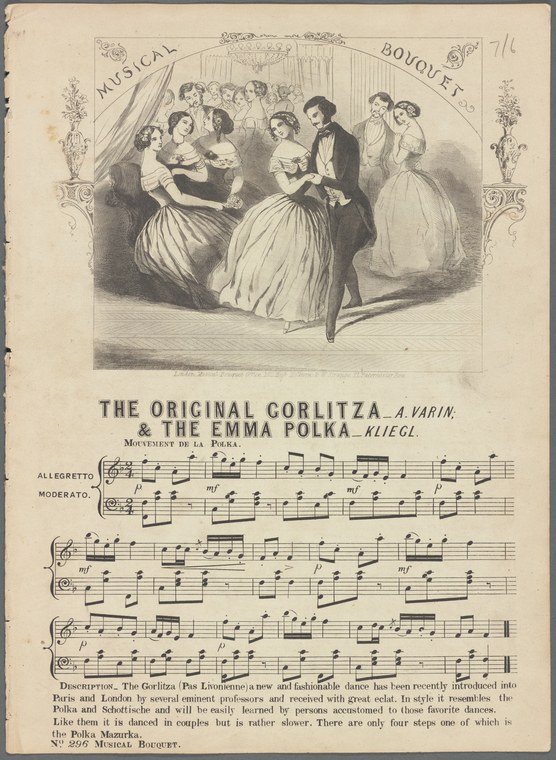
The original Gorlitza & the Emma polka
Unknown artist
- Collection:
- Prints depicting dance
- Source:
- New York Public Library
- Rights:
- Public domain — free to use, share and adapt.
- Recorded as:
- Public Domain
The polka was one of the first dances to cross class and national boundaries in the modern era, and this print is contemporary evidence of that phenomenon. It shows a dance that required no aristocratic privilege or years of training, danced by ordinary people in domestic settings, yet worthy of commercial publication and musical notation. For historians of social dance and the nineteenth-century ballroom, it is an invaluable snapshot of posture, partnering, costume, and the scale of participation.
What you are looking at
A lively parlour dance scene rendered in mid-nineteenth-century steel engraving. A gentleman in black tailcoat and white waistcoat stands at the centre-right, partnering a woman in an ample white ball gown with off-shoulder neckline and puffed sleeves. Around them, other couples and onlookers populate an elegant interior with draped curtains and decorative wall sconces. The figures crowd the foreground in animated conversation and motion, their poses suggesting the quick, energetic steps of a social dance rather than the stately measures of earlier decades. The engraving technique allows fine detail in the fabric textures—the ribbed fullness of the women's skirts, the crisp tailoring of the men's coats—and in the expressions and hand gestures that convey gaiety and social ease. The composition is vertically organised and densely figured, with no single couple dominating; the dance is a social event in which many participate at once.
The dancing
The central couple are in a side-by-side or semi-closed position typical of nineteenth-century couple dances, with the woman's right hand in the man's left and space maintained between their bodies. The woman's posture is upright and slightly backward-tilting, her abundant skirt occupying considerable space; the man leans slightly toward her. Neither dancer appears to be on pointe or executing extreme extensions. Surrounding figures adopt similar frames—several other male-female pairs are visible in the same confident social hold. The overall impression is of a fast-moving, lively dance in which partners maintain a formal frame but the energy is decidedly contemporary to the 1840s–50s, not stately or processional.
The dance depicted
The title identifies this as 'The Original Gorlitza' and 'The Emma Polka,' and the musical notation below confirms a polka (marked 'Allegretto Moderato'). The polka, originating in Bohemia in the 1830s, became a craze across Europe and America in the 1840s–50s, beloved for its quick triple-time bounce and democratic accessibility—it required no special training and could be danced by any social couple. The 'Gorlitza' variant is less well documented in modern sources, but the engraving shows the characteristic frame, the energetic upright carriage, and the crowded parlour setting in which polkas were danced. The musical score printed below the scene suggests this was a published dance instruction or commemorative print, likely aimed at the drawing-room market of middle-class dancers learning fashionable steps.
How it was made
This is a steel engraving, a technique that allowed fine detail, crisp line work, and high-quality mass reproduction. The inscription 'Musical Bouquet' at the top indicates publication in a periodical of that name, a weekly that combined popular music, dance notation, and theatrical prints for a domestic audience. Steel plates could yield thousands of impressions, making this an affordable, widely distributed object aimed at the dancing public itself—people learning these dances at home or in assembly rooms. The combination of engraved image and printed musical notation below was standard for dance instruction and social-dance publicity of the period.
About this work
This is a commercial dance print from the mid-nineteenth century celebrating the polka and its variants at the height of their social fashion. It documents not only the dance itself—its frame, carriage, and energy—but the scene of its performance: the crowded, animated parlour in which respectable middle-class couples executed these lively steps together. The print is a primary historical record of how this dance was dressed, positioned, and enjoyed in the 1840s–50s, and evidence of the commercial infrastructure—music publishers, instruction prints, periodicals—that made the polka a true craze. It belongs in a gallery of dance imagery because it is both a faithful depiction of actual dance practice and an artefact of how dance was circulated, taught, and promoted to its performers.
How to look at it
Attend to the positioning and spacing of the couples: the formal frame maintained despite the animation, the way the woman's skirt spreads laterally, the upright but flexible posture of both partners. Notice the expressions on the faces around the room—smiles, attention to the music, ease of manner—which convey that this is a pleasurable, accessible social activity, not a formal ceremony. The engraving technique allows you to see the individual tailoring and seaming of the costumes, which records the exact cut of a polka-era ball gown. Look at the positioning of the feet in the visible lower bodies: they are taking quick, light steps, not the long strides of a waltz or the processional gait of an older dance.
The artist
The artist is not recorded. The print was published by the Musical Bouquet, a weekly periodical launched in London in 1847 that combined popular dance music, theatrical prints, and fashion imagery for middle-class domestic consumption. Such prints were unsigned or credited only to the publisher; they were commercial products rather than fine-art engravings, and the artists remained anonymous.
The period
The polka emerged in Prague in the 1830s and swept Europe and America in the 1840s–50s with extraordinary speed—more rapid than any previous dance adoption. It coincided with the rise of commercial music publishing, the expansion of the middle-class drawing room, and the development of illustrated periodicals aimed at home entertainment. In this period, ballroom dance was increasingly democratised: the quadrille (which required a caller and formal organisation) gave way to couple dances like the polka that any two people could execute. The dance also sparked moral panic among conservatives who saw its close partnering and quick tempo as improper; depictions like this one, in a respectable family periodical, were part of the effort to legitimise it as wholesome recreation. Artistically, the mid-century steel engraving was the dominant medium for reproducing social scenes and instruction materials before photography and lithography displaced it.
Where it lives
This print is part of the New York Public Library's collection of prints depicting dance (part of the Prints collection). It was published in the Musical Bouquet, a London weekly periodical of the 1840s–50s. Such prints were commercial products, sold individually or bound into volumes of collected issues, and distributed to subscribers and buyers across the English-speaking world.
Dance in this work
Questions about this work
What is the Gorlitza, and how does it differ from other polkas?
The Gorlitza was a regional or stylistic variant of the polka, likely named after a place of origin (possibly Görlitz, a city on the German–Bohemian border), but specific choreographic details are not documented in surviving sources. This print is one of the few contemporary records of its name and performance. It appears to have been danced to the same basic polka frame and tempo as other polka variants, but may have had distinctive figures or styling.
How was the polka danced, and what made it so popular?
The polka is a couple dance in 2/4 time with a quick, bouncy character—typically a step-together-step pattern repeated around the room. It required no special training, no complicated figures, and no caller to direct it. Any two people could learn it quickly in a parlour or at a dance. This democratisation of ballroom dancing, combined with its cheerful, energetic quality, made it irresistible to the middle class in the 1840s–50s.
What is the Musical Bouquet, and who read it?
The Musical Bouquet was a weekly illustrated periodical published in London from 1847, aimed at middle-class households with pianos and dancing parlours. It contained popular music, dance notation, and theatrical and social prints, all affordable and designed for home use. It was a commercial success and circulated widely in Britain and America, making prints like this one accessible to the very people who danced the dances depicted.
Why are the women's skirts so full, and what does that tell us about the dance?
The 1840s–50s was the era of the crinoline petticoat, which created the characteristic bell-shaped silhouette. The fullness of the skirt required a more upright, less flexed posture and made rapid directional changes harder. The polka's quick sideways motion and the way the woman's skirt spreads in the engraving are consequences of this costume—the dance was designed to show off this fashionable shape in motion.
More dance artwork





